WordPress tells me that the most popular search leading to my blog relates to fair use in photography, telling me that a whole lot of people don’t understand what the law in the area is on the issue. My last post on the topic covered Richard Prince’s fight with a photographer, from whom he borrowed/stole/was inspired by/copied photographs of rastafarian men and added little flourishes before displaying the art in a gallery. Below is the picture, which I “stole” from a blog:
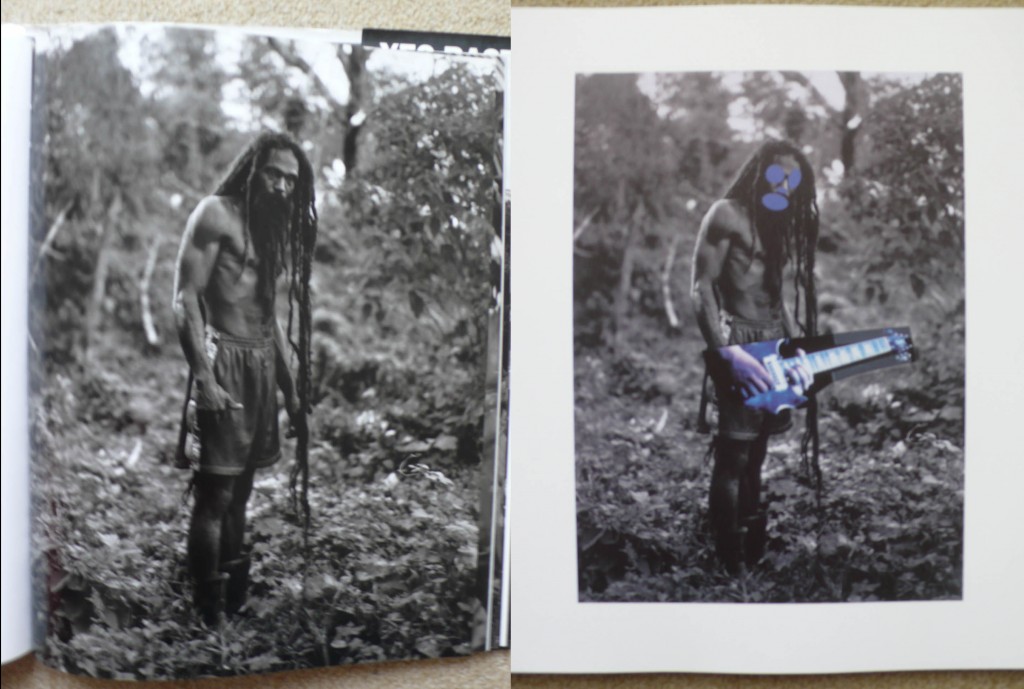
Prince lost the case in the lower court (more on that in a minute), but for us copyright watchers, that opinion doesn’t really matter, because he is appealing, and he is appealing BIG TIME. Boies, Schiller & Flexner, the firm started by David Boies, is taking the case. BSF is a top-flight litigation boutique, and they probably took the case because it could go to the Supreme Court, so IT’S ON. This case won’t be over anytime soon, and will probably redefine fair use by the time it ends.
But back to the lower court – Prince lost primarily because the lower court judge decided that the nature of the use wasn’t “transformative” (if Prince makes it to the Supreme Court, this will be the crux of the case). [Prince also shot himself in the foot by making all sorts of court unfriendly comments, like saying that it never occurred to him to ask Patrick Cariou, the photographer, for permission and that he would have taken the imagery even if explicitly told not to, and that even with Cariou’s work removed his art would be valuable and Cariou’s worthless.] This is only one factor in the four factor test, but it is a really important one, and possibly the one in the most flux as the law goes. Without going all law review article in this post, there are two trends in the determination of “transformative” that the Supreme Court would have to settle if Prince’s case makes it to the Supreme Court. These two approaches vary based on how much they pay homage to the moral rights of the author, or the author’s right to be attributed as the author even in criticism. We don’t have moral rights to copyrighted works in the US, but the concept is inescapable, popular in other countries, and I feel quasi- moral rights drives the two trends, detailed here:
I. Transformative / preserves attribution – Some think that based on the language of the statute, a work is only “transformative” if it comments ON the original in some way, as for the purposes of criticism, research, or scholarship. This was where the lower court decided in favor of Cariou, the photographer who took the pictures that Prince copied. The lower court said that the problem with Prince’s activity was:
Prince’s Paintings are transformative only to the extent that they comment on the Photos; to the extent they merely recast, transform, or adapt the Photos, Prince’s Paintings are instead infringing derivative works.
Prince testified that he doesn’t “really have a message” he attempts to communicate when making art.
The idea is that “transformative” means something like “having the purpose of commenting on”, rather than just changing the message. Commentary that uses a piece as a point of reference is fair use because it preserves the original authors identity. Parody, while not necessarily as explicit on original authorship, is fine as well and this camp would likely also keep the traditional exceptions intact for scholarship, teaching and research for similar reasons.
Reproduction of Cariou’s pictures would be fair use only if they were in a book critiquing something about the work, such as an article on composition that believed Cariou poorly framed a subject, or for use in a class on a similar topic. An article commenting on our society’s fascination with Rasta culture could probably safely print a reproduction of Cariou’s picture as well.
The line is drawn with the second approach where the original work is used as a mere vehicle for commentary, but the commentary doesn’t actually relate to the original work itself. If I reprint Cariou’s work with the words “George Bush sucks” in small font, that’s not going to be fair use (it’s also not very topical). I say moral rights drive this camp’s opinion because they are fine with any transformation that maintains the integrity of the original author as an author of the work, even if the transformation is ultimately a critique.
II. Transformative / doesn’t preserve attribution – Others think that use of another’s work should be protected even when it doesn’t preserve authorship, such as what Prince did to Cariou’s works. The focus on attribution drops away, and the question becomes whether the new work added something new or merely supplants the old work. It’s Supreme Court case law that the more the work is transformed, the more the other factors of the analysis become less important, indicating that a truly radical change in an image, for example, should weigh heavily in favor of a transformation (and fair use). The way the first and ninth circuits have interpreted that, the focus should be on the functionality of the new work as compared to the old – if the new use has a different function, it should weigh in favor of fair use, even without attribution. The problem is, any lawyer can come up with ways in which a use is functionally different from another; Cariou’s pictures were used by Cariou in a book about the history of Rastafarian culture in a coffee table marketed to people looking for coffee table books, whereas Prince’s work is displayed as modern art in art galleries and valuable primarily because he had a hand in making it. See, it’s that easy! Other translations of this camp come out with “is something new added to the original work, which is used as a raw material”, which ends up operating similarly; Prince added his touch to anywhere from 20-30% of the visible canvas. This camp holds that such a simple distinction is fine, because the point of copyright is to protect the original author’s chance to collect profit from his works in the market he might sell the work in – Cariou was unlikely to make the alterations that Prince made and sell them in art galleries. This approach is very market driven in that way, unconcerned with the moral rights of the author.
It is worth noting that I is narrower, in that II encompasses the uses considered fair under I as well. All of the uses deemed fair under I are fine under II because commentary and critique are markets where the original author is unlikely to enter.
So which is the real answer to transformative use? Courts have ruled both ways. As evidenced in the Prince case, some courts think that a transformation can’t be protected unless it is making a commentary on the original work itself, such as for critique or scholarly purposes. Other courts have held to something closer to version two, that to transform the new work must merely add something new. I’m personally in the latter camp – Functionally, the current system puts a big burden on the person making a transformative work. A story recently gained traction about an artist who remixed the cover of a Miles Davis album for his own remixed Miles Davis music. He licensed the music, but didn’t license the cover, because he transformed the cover picture from a normal piece of art to a pixelized version. Here’s the comparison the artist posted on his blog:
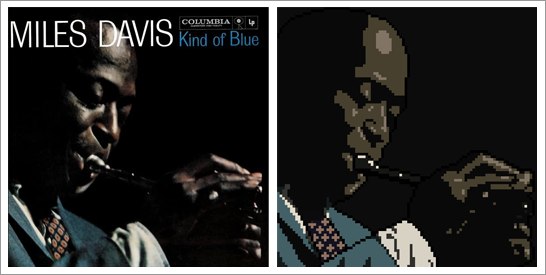
He got sued, and had to settle despite feeling that he had substantially transformed the art, because the legal costs of even a successful defense would have significantly outweighed the costs of a settlement. The artist was probably fine under Transformative II, but not under I. The author has a great series of pictures at the bottom of his blog where he pixelizes the picture further and further until it is just 4 color squares, asking, with desperation, “Where would you draw the line?”.
The artist’s plight underlines the problem with approach I, and with the currently murky legal landscape. It puts a huge burden on artists to try and navigate the legal definition of fair use, a definition which isn’t even clear to legal scholars, rather than letting them work on their art. The Supreme Court needs to clarify the fair use issue, and needs to do so in a way that lets transformative works flourish – the definition needs to be clear enough that photographers will be discouraged from filing lawsuits against transformative works. We need a bright line rule on the issue one way or another, but so far we haven’t gotten one.
 danielmarkmiller.net
Pingback: Copyright & Photography – Why not have mechanical licenses for photographs? « Daniel Miller . Law . Tech . Games