The “long” and “short” cycles of history

Hobsbawm’s cover in the style of our times, really changes the context

Conflict, peace, conflict

One of the most influential works I’ve ever read is Eric Hobsbawm’s “long nineteenth century” trilogy on the development of society from the French Revolution through the industrial revolution. I read the final book, Age of Empire, in the days leading up to the 2016 election, while on a trip in Malaysia. Hobsbawm wrote with much evidence for many of his arguments but a relatively unsupported comment he made about the attitudes of the European elite in the leadup to WW1 have stood out to me more than anything else in his long analysis. A very rough summary would be that WW1 came about because young Europeans had not faced any significant external conflict in their lifetimes, and they were bored! Both I, and Hobsbawm, reduced multiple contributing factors to a general sense of angst, with no other good outlet to channel it. Could such a huge global era with a legacy lasting a hundred years really come about because of a vague ennui? The front page of the Malaysian newspaper the day I finished that book showed a big image of Donald Trump.

A lot has happened since 2016 that would support the idea that we as a global society are caught in a tension between the individual frustrations of a given populace, and world order that generally prefers peace (largely for economic reasons). Plenty has happened in the first 100 days of the second Trump administration which make me feel we are truly teetering on the brink.

The next end of history

If Francis Fukuyama coined the phrase “the end of history” at the end of the cold war, Hobsbawm had basically already found and called a prior end of history in his work on the long nineteenth century (though just a few years before Fukuyama). The insight at the core of Fukuyama’s declaration was that with the USSR’s collapse, the world was essentially unipolar (the USA), liberal democratic, and capitalist, and as such unlikely to continue in the manner of constant global conflicts as it had since the outbreak of WW1 (a range of time Hobsbawm called the “short 20th century”). Though Fukuyama’s reputation was then cast in stone for predicting some long-lasting peace, another of his comments in the same work has seemed at least to me to become more insightful – “If men cannot fight for a just cause… then they will fight against the just cause…for the sake of struggle”
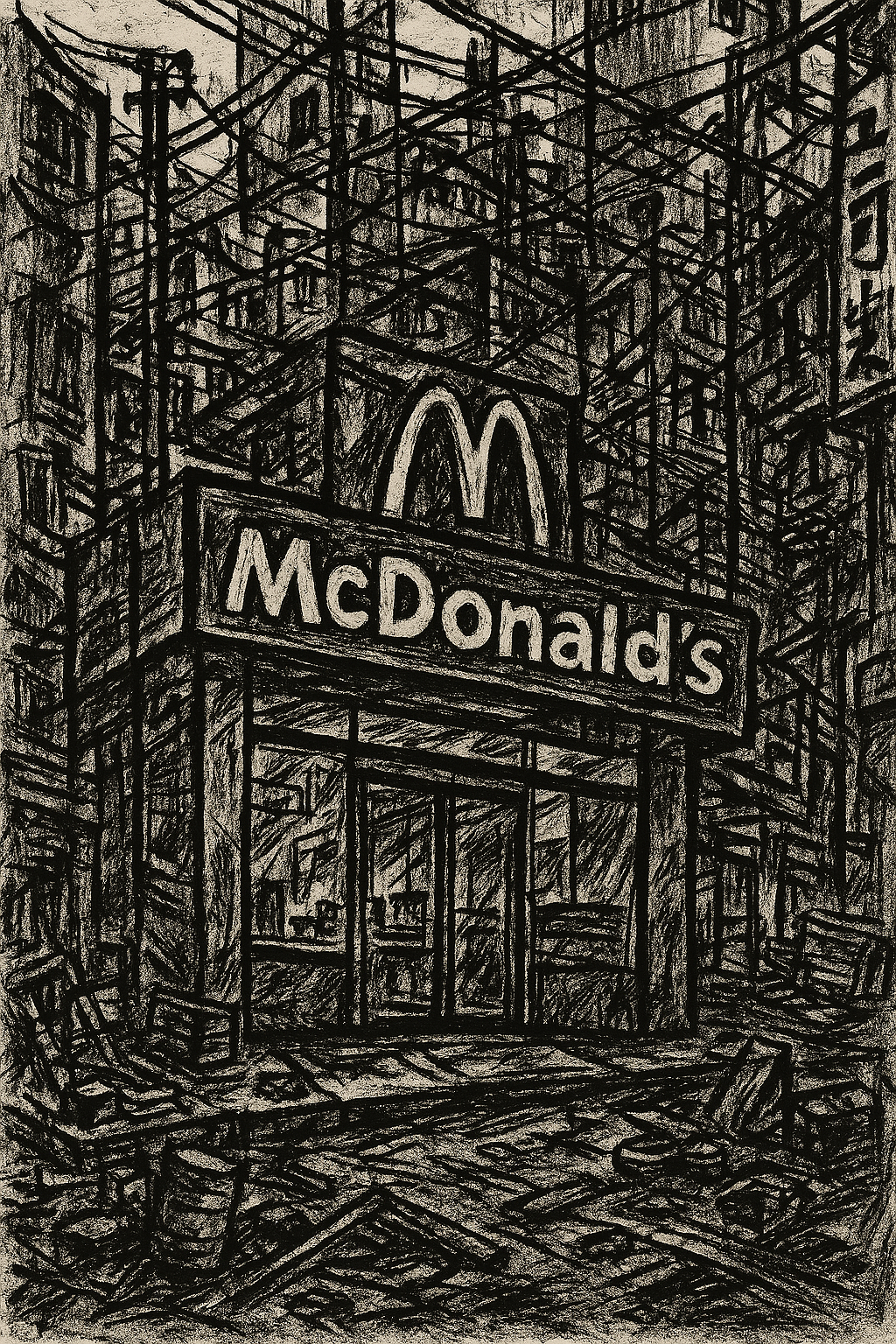
McDonald’s Peace Theory in the style of Max Beckmann (ChatGPT 2025)

It’s been somewhat well-theorized that boom and bust cycles come around in human society every 50 years, though perhaps that’s a conclusion dictated more by the timeframe studied, a 150 year period with a large amount of tumult in the middle. The Belle Epoque that preceded the outbreak of WW1, and the 1990s and early 2000s in the US, invite comparison for the deepening of global interdependence and the rapid technological accelerations that were hallmarks of both eras, with clear pockets of outsized beneficiaries living lives drastically different from the disfavored. We like to point to concrete events like the assassination of Franz Ferdinand or Hitler invading Poland as the triggers for war, but Hobsbawm and Fukuyama both suggest the real reason is an underlying cultural whine that reaches a fever pitch. You could argue that the era from 1990 until roughly somewhere between Brexit in 2016 and Trump 2 in 2024 represented a “long 19th century”-esque period of calm; 30 years where the US was in a hegemonic global position and largely used that power to enforce a regime of democratic capitalism that, aside from small conflicts in the Middle East, kept global powers aligned and out of conflict. There are signs though that something about that era is fading and we may be coming into a “short 21st century”.

Are we entering a new “short” cycle?

Politics in the US since 2016 has seen a notable decline in politeness. “Polarization” is the more common term, but there’s something existentially more terrifying about the situation in the developed world in the last 10 years that goes beyond mere gravitation in preferences towards a pole on a policy issue. Trust in government surveys show we are today at an all-time low. There is a desperation across the populace. Two wars that have polarized populations across the world have sprung up in regions that otherwise had seen long periods of relative peace. And above all, people are mean! Why?

If we ARE entering a new short cycle, it is hard to conclude that it’s because of a decline in objective advantage for the US versus other countries. The US has been the dominant force in global GDP since the end of World War II. The only lag has been in the distance of the gap between the US and multiple other countries, specifically China, and the fear of looking in the rear view mirror and losing the lead (even though we will unquestionably have it) has motivated us to make decisions based on an assumption that we must maintain our hegemony at all costs. This Thucydides Trap is one way to understand the current political dynamic in America.
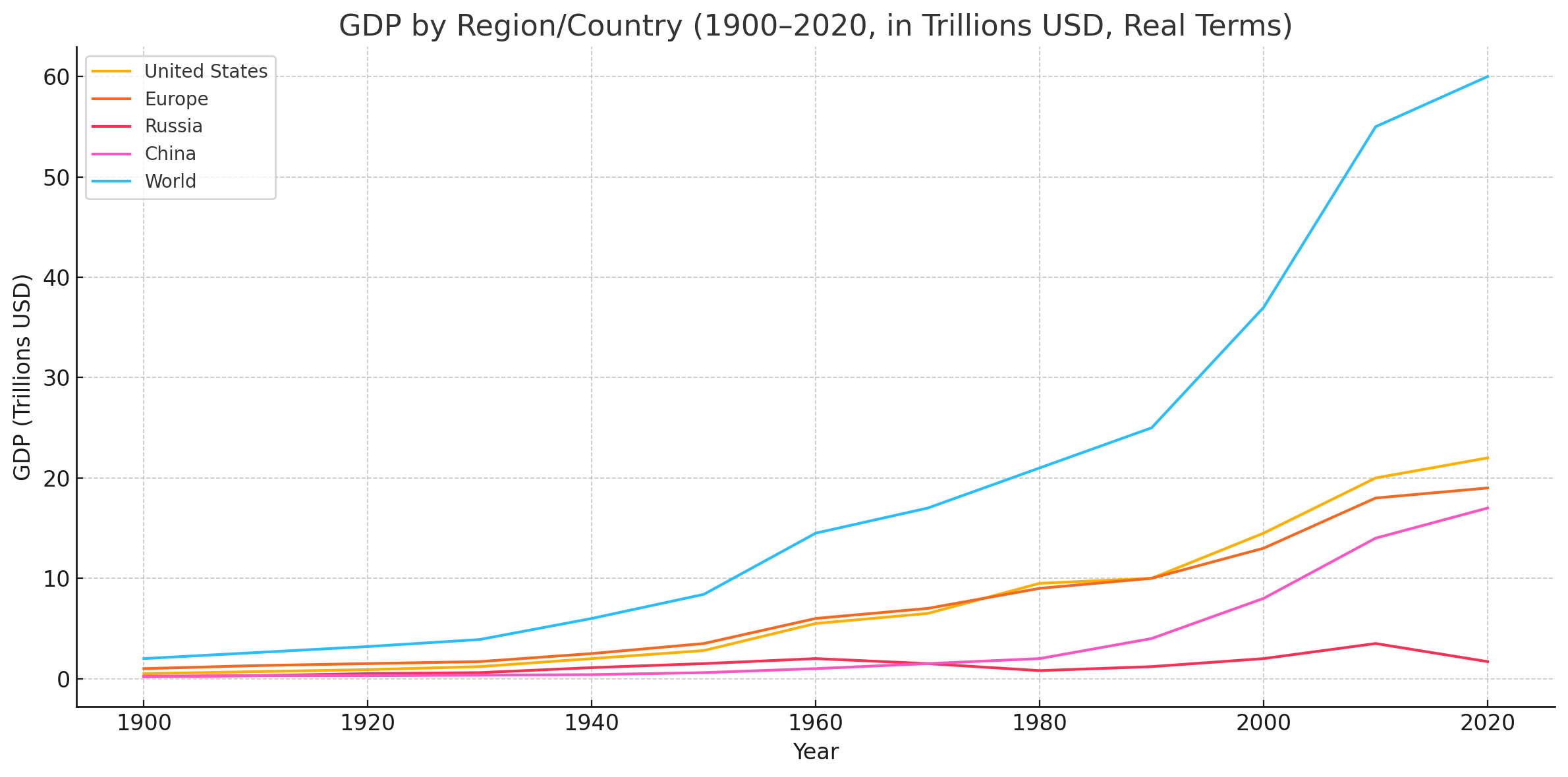
Regardless, the decision seems to have been made by the current administration that we must act now and drastically to do something about the above chart, and the action is to apply massive tariffs of some severity on every other country in the world. There are tons of reasonable debates going on about tariff policy as an economic tool, whether the policy is rolled-out well, whether it is a good fit for the problems the Republican party has suggested they will solve. It’s been a great month for the podcast industry and the financial newsletter industry. These questions all generally frame themselves as questions about the country GDP chart above, and the trajectories of the lines, and how to change them. These are important questions! But I’m not an economist, and I ultimately believe Trump won’t end up doing much of anything because the backlash is too severe. I’m also not certain that tariffs, or any of Trump’s other policies, are actually ABOUT GDP, or manufacturing, or any of their claimed goals, but rather exist solely as a possible response to the angst that Trumpism has captured.

The question I’m interested in is why there is such an angst to be captured. Specific economic or governmental policy aside, the objective data on the state of the United States has diverged from the sentiment of its people. Why, and what would need to happen to reconnect them?

Indicators of a Fracture

Social media isolation // over-exposure

The New York Times had a great article headline about crypto millionaires in 2018 – “Everybody is getting hilarious rich and you’re not”. The article itself was all about the runup in crypto prices that had launched many talentless idiots into a stratosphere of wealth usually reserved for people who had plied some valuable trade into the world, and the ways these fools were both wasting money in fantastic fashion while also making everybody else feel even more foolish for not having shared in their luck.

It’s a great headline, and an article that’s stuck with me, because it so well traces a dynamic that pervades our last ~10 years of internet culture. It’s not really that there are that many more people in the world richer than you, it’s that you SEE representations of of that wealth on social media in a pervasive manner. The perception that any given individual has of their own relative wealth is constantly challenged by these depictions of other people’s success. I’m not certain what life was like it 1980, but I doubt an average American was as inundated with images and videos of other people’s success (real or fake) like we are in the social media era today where videos of high-rise apartment tours in Miami garner millions of views. We may indeed live in an era of opulence, perhaps something we will only recognize fully in retrospect, but in past eras it was not so easy for the unlucky to see the lives of the lucky as social media forces us to witness today. TikTok, Instragram, and “X.com” have made it more likely than ever that a given person will somehow feel both far poorer than they are and relatively isolated in that reality – a sort of retrospective FOMO, because you already missed out.

The main subject of the NYTimes article is such a great encapsulation of this energy, and crypto if nothing else may be remembered as a wonderful barometer of the desperation to be wealthy that so many have. The article mentions a housekeeper who put all their money in crypto while acknowledging that they may “lose it all”. A technology that financially monetized FOMO is truly an invention of the 2010s and early 2020s, and perhaps inadvertently the price of bitcoin has become a direct tracker for people’s lack of faith in a more traditional system to make them hilariously rich. It’s easier then to understand the average person’s affinity for Donald Trump’s presidential pitch, which always resonates when he’s the challenger; MAGA is a “get rich quick” pitch, cast in the light of presidential legitimacy. And since get rich quick schemes don’t actually work, Trump seems to quickly lose his appeal once empowered to enact whatever policy is meant to rid us of the scapegoats that have not in actuality caused our perceived decline, or whatever economic or social policy he has promised with make us wealthy again does not.

Social media’s impact on our society is extremely under-studied, because a large percentage of the US population is in complete denial about technology’s ability to influence us so directly but subtly. But there is plenty of evidence that the major powers of the world view social media as a weapon in international competition – be it the significant Russian influence campaigns in the 2016 and subsequent US elections, or Chinese complete control of the narratives their own citizens are exposed to (and increasingly that a portion of the US is exposed to via TikTok), it’s reasonable to conclude that only the US has missed the boat in tracking and controlling the influence new media has on it’s own country.

Gamergate / and the Manosphere

My dad, a ~65-year old boomer who lives in the Midwest but is socially liberal, recently caught up on “The Last of Us” on HBO. After it’s conclusion he asked me if there was something about my generation and “characters in shows being gay”. My initial distaste for his question included, this short interaction encompasses something quite telling about the zeitgeist of our time.

As I wrote and thought about the impact of social media, and the decline in economic well-being, the rise of commonplace gender discourse particularly around “Men” and male aversion to “wokeness” felt as or more significant as any other single trend in tracing our path to the current moment. My dad inadvertently wandered into multiple of these topics at once in his simple “why is Ellie gay” question. My generation grew up with one somewhat significant civil liberty cause, the right to gay marriage. Prior generations fought for civil rights for minorities, or women, and our cause had been gay rights. We tidily wrapped that one up and then liberals in our country started to debate what to do next. Unfortunately the answer was “face complete societal resistance to every other issue you might choose”, be it guns, trans rights, or abortion expansion. Men, mostly white, but not just “conservative”, became the resistance to all of those issues.

Gamergate was a “movement” that arose in 2014 in the video game world, and in retrospect was one of the early signs that there was a simmering backlash against liberal social causes largely from white men. This was a sensible place to find this movement, if it was brewing generally; gaming, especially at the time, is a predominantly younger and more white, more male demographic. The inciting incident for the movement ended up being false, an early harbinger of the challenges we have today with ‘fake news’ and its ability to spread before it can be debunked. But the sentiment of the gamergate movement, that minority voices were being amplified to an extent that made the majority feel itself marginalized, is one that lines up quite well with cultural underpinnings of Trumpism and it’s naked majority culture self-interest.

As liberalism failed to find a new cause that appealed to a broad coalition, the essential narrative of gamergate pervaded into other parts of culture and took purchase as the “counter” to many stillborn socially liberal efforts. Many left-leaning commenters over the years pointed out that causes like trans rights, and purity tests around their support, would not be likely to yield a large coalition but their largely political observations understated the grave shift that was occurring. The covid pandemic proved to be quite an accelerator, particularly during the Black Lives Matter movement which likely did more to inspire Trumpism in white communities than it did to inspire anti-Trumpism in minority communities. Covid also pushed more people into an online bubble, where largely conservative voices had found success after themselves being pushed out of the mainstream. Ironically as the media landscapes flipped, the online bubbles became the mainstream, and now this land historically dominated by crackpots like Alex Jones became as influential in shaping public narratives around facts as previously mainstream journalism. The last election was likely more shaped by the words of Joe Rogan, Andrew Huberman, and Lex Fridman, than it was by Wolf Blitzer or Jake Taper, and at least some of Trump’s success was credited to a superior media strategy of targeting mass audience podcasts and their predominantly male listener bases, more recently termed “the manosphere”. The fact that a major Trump supporter and future unofficial cabinet member Elon Musk owned one of the largest social media platforms seems now under-considered as a factor in his win.

The short cycle of WMYONT (White Men Yelling On Twitter)?

In search for a single cause to explain the decline in comfort with the status quo in America over the last 10 years, I find many compelling signals of fragmentation. But as in prior antecedents to ‘calm’ global eras, our current moment feels more molded by an ennui that social media and a lack of an otherwise unifying cause have amplified. A gap, an abscess of meaning, that has been filled with amplified mild discomfort. But over time, the amplified discomfort became the problem – “White men yelling on twitter” is itself the problem, the cause of the problem, and ironically the solution to the problem as those loud caucasian males ended up in both the presidency and vice presidency. There’s no single thing they are yelling about, but rather a near endless sea of non-things, a fear of being drowned out // drowned by the non- white men that the liberal groups championed until those groups couldn’t find new populations to rally behind. It feels very stupid and unlikely that such non-issues should cause such tremendous issues (like destroying the foundations of our global economy), but is it surprising? Maybe it would have been predictable to the historians of the the long 19th century that decline would come not from a sudden violent act between nations, but instead after a long period of peace during which the memory of true conflict had faded enough to make not just blaming others for your problems but DOING something about it feel like a desirable course of action.

For a long time in considering China’s rise, I thought the US had nothing real to worry about. I thought that ultimately China’s success would mirror the success of the US, and as in the US a large middle class would emerge that demanded the same rights and protections that we have – namely, the right to free speech. Communist china would become a free market capital democracy in time, like most western nations became even from different cultural starting points. It seemed inconceivable to me that a nation could dramatically curtail free speech with a population of economic parity to ours, without that population either slowly fleeing, or slowly making political demands to unlock it at home. But a lot has changed in 20 years, nothing more than the advent of social media. Free speech means something quite different in the context of a newspaper, or a magazine, than it does on X.com. No technology in our history has done so much to evangelize erroneous, hateful, incorrect, and tribal views as social media, and we don’t seem anywhere close to addressing it as a society. Perhaps our mistake then isn’t in complacency or ennui, it’s in failing to appreciate that social media IS the grave threat to society, a threat we should take far more seriously and be willing to sacrifice far more to combat.
Leave a comment

Filed under Uncategorized

What to do with Generative AI copyright law

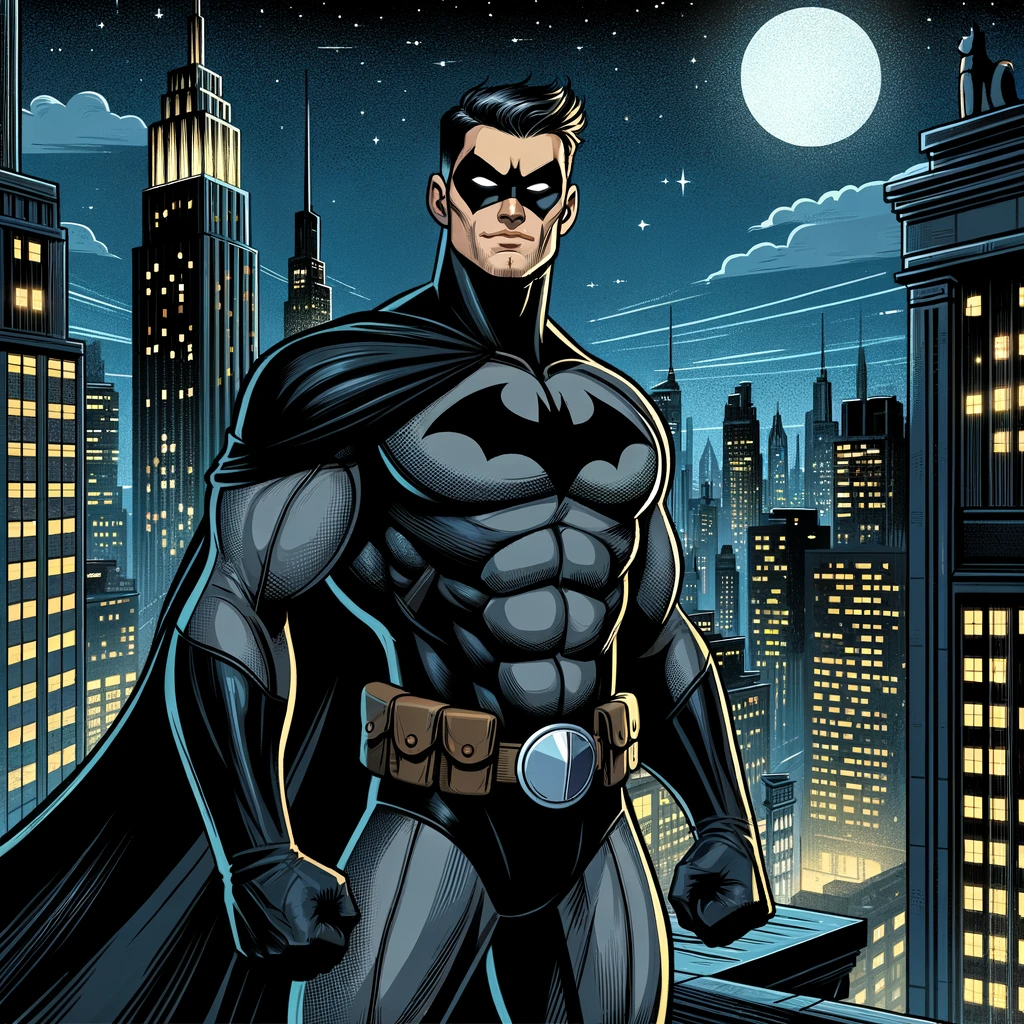
“A superhero in a black and gray costume, with a cape and a mask, stands on top of a tall building at night. The costume has a bat-like symbol on the c…”

Context if you need it:

  • Midjourney, DALL-E via ChatGPT, and Stable Diffusion* all exist and can make images of Batman that seem to obviously be inspired by copyright material that the models have been trained on.
  • The NYTimes has sued OpenAI, and multiple other lawsuits exist between copyright holders and the model makers, alleging that there is copyright infringement under various legal theories.
  • Note: this post was written before OpenAI released their demo of Sora, which will warrant it’s own consideration of how close we are to some of the AI movie creation I note late in the post.

I love Midjourney, and Stable Diffusion (more into Automattic than Comfy). I have hundreds of hours in both. The first time you use a string of words to instantly generate an image that captures the essence of your meaning, often in a quirky or funny or surprisingly philosophical way, is a magic moment akin to that of the first swipe on an iphone, the first reply in a chat room – experiences with technology that happen once every decade, and undeniably change your view of what will be possible in the world forevermore.

AI is creating immediately copyright tension, like the internet before it. A very short version of this analysis would be to simply predict that the exact same scenario will play out with generative AI models, and indeed I think it is likely. Google and other web crawling sites were spared from any serious regulation in the US, and in fact Google won a somewhat precedent-setting case against booksellers that allowed them to scan copies of entire libraries so long as they weren’t reproducing the text for free (quite relevant to the analysis in the case of LLMs). In other venues Google either voluntarily or by regulation agreed to pay certain large publishers for the ability to show links to their content in searches. We live in a capitalist society and new technology is often an incredible aggregator of wealth, quickly and suddenly, away from old industries. Google killed many smaller business models, particularly those around content, and the larger ones had to cut deals to stay afloat. Laws were not suited to protect the old models, and there was little capitalist incentive or political will to correct it, so the old models suffered at the expense of the new. Likely the same will happen with generative AI, as OpenAI has quickly become one of the most valuable private companies on the planet. Congress’s ability to pass a law regulating technology is very questionable.

But let’s pretend that outcome is not inevitable, and that the United States will need to develop a framework for understanding the impact of Generative AI on creative work, and how to modify copyright law (if it should).

Copyright law and whats different with Generative AI

Copyright law has a basis in the Constitution, which says Congress can give authors rights to their work for a limited time. Many also assert a moral basis (which is really a capitalist basis) that an author deserves compensation for their work. Form that sprang our current copyright laws, which date to a law passed in 1976, and have held up surprisingly well despite the dramatic transformation of creation and distribution of content that has transpired in the ensuing 50 years.

I won’t do a comprehensive analysis of every element of copyright law as it applies to AI. The main surface areas of debate center on a few specifically:

  • Originality: A work must be original to be covered by copyright. Certainly the works ingested by LLMs are copyrighted. But what about the output? Is the cover image at the top of this post original? I told chatGPT to make an image of a batman like character. It’s certainly unique in the sense that I would image it’s the only one EXACTLY like it in the world. If I had drawn it by hand it would qualify as original (though there would be other issues), if I had used Adobe Photoshop to create it it would still qualify. More on this later.
  • Fair use: There’s a phrase in copyright law called transformation, which is something like a get out of jail card. Copyright law wants to make it clear that criticism, parody, etc are protected given our strong bias to enable First Amendment speech. So copyright law grants perhaps incredible leniency to behavior that would otherwise be considered infringing. This is a red herring in my mind; the fact that copyright materials are in some way processed by the algorithm before some ultimate end material is produced is essentially irrelevant. The algorithm itself has no intent, so it can’t be transforming a work for the sake of parody or critique. It matters far more what a user of a model does with the output, which is a case-by-case determination so unlikely to ever be the basis for a broad ruling on generative AI models and copyright.
  • Nothing else: Every other element is basically irrelevant as applied to the models themselves. This isn’t to say that there aren’t interesting questions related to the output of the models, but those decisions are unlikely to be the basis for a broad ruling about whether the models themselves violate copyright law as the cases against OpenAI and others allege.

How will current Copyright law play out with regards to the Generative models?

The NYTimes suit relies entirely on the premise that since GPT models are trained on a dataset which includes copyrighted NYT material, and it can reproduce something sort of like that material when prompted correctly, then it must be infringing. There’s more than 60 pages in the complaint, with lots of flowery language about the value of the news and how great the NYT is (I love the NYT and am a longtime subscriber). But all of that is going to be irrelevant to the legal question, which the court will do it’s best to analogize to the internet indexing of websites, and in general this argument is not very strong for the NYTimes. If it’s OK for google to index and reproduce the EXACT text of NYTimes articles with attribution, why would it be not OK for OpenAI to index and reproduce the INEXACT text of NYTimes articles with attribution? The fact that what LLMs produce is not exactly the copyrighted material, certain in image generators, and mostly in text generators, is pretty relevant. This is why it’s highly likely to me that the NYTimes suit will fail. LLMs may ingest copyrighted works in their training, but they output something different, so they aren’t actually reproducing the copyrighted work anyway.

And every other fact that OpenAI and other LLMs will present is pretty strong for them. It’s not exactly legally relevant (though the NYtimes complaint spends a lot of time on it anyway), but trademark has a concept called confusion regarding whether consumers would believe an infringing product is actually being sold by the original trademark holder or not. There’s NO chance anybody is going to ChatGPT asking for pictures of Batman and thinking that it is an official DC product. There’s similarly no chance that the people prompting ChatGPT to produce substantially similar text to NYTimes articles are confused that the information is not from the NYTimes. If copyright law is intended to protect a creator’s ability to profit from their original work, it seems very unlikely that an LLM is currently a substitute in any way for going to the NYTimes for news, or to a comic book store to buy a Batman comic.

What happens when Generative AI is a lot better?

The internet was primarily a distribution innovation as it regards copyright infringement – Napster was bad for record labels because it created unlimited and unrestricted access to song files. I can google the name of any artist and see their art, and make a copy of the file, and I sort of have the image now. You can email somebody a pdf of a comic book (if you have one). Congress passed the DMCA to make sure that access to copyrighted information wasn’t too broad with centralized providers, and largely that has struck the right balance, though the internet has still completely disrupted almost every form of media to varying degrees. Print media is essentially dead, the music industry has changed forever, etc. But it did not eliminate human creativity in the slightest, and arguably the internet greatly enhanced human creativity because the ability to distribute and access create works was democratized dramatically.

The words in the copyright act that the internet complicated were “reproduce” / “distribute”. It was not trivial to reproduce a song before the internet, at least not in a way that you could distribute it permanently to millions of people. Generative AI is not an access innovation, but an originality innovation. Indeed a big challenge for the cases currently made in court against Generative AI technologies is the fact that what they produce is not actually a copy, but something we have historically regarded as an original-enough reinterpretation. Generative AI ought to reframe our understanding of originality dramatically, both for written text and images, and soon enough for video as well. If you are willing to spend the money on the compute cost, you could conceivably assign a Stable Diffusion instance the task of creating an image for every possible super hero design, or every possible pokemon. You could ask an LLM to generate the first paragraph of every possible news story about the Middle East. LLMs have revealed something uncomfortable about human creativity; that it is more deterministic than we’d previously chosen to believe, and that the monkeys with infinite typewriters are here at our disposal right now.

Copyright law was intended to protect the creator of a work from it’s exploitation without receiving profit, and in some regard it does feel that Stable Diffusion, for example, is benefiting from the work of copyrighted material without giving any sort of compensation. Whether courts twist current law to conform is a somewhat irrelevant question because it seems inevitable that money will allocate correctly in due time to award the largest copyright holders with some modest compensation for the ability to train AIs on their works (ala Google indexing in the Web 1.0 era). This is a question of inputs rather than outputs.

On outputs, though, what to do with the reality that soon machines will be generating an infinite amount of content that likely outpaces and completely mimics, and thus replaces, much of the output of humans in the creative realm? The current stance of the copyright office that these works are not subject to copyright protection seems obvious to become obsolete quickly, either with pressure from the large corporations that produce much of the valuable copyrighted work in the world and who no doubt will use new technologies to make that work more efficiently and demand the capitalist system the operate under afford them the same protections for a script partially written by an AI as it does for one entirely written by humans. That iteration of the question seems, again, pretty obvious in it’s outcome, and for large studios, music publishers, news organizations, and the other major institutions that primarily benefit from copyright protections, not much will or ought to change. Whether The Avengers 12 is made partially with AI or not, Disney will find a way to ensure it is not freely available. Even if the budget for The Avengers 12 is reduced across the board with AI actors, AI voices, AI imagery, and an AI script, the cost to market and promote and distribute the movie will be plenty of incentive to ensure its creation also establishes a copyright protection.

The bigger challenge is 10 or 15 years beyond that, when I can simply ask ChatGPT to make Avengers 13 and show it to me. That sounds ridiculous now because inserted below is what I get currently when I ask ChatGPT for the same.

My contention here is that the image above is “original” in our current framing of copyright law, but also completely undeserving of any legal protection. If the output moved, and had mediocre dialogue, and a plot arc, and the villain lost in a startling comeback by the Iron Man character right as all appeared to be lost, would it be more original / more deserving? Disney / Marvel will likely make that movie and spend millions of dollars in all sorts of ways to promote it, and their efforts and investment in that regard deserve protection. But what if an AI COULD make not just 1 exact copy of that movie by complete chance, but also make, deterministically, every possible iteration of that movie if given the correct prompt and infinite chances to make it? On ChatGPT 12, when I ask for an Avengers movie, will that be as obviously unoriginal to us as the image above, and would it deserve copyright protection?

There strike me as being only one likely outcome, which is that nothing will change in copyright law at all. As long as copyright law protects output from AI models, then we are largely in the same place as we are today, and AI is just another tool in the toolbox of creative entities. Works subject to copyright have no intrinsic value other than what they are worth on the open market, and though AI tools will make it easy to flood the market with crap, the market will deem them worthless and they won’t be duplicated anyway. The best and most valuable works will be promoted, marketed, surfaced by social media, and otherwise invested in or chosen by the masses as having merit and exploiting them for profit will be similarly protected by copyright law.

The gap in this approach, though, is that it seems more likely than ever that media may evolve to be more adaptable to the preferences of an individual, and more valuable work over time will be co-created by the technology and the consumer. We call this “fan fiction” today, works made which generally blatantly violate copyright but have non-cannon plots and no distribution beyond tiny fervent communities. Fan fiction is largely ignored by the copyright holders because it tends to be non-conflicting with the main works, and suing your biggest fans is often a bad look. But what if a huge percentage of media was fan fiction? This is already starting to happen with entertainment like TikTok and Roblox, where the majority of the content is user generated using the tools at the disposal of the medium versus created / curated by large entities. It may not be far-fetched to imagine a future where the majority of content preferred by consumers is in some iteratively generated and modified by mass user input versus curated by teams of creatives.

In the internet days (eg 2001 -> roughly Nov 2022 when ChatGPT launched), copyright law did nothing, and though capitalism took over it did not save a key pillar of our society that was built on existing distribution models: journalism. There was a cambrian explosion of journalism models after the internet came of age and evolved, and essentially none of them worked for very long. Today you can find the nth iteration of techcrunch, and it is ironic in some respects that the NY Times is leading the way in suing generative AI companies, but ultimately the news lost the battle long ago when the business model that long sustained them (ads) found a more efficient home in the new technology that reduced their distribution costs to zero. It was not instantly that this was clear, it took many years and iterations of both social media and journalism on the internet to arrive at the conclusion, but ultimately the answer is that far more people get their “news” directly from social media than from any legitimate journalistic source today, and the social media companies earn a lot more from serving ads than the journalists do.

Now in the coming AI age (2022 -> ?), we will quickly face the problem in a different form. What key pillar of society suffers when I can ask GPT for Avengers 12 and get more than an ersatz replica of what Disney would produce? Much like google and facebook reproduced news until they choked the industry they siphoned from, I suspect the entertainment industry will be generally demolished by the coming innovations in AI; when you can get a custom version of the next episode of your favorite show, why defer to what a writer in Hollywood thinks you might like instead? I think the copyright implication of Generative AI technology in this generation will be that less and less of the content consumers enjoy comes from big publishers and producers, but from outputs of generative AI models in a 1-of-millions format, and is therefor not going to be covered by copyright. But copyright holders will have secured some fee on inputs into training models, and it’s likely you’ll be generating your custom Avengers 13 movie in a Disney owned and operated LLM anyway. And like the print media in the age of the internet, many of those copyright holders with whither away as the majority of the revenue in the industry moves from the creators of the IP to the technological innovators that control the most powerful LLMs.

Leave a comment

Filed under Uncategorized

Spotify cover artists are making money while other musicians fight over payment

Spotify and musicians have been going back and forth for some time over the amount Spotify pays out. See here for a recent story on the issue.

Meanwhile, I’ve noticed an interesting phenomenon on Spotify and it seems to show that at least a few artists are benefiting from the licensing woes of their brethren. The phenomenon, which I’ll call Song Placebo, occurs where Spotify has failed to secure a license for a top radio song, thus signalling to pragmatic cover artists that a common search term on a service with millions of subscribers is open for business. If you google around, you’ll find that a listen on Spotify is worth somewhere in the neighborhood of $.007 – .01 per listen, and there is an argument that cover artists would probably reap a high amount of the absolute cash because they are less likely to be signed to a major label. Taking the high-end of that range then, a cover artist is probably reaping about $1 for every thousand listens on Spotify, give or take 20%.

So how prevalent is Song Placebo’ing? Probably more common than you think, and two artists in particular seem to have nailed it. Let’s look at some prominent examples.

Search results for Rihanna's "Stay" on Spotify

Search results for Rihanna’s “Stay” on Spotify

Rihanna’s “Stay” is certainly a hit, certified Platinum in the US with sales over 3 million, and radio success topping Billboard charts in multiple countries. But as the image above shows, it is nowhere to be found on Spotify.

The top hit is a cover by Shaun Reynolds, a UK-based singer-songwriter dude who is a leading prescription writer for Song Placebo. His cover of “Stay”, which is sung by a guest named Laura Pringle, has a whopping 19.8 million listens on Spotify. Opening up Shaun’s larger portfolio on Spotify reveals that Shaun quite likes him some covers, and his top 10 are all works originally (made chart-toppers) by other artists. “Stay” stands out, however, as the only one that seems to have gained any traction (his second most popular song has 200k listens, and his third just 20k). But at the conversion rate above, “Stay” has generated about $19,800 for Shaun. Not bad for a song he didn’t pay a dime to market.

Tyler Ward is another ‘popular’ cover artist in the Song Placebo game. Here’s what his top 10 hits look like:

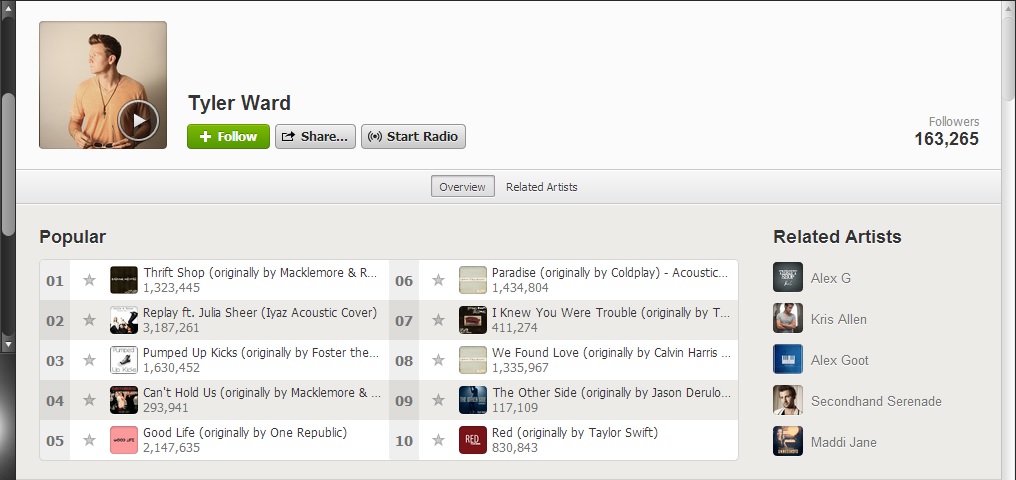
Tyler Ward Spotify Profile

Tyler Ward Spotify Profile

As you can see, his top 10 is all covers. In contrast to Shaun Reynolds, however, many of the songs he has covered are actually up on Spotify, though in the case of a few of them at least, I know they were put up after Tyler had a chance to corner the market. Altogether, Tyler has more than 11 million listens on these covers alone, good for $11k.

Is there a video of Shaun Reynolds and Tyler Ward meeting, called “When Shaun Met Tyler”, you ask? Why, of course there is.


So no judgment on these artists, providing our Song Placebo before the big labels come to terms with Spotify on the details for the real deal. I’m sure Shaun and Tyler are hard-working, aspiring artists, using covers as a vehicle to push their brand while also making some income. No shame there.

But it opens up an interesting question about the legal justification for allowing “covers” of songs in the first place, and possibly questions about how much we really value an original recording versus a cover. 19 million people made it through Shaun’s version of “Stay”, and probably liked it (it’s a good cover)! In a world where artists are fighting to move payouts from $.007 per play to more than $.01, though, you have to wonder if Shaun and Tyler are helping to prove that we don’t need the real thing when an army of Song Placebo providers are willing to give us “the same” for less.


Leave a comment

Filed under Uncategorized

Have video games gotten shorter?

The length of video games seems to be a hot topic lately. As somebody who plays video games on occasion, and probably reads too much about them, it’s an interesting discussion. This article at ArsTechnica was referenced heavily in video game media for a while, with Raptr writing a bit of a nonsensical rebuttal here, which showed that people on average only play a game for 7-8 hours no matter how long it is, an interesting but tangential point. Early 2013 speculation about the price of next-gen games going up provided additional kindling for the conversation, specifically whether it was worth it to pay $70 – $80 if games weren’t going to get any longer.

When considering the question, it’s important to define the scope – there are certainly more video games released each day today than ever before, across a wider range of platforms than ever before. But if the question is “have home console games gotten shorter”, ignoring iOS apps and Facebook games, then I think the answer is no.

I threw together the below charts based on two data sets: the VGChartz all-time sales list, and game length data from (appropriately) gamelengths.com. First I looked at the best-selling game for each year since 2000, and charted the length of the campaign. There are a number of caveats though; many of the top-sellers don’t have campaigns, and many came packaged with a console (inflating their sales numbers). For example, Wii Sports is the best selling game of all time according to VGChartz, but it doesn’t have what you could consider a “campaign”. Similarly, a sports title like Madden doesn’t have a real campaign either. So I ignored any game that didn’t have a length on gamelengths.com, and went to the next best-seller for the year. Also, console only (Xbox/Wii/PS etc.)

Top Sellers by year, with campaign length for comparison

Top sellers by year, with campaign length for comparison

This is admittedly a clunky approach, and only answers the question as it relates to the single most popular games with a campaign each year (along with answering “how much has Call of Duty dominated the last half decade”). Also, Need for Speed Underground was the best-seller two years in a row? Where was I for that game? Gran Turismo 3 was actually the best seller in the year prior as well, but had no official campaign length to quantify. I can guarantee that represents a unique three year stretch in video game history where racing games were king, an era we aren’t likely to see repeated.

Anyway, the chart above doesn’t give us much of a pattern across time. Shooters tend to be in the 7-10 hour range, Action & Racing are in the 10-30 range, and RPGs (of which Zelda really should be classified) are 40+. It would be foolish to make a broad statement about game length based solely on which genre sold the most units in a single year, even more so because Call of Duty tends to actually suck up more total hours than any of the games on this list, if this chart is to be believed, showing that gamers spent 67 hours on average with Black Ops 1 in contrast to its 7 hour campaign.

So let’s take a different approach. How about looking at established series in these established genres to track their progression over time? I, somewhat arbitrarily, picked Shooter, Action, and RPG as my genres, and Call of Duty, Assassin’s Creed, and Final Fantasy as the series to track, respectively. Here we go:

Call of Duty length over time

Call of Duty length over time

As sure as the sun rises, Activision releases a new entry into the Call of Duty series every fall. Call of Duty has barely  moved over the past 9 years, sticking right at that 6-8 hour band where Raptr claims we simultaneously lose interest, but  stick around for another 60 hours. I omitted a few where my source had no reliable  campaign data, but I have a feeling  it’s in the same range.

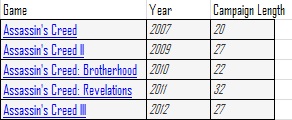
Assassin's Creed length over time

Assassin’s Creed length over time

Similarly, Assassin’s Creed has been relatively consistent since it’s debut in 2007, adhering to that 20-30 hour mark. If  anything, the first entry was something of a tech demo for the ps2, and it’s been easier to add in content since the basic  engine was completed.

Final Fantasy length over time

Final Fantasy length over tim

Besides the few entries here where I either have no data or the game had no campaign (XI and XIV were MMORPGs), the  FF campaigns have actually trended upwards since the olden days, when cartridges likely limited the number of hours a  developer could cram into a machine. Final Fantasy 3 should probably be in the all-time efficiency hall of fame, providing  a 31 hour campaign on a cartridge that could only hold 512KB of data. For context, the images in this post alone take up  200kb of space, and they certainly don’t provide more than 2 minutes of entertainment!

So in terms of an empirical answer, it looks like no, home console games have not gotten shorter. If anything, the evidence suggests that increased storage capacity has yielded longer games in at least one genre (the RPG). And with the advent of broadband multiplayer, many games that are technically “short” (like Call of Duty), are actually played the longest (67 hours on average for Black Ops, according to Raptr, as one data point). We can also conclude that Shooters have gotten too popular, but at least they aren’t racing games. 🙂

Leave a comment

Filed under Games, Social Games

Studying for the Bar

I’m out of toothpaste, I need a haircut, and my car needs an oil change. I must be… studying for the bar! See you in a few weeks.

Leave a comment

Filed under Uncategorized

Would newspapers benefit from collusion over paywalls?

I’ve had almost no time to post here in the past few weeks, as I just began studying for the bar, but I wanted to take a break from studying Evidence and Torts for a second. I have owed my friend Brad Greenberg, a fellow UCLA law new-grad, some attention. Brad’s most recent contribution to the world of legal academia is available here, and it covers a topic that should be interesting to law nerds and normal nerds alike – the survival (or, alternately, impending doom) of the newspaper industry. And the discussion is currently as alive as ever, with recent discussion of the topic focusing on the New Orleans Times-Picayune laying off staff despite it’s profitability.

Brad’s paper can be broken down into a few key arguments:

– Newspapers need to make more money than they are making now to survive,

– Collusion to set paywall prices could save them, but antitrust law bans such action,

– Congress should endorse and promote an exception to the antitrust laws to save the newspaper and the United States itself (I added that last part…).

Typical for a guy with multiple published pieces who also blogs on the side, Brad’s piece is refreshingly easy to read for a law article – but that doesn’t mean I agree with his points. Actually, I disagree with just about every one of them. Originally I thought of reasons why each point was wrong – newspapers can make money without paywalls, newspapers could probably escape antitrust charges through signaling their concerted action anyway, points about how the last government-endorsed entertainment/news monopoly (cable) has set us back by a decade. But really, none of those things matter, because ultimately the newspaper is dead and our children simply won’t care because the world will be just fine without them:

Welcome to the 21st Century, now with 100% less Newspaper – 

Newspapers were lazy, crappy, overachieving businesses for decades. These weren’t glamorous jobs, necessarily, but they weren’t well-run businesses either. Major newspapers lived off of two major cash cows – the natural monopolies of the classifieds and print ads. The network effect of having everybody in town looking at the same few pages of paper everyday let newspapers turn 10 cents of ink into a $1,000 ad or a $100 classified. If you needed to fill a job opening in the pre-internet era, you went to the newspaper, and you paid whatever it cost. Couch to sell? Car to sell? Plumbing services to offer for consumption? Same deal. Call the newspaper. The rest of the business wasn’t particularly fine-tuned, because it didn’t need to be.

A decade of Facebook, Google Adsense, and Craigslist later, and suddenly those ad monopolies are gone. Newspapers now offer an unattractive product (ie we pick the news that’s important, deliver it to you in a physical format once a day, and you pay for it) compared to what the internet offers (ie you pick the news you want, whenever you want it, and you don’t pay for it). It’s a lot like what’s happening right now with cable: people are realizing they shouldn’t have to pay for the 200 channels full of shows they don’t watch when all they want is Mad Men and Game of Thrones, and they can watch those on-demand online (if not completely legally at this point).  The fundamental problem facing newspapers is the same one facing cable, but the newspapers don’t have any unique content. The papers that do have unique content (for example, the Wall Street Journal) are having less trouble staying profitable, because they have something they can charge for and make a margin on. The ones that don’t are struggling to drive readers to their website, because in all likelihood those readers are already getting that same news from the few sites that have successfully transitioned online already. Content with value will always find a way to get out – but most papers just don’t have much content of value, and that’s a business problem, not a societal one.

But Brad would tell me that I’m focusing too much on the business and not enough on the societal benefits of the newspapers; ‘why don’t you lament the loss of our bold muckrakers, Dan?’ he might contest. For the most part, I just don’t think there is any risk that the sort of injustice newspapers cover will go uncovered in a digital world. As newspapers die and websites take their place, journalists will make careers (though likely fewer) of breaking and covering the same stories as they did when those stories were cast in ink. Will that make it easier to “corrupt” the news with bribes? To corner the market on an area of journalism and subvert it? Who could say at this point, but the bottom line is, newspapers are on the way out and personally curated digital news has already taken over. I’m almost certain we wouldn’t have missed Watergate if we had only had Twitter to rely on, but only time will tell.

Leave a comment

Filed under Misc, Uncategorized

Sensationalist reporting of legal battles by Techcrunch continues with Oracle/Google

Google has been embroiled in a legal battle with Oracle for some time now, and the jury in the case is slowly releasing their verdicts on multiple issues. I haven’t written on it much here, because it’s being covered extensively by far more intelligent people elsewhere. The basics of the case are that Oracle has claimed that Google infringes on Oracle’s copyright in their Java APIs (37 API packages, specifically), as well as infringing on patents related to the same.

Though the story has been reported on quite extensively, the twitters and techmemes were abuzz yesterday when the jury in the case released their first verdict. The verdict? Well, they didn’t really reach one. The jury was instructed to assume the copyrightability of the Java APIs, and to come to a conclusion on whether Google’s use of the APIs was “fair use”. The jury instruction all but ensured that the jury would decide that Google infringed the API copyrights – the real issue in the case really ought to have been whether the APIs were indeed covered by copyright, but the judge has saved that determination for himself. The jury came back Monday with the statement of “we don’t know” on the issue of fair use.

How is that news being reported? This is Techcrunch’s Headline:

The Verdict Is In: Google Infringed On Oracle Copyrights

Correct, but completely misleading. Anybody following this story knew that the jury was going to find infringement (see here for one example), and anybody following the story also knew that the real issue was whether the jury would find the infringement to be fair use, and whether the court would find the APIs to be copyrightable. Techcrunch’s article is written as if the case is over. It’s not just Techcrunch – Wired is reporting today that “if” APIs are copyrightable (note: many legal pundits say that they are, and have been for a long time), then apparently the world will explode. The lead picture for the article is an atomic bomb. An atomic bomb? Really?

This isn’t the first instance of overzealous tech journalism, far from it, but Techcrunch’s (and other outlets’) coverage of major legal battles has sunk into the realm of tabloid sensationalism. Techcrunch recently reported on the Facebook v Yahoo patent fight by analyzing the patent abstracts, rather than the actual claims, to come to the ridiculous conclusion that “Facebook has the upper hand”. This is, obviously, months before any actual claim construction or significant developments in the case.

These are really important issues for the tech community to understand, but sensationalism and poor analysis only confuse the issues for readers. If Techcrunch wants to help educate on these issues, the least they could do is have a reputable source write a guest post.

Leave a comment

Filed under Copyright, Law

Spotify Frankenreview: Nine Months Later

I listen to a lot of music, and I love the internet, so one year ago I was avidly following the race to capture the internet music space. Obviously this race isn’t quite over, but it’s been about 10 months since I handicapped the race (and some here, too) and about 9 months since I wrote what turned out to be one of the most popular posts on my blog, a rather harsh review of Spotify that garnered a couple hundred page views by itself (even the picture of Spotify’s interface that I included got a few hundred views alone, so there was clearly some interest).

In my original handicapping of the internet music scene, I gave a big nod to iCloud and Turntable.fm. iCloud seemed like it would have an immediate headstart based on the cross-promotion possibilities with iTunes and iPhone, and Turntable.fm saw explosive early growth and looked like a winner based on it’s ability to sell virtual goods. Plus, Spotify hadn’t officially launched in the US yet. What’s happened since? Spotify has grown after launch, but not incredibly (just 3 million subscribers, only 20% of whom pay for the service). Turntable has gone legit with licensing by the major labels, and they’ve raised a bajillion dollars. And most people still don’t know what iCloud is.

That gets us to my original review of Spotify. The highlights: On the day I signed up, Spotify was doing pretty poorly and users couldn’t play a large number of popular songs. And the discovery-through-facebook method wasn’t particularly thrilling because nobody was on the service yet. I’m happy to report that 9 months later I’m still using the service, and it has now gotten more money out of me than any single internet service in the past couple years outside of the Apple app store. The viral/social component is great as Facebook jumped on board with Spotify integration whole-hog, and now my news feed constantly shows me songs my friends are listening to. One click there and Spotify launches, and I’m listening to whatever it is my friend listened to. Popular playlists are also a cool feature, and one I actually use. The radio feature and app store are cool too, though I use those less. I gave Spotify a 72/100 in my review based on the nonworking aspects, and modified that to an 80/100 after they fixed the non-playing songs issue. Now that the social features actually work, I’d revise that up even further to a 85/100.

But is Spotify going to solve all of the world’s music problems, and take over the world? If the numbers are any indicator, then my original review nailed the problem:

It’s not better than downloading the whole album for free as a torrent. People who pay for music pay for music, and maybe for them this service makes sense. But people who don’t pay for music get nothing from Spotify that they aren’t getting for free at a torrent site – on both I need to know what I want, and search for it. As a torrent, I can have the whole thing in 3-5 minutes, on Spotify, I have to pay, they may not have it, and it may not stream if they do. The only chance the music industry has to recapture the people who don’t want to pay for music is to either ramp up enforcement (which they’ve tried, and doesn’t and will never work), or to offer them a value proposition that they can’t turn down – Like utilizing the social graph in a new and cool way (turntable.fm) or offering an interesting method of discovering new music (pandora). Spotify doesn’t do either of those things well. It’s just a legal version of Napster, which is cool, but Napster was cutting edge in 1999, and didn’t have the possibility of drawing on advanced algorithms or facebook friends to suggest new music. Spotify should utilize those things, but it doesn’t.

Spotify is absolutely loaded at this point with every feature you can eke out of a service that knows your friends and your tastes – it’s got radio, it’s got an open development app store, it’s got recommendations. It’s doing everything I said it would have to do to have a chance at revolutionizing the industry. But it still is only converting about 20% of it’s (rather puny) 3 million user base to paying customers. In the end, if utilizing the social graph to provide the experience Spotify is now providing can’t convince more than 600k people to pay, there probably isn’t much that will. In my original breakdown of the competitors in this space I noted that even Pandora, hailed as a blueprint for the new internet/music fusion, hadn’t turned a profit. Spotify is likely in the same position, and the music industry still hasn’t found the route to getting another company to make it’s product wildly profitable again.

Leave a comment

Filed under Misc

The value of a software patent, why Twitter voluntarily forfeiting a property right isn’t crazy

You can look at Twitter’s move to their new invention assignment agreement (they are calling it an Innovator’s Patent Agreement, which has a fittingly unlegalese ring to it) from a number of different angles.

For one, it signals a growing movement in the technology space to do SOMETHING about software patents. To put it bluntly, many feel that things are out of control. You don’t have to pay too much attention to the industry to have heard about the battles between every major technology company. Patent holding companies are making a fortune off of licensing, and companies are abandoning their Business Plans! in favor of Patent Trolling!. Hell, companies are forming with business plans that consist of Step 1 Acquire Patent Step 2 Sue People. If you are into the efficient allocation of resources (and who isn’t, these days?), let’s put it this way: Nathan Myrvold is currently using his time to buy and license and sue over other people’s inventions. The patent problem is skewing incentives for the economy, luring our greatest minds from more productive innovation! Silicon Valley and it’s bevy of engineers knows something is wrong, and as the inventors of 90% of the problem patents in the country, Twitter is empowering them to do something about it. Or at least, Twitter is saying they will and taking a step towards that end.

On the other hand, think about Twitter from the business aspect. This is a company that is criticized for lacking a revenue plan. It’s the weakest “business” of the major social networks, and it’s seen many changes at the top over the past few years, plus it’s sat on the sidelines while Zynga, Groupon, LinkedIn, Yelp, Pandora, and soon Facebook have gone public. Twitter has some of the highest average salaries in the scene, and it’s a place engineers want to work, yet it has weak ad revenue compared to the company it will always be compared to in Facebook. With patents being so valuable, and social networks becoming so prevalent, and Twitter being a social network with a strong engineering team, one might think that a strong strategy for Twitter to boost revenue would be to start firing off licensing efforts of their own. Here’s the thing though: They only have one granted patent (though it’s a good one that probably reads on all mobile devices and many mobile apps). If a patent nuclear war started yesterday (oh, wait, it started months ago), they are the Melians to the Facebook/Yahoo!/Microsoft Athenians. Twitter is clearly at a bit of a competitive disadvantage in a world where patents are incredibly valuable.

So for Twitter to take this step of limiting the downstream value of their patents (ensuring that the Coase theorem dictates the patents remain with Twitter, though I’m torturing the Coase theorem a bit there [another shout-out to my resource efficiency homies!]), while also potentially cutting off current licensing revenue potential… well, it’s a tiny bit noble, but a whole lot more a Trojan horse for the rest of the patent-holding technology companies of the world. Very clever, really. Twitter is politely asking everybody to sign a non-proliferation treaty, and making a nice gesture by signing it first, but that would be like Switzerland looking to end World War II by being the first to sign a peace treaty. Twitter is hoping this international relations metaphor is a bit more Gramsci and a bit less Hobbes (If I haven’t shaken you yet with all these political theory references, then congratulations). They would love nothing more than for every company that has already invested millions of dollars in patents to sign the treaty for Twitter’s own protection as much as they would like them to for their edification. So Twitter makes this big PR gesture, they will be hailed as saviors by the anti-software patent crowd, engineers will claim this as a great reason to work for Twitter, and Twitter gets to step back and hope others give up more to gain less by doing the same.

So there you go. I’ve successfully told you why Twitter’s move today is great for software patents generally, pretty clever by Twitter itself, and not really a big loss for them in terms of what they had to give up to get some amazing PR and recruiting, all while hitting you with multiple resource efficiency, political science, and international relations references. Hopefully more entertaining than self-indulgent, but the blog does have my name at the top so maybe I can take that luxury every once in a while.

(Some other articles that helped form my thoughts for this article: 1. 2. )

Leave a comment

Filed under Law, Patent

The JOBS Act Part I – Crowdfunding.

The JOBS Act has passed both House and Senate, and all signs point to it being signed into law sometime this week. The JOBS Act does a few things, but the two big ones that will be widely publicized are 1). it allows companies to “crowdfund” by selling securities to nonaccredited investors for total funding amounts below $2 million, and 2). it raises the number of shareholders that trigger a company to file SEC disclosures from 500 to 2000.

First off, let’s get one thing out of the way: This isn’t going to create many JOBS. Despite the title, this is not a “jobs” bill. No money is being spent on anything (you can imagine the pitch and see why it passed: will you vote for this bill that has JOBS in the title but doesn’t increase the deficit or raise taxes?). The crowdfunding portion of the act will likely increase the misallocation of money in the economy, and the increase in the shareholder limit doesn’t have any clear connection to increasing jobs at all. So ignoring the blatant pandering by the Act’s title, is it a good law?

I’m going to focus on the crowdfunding portion of the bill for now, and save the shareholder number increase for another time. I’m also only going to talk about equity – crowdfunding small business loans will likely catch on as well, but people seem to be more interested in the equity side of the equation. Anyway, two obvious questions spring to mind:

What sort of company will raise money this way?

Not the Facebooks of the world. The startup/technology world probably won’t go the crowdfunding route very often. There is already plenty of angel and VC money available to promising startups in major cities, and startups tend to burn through cash pretty quickly before they become profitable, so few will have a business plan where $2 million is sufficient to get them to profitability. Furthermore, raising 100k from 100 people is going to be less attractive than raising it all from 1 angel who can add some value through expertise and connections. It’s also not going to be pretty to raise a Series A after taking investments from a few hundred random people, and VCs will probably be less than excited to get onboard with that cap table. I wouldn’t be surprised if mainstream VCs never back crowdfunded businesses. So forgetting startups, that leaves your regular ye olde small business, and they are probably the sort most likely to avail themselves to crowdfunding. But….

Who wants to invest in crowdfunded companies?

In an era of Shark Tank and The Social Network, it is no surprise that everyday people want to invest in young companies. But keep in mind, these aren’t going to be the sexy startups that regular Joe American has heard about. The companies that pursue a crowdfunding route will either be less-known startups that are struggling to raise money through traditional channels (which you’d think would lower the potential IRR for a portfolio of such companies, but more on that in a second), and small businesses. I’m no expert on the state of small businesses in the majority of the country, and I can’t say I really have a clue whether this crowdfunding option will be appealing to them as an alternative to other fundraising options. But I just have this gut feeling that if you want to start a small restaurant in a suburban neighborhood, it’s gonna be really really hard to convince a random person on the internet to care, let alone invest. The business plan on the investor side just doesn’t make a lot of sense: investors in startups (Angels and VCs) have one basic premise – if you invest broadly in enough startups, you’ll get a solid return by losing money on 80% of them, breaking even on 10-15% of them, and hitting homeruns (10x+++ returns) on 5-10%. The ability to get the homerun return is absolutely essential to a portfolio where 80% of the investments go bankrupt, but what small business can reasonably project a world where they offer their investors those kind of returns? The local restaurant/crafts store/yoga studio sure can’t.

This is the main problem I have with the crowdfunding plan: In a few years, we will probably say that no rational investor should invest in companies this way. The Act offers low net-worth investors the chance to make small investments in a number of small companies. This is essentially what high net worth investors do at the angel stage for startups, but the companies in the crowdfunding portfolio are 1) less likely to be wildly profitable, as most small businesses can’t even project 10-15x returns with a straight face, and are 2) more likely to be fraud [and this isn’t being alarmist – states first passed securities regulations specifically to combat fraud]. Oh, and the portfolio is even less liquid than an angel portfolio, because angel portfolio companies will be acquired or go public with some frequency, something no small business will do. Plus small businesses fail at an extremely high rate. What rational investor would take this portfolio of high-to-extremely-high risk, low upside, illiquid investments over a 5-year treasury? When the stock market is doing well, I just can’t imagine this being an attractive way to invest money.

In conclusion, I think the sale of equity through crowdfunding platforms just won’t catch on. I don’t think investors will want to put money into the sorts of businesses that will use the platforms, and over the long run those investors that do will realize they aren’t making a reasonable return. Maybe debt financing through crowdfunding will take off, but I just can’t see the equity side ever becoming popular.

Leave a comment

Filed under Funding