Compared to most areas of law, copyright is a rather polarizing issue for people. It’s a perfect storm of sorts – Copyright pertains to just about every creative work authored by man in our country, so most everybody has some opinion on how it should work, because it probably impacts them in some way.
One of the strangest problems in copyright to me is that around fair use. Thinking about the topic, I’m reminded of how a Professor framed the issue for the class – Copyright is about whether you have to ask, and whether you have to pay (a rather realistic approach). With most works, and with most potential infringement, the answer is that the person seeking to exploit/further the original work has to ask, and probably has to pay (unless the original artist grants the license for free). If the use is “fair use”, then the new artist doesn’t have to ask, and doesn’t have to pay. For most situations then, the new artist either asks and pays, or doesn’t ask and doesn’t pay.
There is one rather unique situation in copyright though, where a new artist doesn’t have to ask for permission to use an original work, regarding covers in music. New artists seeking to rerecord a song already released by another artist need not ask that original artist for permission, they only have to pay a statutory license. It’s been the law of the land since 1908, when Congress was pushed to add the mechanical license by piano roll manufacturers who feared a monopoly by a major player in the piano roll market. Can’t make that stuff up.
If you really think about it, the exception for covers of musical compositions is exceedingly strange, and it casts some doubt on a lot of the justifications you hear for copyright law in other areas. It’s kind of like fair use, where we have agreed that there are some instances where the new use is so valuable for society that we don’t want to give the original artist the right to disapprove and shut it down. Fair use is typically found when a copyrighted work is used for something like research, parody, teaching, or the like, and the two main factors the court looks at are both economic, asking whether the new work is commercial in use, and whether the new work is likely to displace the older one in the marketplace. If covers in music weren’t protected by statute, however, they definitely would fail the fair use analysis – when a band releases a cover of an older song, they almost always are doing so for commercial gain, and the new version is likely to compete with the old version for ears. The license, though, solves these worries – every play of the cover generates some revenue for the artist of the original, and thus, everybody wins.
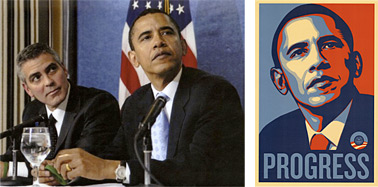
A compulsory license would have definitely been an economically efficient outcome for Fairey and the AP, who fought a high cost legal battle over the above images
Photography, on the other hand, seems to have reached something of an impasse of late. I wrote a post on the topic recently, and to summarize, what has happened in photography is that artists just end up taking work by prior artists for use in their new art, hoping to win the lottery on a nuanced piece of language in the law that has driven courts to rule in two different ways. Basically, artists are forced to decide if their use of the photo will be “transformative” under one of two different definitions embraced by different courts, in the hopes that a judgement in their favor will exempt them from seeking permission by qualifying their use as “fair use”. In practice, neither the original photographer nor the new artists have any idea whether a use is going to be deemed transformative and thus “fair” except in the most extreme cases, so the industry sees a chilling effect. Which system sounds easier and clearer to you, the system that photographs operate under, or the system that music operates under?
I’m not the first to suggest that photographs should be subject to a compulsory license, though the idea doesn’t seem to come up a lot. Mechanical licenses would be easy – just as in music, an agency would likely arise in the market that would make the transactions easy, and provide a way to connect a new artist to the original photographer. If the original photographer can’t be found by the new artist, then they can go ahead and continue without fear of a costly copyright infringement suit later, knowing that the maximum amount of risk they will take on is the cost of paying a mechanical license if the photographer comes out of the woodwork. It would be a smarter system, and I’m not sure why it hasn’t gained more traction.
 danielmarkmiller.net
You must be logged in to post a comment.