Google+’s main challenge, as I see it, is to develop a core use that draws users away from Facebook in a new way. Let me explain by highlighting the core uses of the other major social networks of our time / Myspace was really the first social network that worked, and it did so on the strength of one principle – a custom space on the internet that is yours to do with what you please. It was a great idea, and at the time, completely groundbreaking in that it was too far head of its time in many ways. It started out before internet companies needed a revenue model to get anywhere, and in many ways that made Myspace a really charming experience. The core principle worked for its uniqueness, but primarily surged based on usage by a teenage customer base that was increasingly using the internet as a way to entertain themselves in the boredom of middle and high school. I was a teenager when Myspace was popular, and every teenager I knew had a Myspace, while my Dad wondered what on earth the internet was. Brands that sought the attention and money of teenager flocked to Myspace, and the network seemed like a hit. Except that eventually the principle wore thin for that teenage set when they grew up a little and realized they didn’t want shiny stars shooting behind 4 simultaneously playing youtube videos of a crappy pop band above two years of sappy blog posts about gym class to represent themselves to the world. Plus, it was really hard to look at some of those pages, providing a big disincentive for users to explore the service more than just their immediate friends.
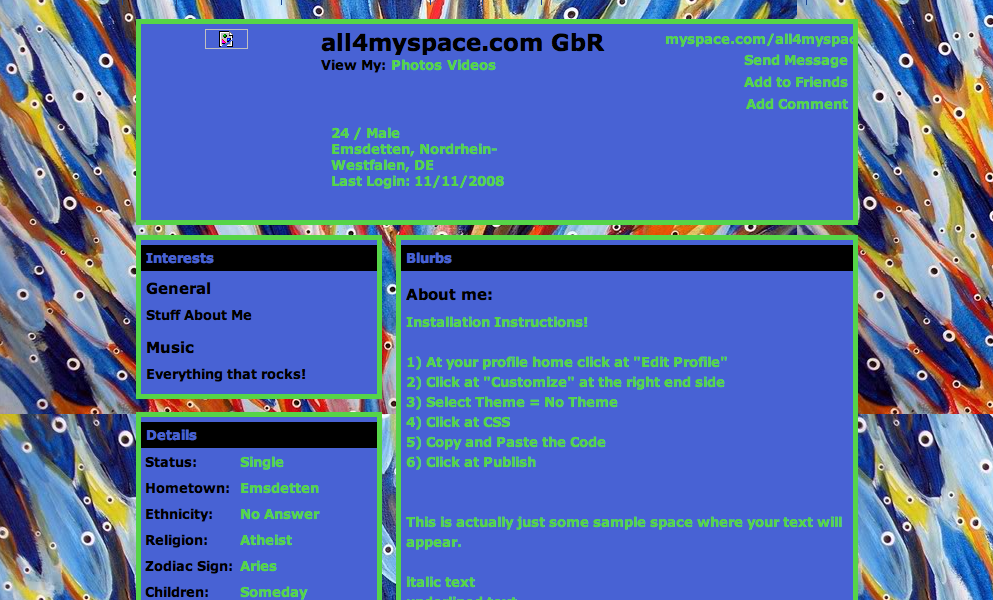 (Believe it or not, this isn’t just a bad myspace layout – it’s a layout somebody put together and recommended to others)
Facebook’s one principle was to be the antithesis of Myspace in certain ways (no shooting stars, no music, a fixed color scheme and one choice for layout). But the core principle that made Facebook work initially was as a psuedo scrapbook of all the things your friends were doing, with tagging all over so you could just sit and get completely distracted clicking on the profiles and pictures of people you hadn’t seen for years for seemingly no reason. People refer to it as Facebook stalking, and while I suppose that’s accurate, it paints a pretty voyeuristic picture of a completely voluntary decision to make certain things in life public by putting them on Facebook in the first place. It’s not even a really destructive thing, and it tends to make the service money! The more you partake in life on Facebook – inputting interests, perusing and clicking on things your friends like and liking them, the more Facebook can target you with ads that are more likely to convert, and the more Facebook makes from transactions using Credits. Facebook was wise to position itself in other ways to survive when their generation of users (Facebook rose on the backs of college students) again realized that they were in need of an image shift and that they didn’t want pictures of keg stands and posts about how drunk they were last night to show up as the online representation of themselves – Facebook persisted by allowing users to lock up their privacy and delete pictures and walls, while at the same time becoming indispensable (for now) as a picture warehouse, game platform, phone and address book and messaging service.
Twitter works on an entirely different principle – it’s a way to connect with anybody in the world, and access everything they choose to say on the service, with no privacy walls whatsoever. It’s part news aggregator, part friend activity monitor, part brand outreach, part celebrity follower, part location sharer, part revolution starter – Part of what has made Twitter so hard to monetize is that despite being popular, it appeals to people for different reasons. It’s really the only technology of its kind, and it works on many levels, making it a powerful social network (if not a very profitable one). Whereas Facebook is a very individual experience in many ways (much of the use is directed completely by the user and you navigate to the person you want), Twitter is an avalanche of information about where people are, what they are doing, what’s going on in the world. You are agreeing to submit yourself to viewing the 160 character thoughts of a random assortment of people anytime you access the service, and “following” somebody is not nearly the commitment that “friending” somebody is.
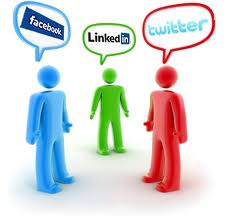 (A really ugly picture representing three successful social networks and, at the same time, looking like it was made before the founders of those networks had graduated college)
LinkedIn doesn’t deserve extensive treatment, but it is relevant here because Google+ is really Facebook+, and LinkedIn is really Facebook+Job Stuff. Whereas Facebook represents you as a person, LinkedIn’s core principle is that it represents you as a professional – a great, profitable twist, because Job Stuff is pretty important to people, and people who take Job Stuff seriously tend to be willing to spend money on Job Stuff, meaning advertising works well on Facebook+Job Stu… ahem, I mean LinkedIn. Where Facebook’s emphasis on on the Social in social networking, LinkedIn’s is on the Networking – perhaps a glib way to put it, but accurate I think. LinkedIn wasn’t particularly creative as it comes to pushing technology forward – sort of just a “well that’s obviously a good idea”, but also a “boy this is set up just like Facebook isn’t it”.
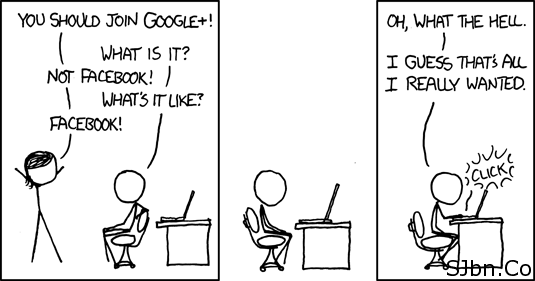 (My favorite comic on Google Plus, though I disagree with the last pane [see below])
Google+ is basically Facebook+Different Social Management. That’s it at this point. It’s not even a new take on how you interact – it borrows heavily from Facebook in lots of respects, be it the News Feed/Profile setup, the “Friending” mechanism of adding somebody to a circle, and the desire to be your picture warehouse and phonebook and address book. It’s missing a core principle that is different from Facebook- Myspace had being a unique online sanctuary to yourself, Facebook had stalking everybody you knew in a digestible format, Twitter had a firehose of unapologetic information from everybody you’ve ever been interested in hearing from, LinkedIn had Job Stuff. But what does Google Plus have? It’s more like Facebook Minus, Facebook, minus all my friends, photos, events, etc. It isn’t even as easy as typing in the names of all your friends to recreate the Facebook experience – you have to actually put all of your friends in circles that have been suggested to you, or you have to invent an entire inventorying system on your own, on the fly. Sometimes you drag one person into many circles, sometimes just one, but each time it feels more like work than like an innovative social experience. It can do everything Facebook can, and maybe even a bit better in some respects, but only if I sit through and recreate exactly what I have on Facebook already. It is completely derivative.
Maybe in 2-3 years I’ll look back and wonder how I was so blind to Google+’s beauty (even dumber… search engines ignore plus signs as a default, so “Google+” is difficult as it comes to the very technology made famous by its namesake). But more likely, I think Google+ will complete the holy trinity of hot, buzzy social products that eventually get dropped of Wave, Buzz, and Google+. Google really needs to add some new spark to Google+, or the early adopters may be the only adopters.
 danielmarkmiller.net
You must be logged in to post a comment.