Blizzard announced last week that Diablo III will come with DRM that prevents players from playing the game unless they are online. Presumably this is an anti-pirating measure – being online will allow Blizzard to check your CD-Key against a database of CD-Keys, and thus prevent multiple people from using the same CD-Key simultaneously. But DRM is a terrible idea – As Sony found out this Spring, restricting what your consumer can do with a product they purchase can have tremendous consequences for a company. Blizzard is obviously unlikely to be attacked as viciously as Sony was, but the business and legal ramifications of bad DRM can be far-reaching even in the field of computer software where DRM is relatively common. EA saw a hard backlash against DRM in the game Spore a couple of years ago, with players harshly rating the game on Amazon to express their displeasure.
But back to Diablo III: Everybody who is looking forward to the game knows about this DRM by now – it’s garnered a tremendous amount of attention on websites of all varieties. A Diablo fan site recently conducted a poll, with the following results:
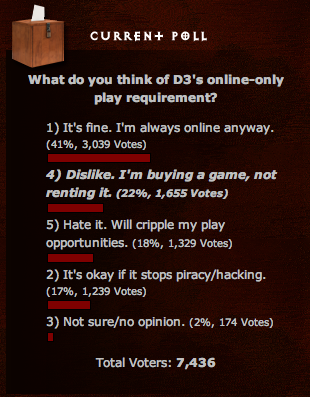
Obviously these aren’t the most scientific poll response choices, and the political science major/statistics guy in me is cringing at the double-barreled options on there (I hate the DRM but it definitely isn’t going to cripple my play opportunities), but clearly a lot of people don’t like the DRM. 40% either dislike or hate it.
Besides being interested in games, there is a legal component to this – when you buy Diablo III, you’ll be buying it under a lease agreement subject to a terms of use, which is how companies like Blizzard control and restrict the activity of a player. Doing this with software is nothing new, but let’s be honest – nobody reads those terms of use when they install a video game. Players have been clicking through those terms without thinking about the property rights (understandable, really) for years. Players simply assume that they purchased a game, that they are free to resell it, that they own it currently, and they can do what they want with it (except for a few things that will get them banned online, but that doesn’t usually enter the mind of a player as a limitation on a property right). As the phrasing of the “dislike” option in the results above shows, consumers really do think they “own” the games they purchase free from obvious limitations on things like copyright.
When a company like Blizzard makes a move like putting an online-only DRM onto a major release, it pushes the fact that the player doesn’t own the game into the player’s face. I’d argue that this isn’t a good thing for game developers – for better or for worse, players believe they own the games they purchase, even if that belief is somewhat incorrect. When that belief is disrupted by new, invasive DRM, players tend to get upset and generally pessimistic about the intent of the companies, who players view as punishing their paying customers.
I’m generally against putting DRM in a game for a few reasons:
For one, it isn’t a low cost for a developer.
Putting in traditional DRM like a CD-Key is cheap, but it also is incredibly easy to break, because hackers have had years of experience cracking existing DRM. For DRM to really work with computer software, a company needs to make something relatively customized, which usually involves hiring a security company. This isn’t going to be cheap, and the consumer gets to pay for that cost a lot of the time, though often indirectly through a diversion of resources away from making the game higher quality.
Second, it never works and doesn’t make financial sense.
I don’t have the stats to back that one up, but DRM doesn’t work. There’s something of an economic reason for it, so that will have to suffice for lack of empirical evidence. Think of the PC game economy as having 4 actors – there is the game developer, the paying user (“user”), the non-paying user (“pirate”), and the hacker. Putting DRM on a game has a cost – the initial payment is made by the game developer, but the cost is ultimately passed on to the paying user in the form of a lower quality game for the same price (since the developer diverted some resources away from making a higher quality game to put towards the development and testing of the DRM). The pirate bears none of the cost, because they aren’t paying anyway, and the hacker (who might also be a paying customer, a pirate, or even a developer in rare cases) is presumably motived by the desire to crack the game. This is actually a somewhat interesting point that I think is overlooked – hackers are naturally attracted to new challenges, and DRM is one place where an amateur hacker’s natural propensity for computers and likely shared affinity for games played on them leads to a cracking race. PC games are often cracked by the hacker community in less than a week, and major releases with new DRM tend to excite that community more than the simple CD-key crack, because new DRM brings some level of prestige to the first hacker to crack it. I can guarantee you that not only will Diablo III be cracked in a week after release, but it will be widely reported news because of Blizzard’s approach thus far. So hackers actually see new DRM as something of a gain, pirates are unaffected, and paying customers lose, while the developer is spending the same to put out an inferior product, which will likely sell worse. All the costs of DRM are born by the people already paying to play, and there’s mostly only an incentive on the side of the nonpaying pirates and hackers. The financial logic just isn’t there.
Third, it generates bad press, and burdens the paying customer more than any other party.
As the poll above and hundreds of other articles on the topic show, Blizzard has already paid a price for publicizing the DRM they are throwing on Diablo III. Will it hurt sales? Maybe not – it’s a multiplayer game that 90% of people want to play online anyway. But they basically just killed all of their single-player only sales, and limited the ability of some to enjoy the game entirely. I plan on buying the game, and now I’ll have a slight chip on my shoulder for having my play limited by Blizzard’s desire to cut back on activity that I don’t even engage in (though I’ll admit to having hacked Diablo II a vast number of times back in high school). If Blizzard wasn’t making a game that I’ve been waiting for for almost a decade, I’d actually consider avoiding the game. I’m sure less interested fans will be turned off completely.
 danielmarkmiller.net