This post started off as a reflection on the importance of the Kickstarter/Double Fine fundraising event in the history of the game industry – but then I got bogged down in thinking about all sorts of other issues associated with small game developers in general. So, as background to my awesome reflections on whether Kickstarter is going to change the world of game financing, here’s a slightly different topic: how does a consumer actually discover a game?
This might not sound novel – in fact, I’m sure it’s not (but what on the internet is?). Discovery is a popular topic, indeed a buzzword, in the social/mobile game development universe. Putting your game in front of more consumers is key, and Tapjoy made a lot of money doing just that before Apple shut their main monetization strategy down. User acquisition moves mountains of money and gets lots of attention in social/mobile, and though it is less frequently discussed in the technology/video game blogosphere, similar mountains of money move to do the same in other game platforms, albeit with altered terminology.
Below is my chart of how I personally discover games. Behold!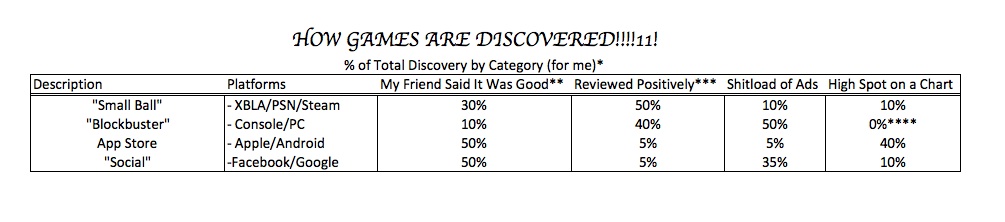
Hmm, it’s deceptively small, so click it! Anyway, here’s my notes on the subject:
* Obviously this is overly-simplifying a lot of interactions – if something is reviewed positively, I’m more likely to hear about it from a friend, and it’s more likely to be on a chart in a favorable spot. But the basic gist of this chart is how much of my personal knowledge of a game’s existence and quality comes from various categories. I almost never become aware of games on Facebook, for example, based on a review, whereas I almost always become aware of a “Small Ball” game because of a review.
**“My Friend Said it was good”: This is straight, old-school virality. I end up buying a rather large portion of my apps because friends say they are good. If I trust a friend’s opinion, I’ll buy almost anything they suggest in mobile. For blockbuster games, by contrast, the market is so large and I know so many people who play games, I give little credence to one friend saying the game was good. I’m sure you DID like Infamous 2… but I don’t care. I probably already know about the game and its quality by the time most friends have a chance to recommend it.
***“Reviewed Positively”: “Small Ball” games rarely have the ad-spend to raise awareness of their existence, so a lot of the legwork is done by positive reviews and old-school virality. I heard about Trenched/Iron Brigade (I hear you out there Mr. “Omg Double Fine talk about them more” – don’t worry, I’ll get to you) from a friend, so I bought it. Good reviews on Limbo and Braid probably drove the majority of their initial sales. For the other platforms – Blockbuster games are frequently seen as getting de facto positive scores from review sites, in part because they spend that “shitload on ads” at the very places that review them, a conflict of interest that savvy media consumers like myself are slow to forgive. I’m probably starting to conflate knowledge of game with likelihood of purchasing game here, as a positive review of a small ball game leads to a buy from me way more than a positive review of a blockbuster does, but oh well, it’s my chart!
*****“High Spot on Chart”: Lastly I want to point out that this category drives discovery disproportionately for App store / mobile right now, something that must change eventually if the medium catches up with other platforms. And for Blockbusters, nobody reads sales charts unless they are really into the industry and frequently visit Gamasutra, at which point the person probably knew about every game beforehand anyway.
That’s all for now – next post, I’ll stay on this games tangent and talk a bit about Kickstarter and try to connect the dots with this post.
 danielmarkmiller.net
You must be logged in to post a comment.