Category Archives: Games

Have video games gotten shorter?

The length of video games seems to be a hot topic lately. As somebody who plays video games on occasion, and probably reads too much about them, it’s an interesting discussion. This article at ArsTechnica was referenced heavily in video game media for a while, with Raptr writing a bit of a nonsensical rebuttal here, which showed that people on average only play a game for 7-8 hours no matter how long it is, an interesting but tangential point. Early 2013 speculation about the price of next-gen games going up provided additional kindling for the conversation, specifically whether it was worth it to pay $70 – $80 if games weren’t going to get any longer.

When considering the question, it’s important to define the scope – there are certainly more video games released each day today than ever before, across a wider range of platforms than ever before. But if the question is “have home console games gotten shorter”, ignoring iOS apps and Facebook games, then I think the answer is no.

I threw together the below charts based on two data sets: the VGChartz all-time sales list, and game length data from (appropriately) gamelengths.com. First I looked at the best-selling game for each year since 2000, and charted the length of the campaign. There are a number of caveats though; many of the top-sellers don’t have campaigns, and many came packaged with a console (inflating their sales numbers). For example, Wii Sports is the best selling game of all time according to VGChartz, but it doesn’t have what you could consider a “campaign”. Similarly, a sports title like Madden doesn’t have a real campaign either. So I ignored any game that didn’t have a length on gamelengths.com, and went to the next best-seller for the year. Also, console only (Xbox/Wii/PS etc.)

Top Sellers by year, with campaign length for comparison

Top sellers by year, with campaign length for comparison

This is admittedly a clunky approach, and only answers the question as it relates to the single most popular games with a campaign each year (along with answering “how much has Call of Duty dominated the last half decade”). Also, Need for Speed Underground was the best-seller two years in a row? Where was I for that game? Gran Turismo 3 was actually the best seller in the year prior as well, but had no official campaign length to quantify. I can guarantee that represents a unique three year stretch in video game history where racing games were king, an era we aren’t likely to see repeated.

Anyway, the chart above doesn’t give us much of a pattern across time. Shooters tend to be in the 7-10 hour range, Action & Racing are in the 10-30 range, and RPGs (of which Zelda really should be classified) are 40+. It would be foolish to make a broad statement about game length based solely on which genre sold the most units in a single year, even more so because Call of Duty tends to actually suck up more total hours than any of the games on this list, if this chart is to be believed, showing that gamers spent 67 hours on average with Black Ops 1 in contrast to its 7 hour campaign.

So let’s take a different approach. How about looking at established series in these established genres to track their progression over time? I, somewhat arbitrarily, picked Shooter, Action, and RPG as my genres, and Call of Duty, Assassin’s Creed, and Final Fantasy as the series to track, respectively. Here we go:

Call of Duty length over time

Call of Duty length over time

As sure as the sun rises, Activision releases a new entry into the Call of Duty series every fall. Call of Duty has barely  moved over the past 9 years, sticking right at that 6-8 hour band where Raptr claims we simultaneously lose interest, but  stick around for another 60 hours. I omitted a few where my source had no reliable  campaign data, but I have a feeling  it’s in the same range.
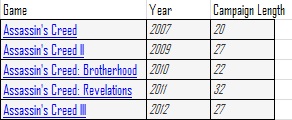
Assassin's Creed length over time

Assassin’s Creed length over time

Similarly, Assassin’s Creed has been relatively consistent since it’s debut in 2007, adhering to that 20-30 hour mark. If  anything, the first entry was something of a tech demo for the ps2, and it’s been easier to add in content since the basic  engine was completed.

Final Fantasy length over time

Final Fantasy length over tim

Besides the few entries here where I either have no data or the game had no campaign (XI and XIV were MMORPGs), the  FF campaigns have actually trended upwards since the olden days, when cartridges likely limited the number of hours a  developer could cram into a machine. Final Fantasy 3 should probably be in the all-time efficiency hall of fame, providing  a 31 hour campaign on a cartridge that could only hold 512KB of data. For context, the images in this post alone take up  200kb of space, and they certainly don’t provide more than 2 minutes of entertainment!

So in terms of an empirical answer, it looks like no, home console games have not gotten shorter. If anything, the evidence suggests that increased storage capacity has yielded longer games in at least one genre (the RPG). And with the advent of broadband multiplayer, many games that are technically “short” (like Call of Duty), are actually played the longest (67 hours on average for Black Ops, according to Raptr, as one data point). We can also conclude that Shooters have gotten too popular, but at least they aren’t racing games. 🙂
Leave a comment

Filed under Games, Social Games

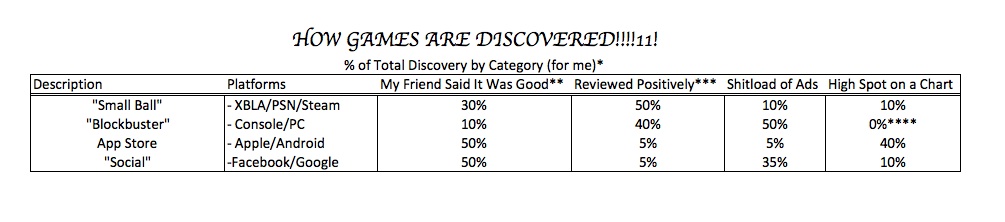
Discovery of games by platform (for me)

This post started off as a reflection on the importance of the Kickstarter/Double Fine fundraising event in the history of the game industry – but then I got bogged down in thinking about all sorts of other issues associated with small game developers in general. So, as background to my awesome reflections on whether Kickstarter is going to change the world of game financing, here’s a slightly different topic: how does a consumer actually discover a game? 

This might not sound novel – in fact, I’m sure it’s not (but what on the internet is?). Discovery is a popular topic, indeed a buzzword, in the social/mobile game development universe. Putting your game in front of more consumers is key, and Tapjoy made a lot of money doing just that before Apple shut their main monetization strategy down. User acquisition moves mountains of money and gets lots of attention in social/mobile, and though it is less frequently discussed in the technology/video game blogosphere, similar mountains of money move to do the same in other game platforms, albeit with altered terminology.

Below is my chart of how I personally discover games. Behold!

Hmm, it’s deceptively small, so click it! Anyway, here’s my notes on the subject:

* Obviously this is overly-simplifying a lot of interactions – if something is reviewed positively, I’m more likely to hear about it from a friend, and it’s more likely to be on a chart in a favorable spot. But the basic gist of this chart is how much of my personal knowledge of a game’s existence and quality comes from various categories. I almost never become aware of games on Facebook, for example, based on a review, whereas I almost always become aware of a “Small Ball” game because of a review.

**“My Friend Said it was good”: This is straight, old-school virality. I end up buying a rather large portion of my apps because friends say they are good. If I trust a friend’s opinion, I’ll buy almost anything they suggest in mobile. For blockbuster games, by contrast, the market is so large and I know so many people who play games, I give little credence to one friend saying the game was good. I’m sure you DID like Infamous 2… but I don’t care. I probably already know about the game and its quality by the time most friends have a chance to recommend it.

***“Reviewed Positively”: “Small Ball” games rarely have the ad-spend to raise awareness of their existence, so a lot of the legwork is done by positive reviews and old-school virality. I heard about Trenched/Iron Brigade (I hear you out there Mr. “Omg Double Fine talk about them more” – don’t worry, I’ll get to you) from a friend, so I bought it. Good reviews on Limbo and Braid probably drove the majority of their initial sales. For the other platforms – Blockbuster games are frequently seen as getting de facto positive scores from review sites, in part because they spend that “shitload on ads” at the very places that review them, a conflict of interest that savvy media consumers like myself are slow to forgive. I’m probably starting to conflate knowledge of game with likelihood of purchasing game here, as a positive review of a small ball game leads to a buy from me way more than a positive review of a blockbuster does, but oh well, it’s my chart!

*****“High Spot on Chart”: Lastly I want to point out that this category drives discovery disproportionately for App store / mobile right now, something that must change eventually if the medium catches up with other platforms. And for Blockbusters, nobody reads sales charts unless they are really into the industry and frequently visit Gamasutra, at which point the person probably knew about every game beforehand anyway.

That’s all for now – next post, I’ll stay on this games tangent and talk a bit about Kickstarter and try to connect the dots with this post.

Leave a comment

Filed under Games, Social Games

Copyright in social games drama as Nimblebit takes to Twitter to vilify Zynga

Copyright in social games is one of my favorite hot IP issues – back in the day, people sued Zynga for copying their games (though, admittedly and perhaps tellingly, not for copyright infringement). Then, Zynga sued other people for copying Zynga’s games, and those people defended themselves by saying that they both copied the games from somebody else. Now, eschewing the legal system, a small developer is taking to the streets (ie Twitter) to spread the word that Zynga is copying their game, Tiny Tower. Zynga has good reason to copy Tiny Tower, as the game was named iPhone game of the year by Apple. But the copying is pretty blatant, as can be seen by some side-by-sides created by the Tiny Tower developer (Nimblebit).

The whole thing is great theater and it inspired a field day on Reddit, but what does it mean? Would Zynga be liable for infringement if Nimblebit chose to sue? (Note to all small game developers reading at home: Don’t warn an infringer like this if you want the option to sue, ever. /end lawyerish). I wrote pretty extensively about the gray area in copyright in social games back when Zynga sued Vostu, because the issues are in some respects totally unique. For one, while any single game is clearly eligible for copyright protection, it’s not clear how far that extends in the context of a game – straight copy and paste of the art from one game would clearly be infringement, but what if you just have your own artists and engineers reproduce the basic elements of the game, the UI/UX, and the mechanics? Now you are moving from the realm of copyrightable creative content to uncopyrightable genres and ideas, which games in general have been building on for years. As Vostu noted in their defense, the big games on Facebook are largely paying homage (to put it nicely) to a PC or Game Boy game (remember when game boy was “mobile games”?). Secondly, copyright law has been seldom deemed to protect the menus and interfaces of computer software, but that’s largely what most of the copying allegations in the social game space point to as evidence of copying. To really get into some common copyright terminology, it is often stated that copyright protects the “expression” and not the “idea” – in this context, both genres and user interfaces fall more on the “idea” side.

An excerpt from Nimblebit's anti-Zynga screed

Anyway, the short answer to the Nimblebit lawsuit hypo is that they probably wouldn’t win, but I’d love to see the issue of copyright in social games tested more thoroughly in court. There’s two dimensions to the issue as I see it, one non legal and one legal:

Does game copying hurt consumers? 

The issue of copyrightability as between two game developers never came up often in the context of console games, the basis for what we have in terms of precedent, because the production and distribution cycles made it practically difficult to see a successful game and push out an identical competitor before it was too late to capitalize on the popularity of the original. Now, game production cycles on web and mobile are so fast and iterating happens so quickly that games are experiencing duplication as a threat like never before. Companies like Nimblebit can spend a ton of time and money creating a game that another company (ahem) can copy in a matter of days. Full disclosure: I really like Zynga and I’m sitting on the couch of a friend who works for Zynga as I write this. But Zynga isn’t the bad guy here regardless – it really isn’t clear where the line is between paying homage to a game and infringing the game’s copyright. Zynga adds a lot of value to a game beyond the graphics and game mechanics in the form of an extensive network of users and a level of polish that only a public company can provide. To put it another way, no matter how many different Scrabble clones there might be out there, the free market is inevitably going to settle on one as the network effects push users to the game where there friends are, until everybody is playing Words With Friends. Users aren’t necessarily hurt by the copycat culture in social games, because network effects will push people to one platform anyway, and the art isn’t usually what’s drawing people to the game in the first place.

Is the copying we are seeing now a violation of copyright law?

Maybe, maybe not. Okay, probably not. It’s a weird issue, because to say there is no copyright in social games, or more specifically that copyright only protects against exact replication of graphic assets, is to say that social games have really no effective IP protection at all beyond unauthorized reproduction. To say that copyright protects more, however, would be to extend copyright protection to the area of a genre, something more akin to an idea than an expression of an idea. It would also be a complete disaster for the game industry in many respects if a court ruling gave more than cursory copyright protection to game developers over entire genres, as there has been an implicit understanding that genres aren’t copyrightable since the the first Wolfenstein clone. But as computers become more and more a part of our lives, and as games on those computers become more and more valuable, is the network effects + limited consumer harm enough of a rationale to support an environment where Zynga should inevitably push out every competitor through copying as soon as that competitor hits on a strong genre? (I hate ending a long post with this, but it’s true in this circumstance) – only time will tell. For the most part the big companies aren’t going to push the issue because the stakes are too high and the companies are doing fine in the current environment.

Update: Of course, just a few hours after writing this, Spry Fox sued 6waves lolapps over the cloning of their popular new game, Triple Town. I’ll read the complaint and write more if it gets interesting, though with Spry Fox being a rather young company, I’d be surprised if they rejected any reasonable settlement offer to pursue litigation.

Leave a comment

Filed under Copyright, Games, Law, Social Games

Riot games plans anti-SOPA awareness campaign for LoL

SOPA, the broad bill being considered by Congress which would expand liability for content hosts if users post infringing content, is generally supported by content creator groups and generally opposed by internet and technology groups. This puts game industry companies in a strange spot, at least theoretically – game companies obviously create content and make their money primarily through sales of that content, so if they fell in line with the rest of content creators, they should complain about piracy and join the ranks of the SOPA supporters. Indeed, many of them are implicitly supporting SOPA through their membership in the Entertainment Software Association, which is lobbying support for the bill. But game companies also increasingly make their money over the internet, taking advantage of many of the networks that SOPA would hinder to both sell virtual goods and build communities (games also increasingly have some unique built-in DRM, but let’s ignore that for now). So where are these companies falling as the battle lines are drawn?

Riot Games, maker of League of Legends (LoL), came out yesterday in strong opposition to SOPA on their forums. Brandon Beck, CEO of Riot Games, wrote rather briefly saying that SOPA would kill streaming, threaten content creation, hurt the community of LoL, and more. The post was popular to say the least, and it’s already garnered 2,196 posts in slightly over 24 hours. Even cooler, an attorney at Riot Games took to Reddit to answer questions about SOPA and whatever else people wanted to know about relating to Riot Games, IP, and the proposed act itself. While the entire thread is worth a glance, the quote I think worth highlighting is where he says that based on the response, Riot Games will be taking more public actions against SOPA later:

Yeah, we’re definitely doing more beyond just this announcement. Some of it will be public-facing, some of it is more calculated to maximize legislative impact against this bill (and is far less interesting to the public at large). But yeah, we’re not just saying “we hate SOPA!” and going away.

Riot Games is already one of my favorite companies – They are making a free-to-play game that monetizes by building a compelling product, and it’s working, which is awesome enough. They also have a great sense of humor, and now they are taking a stance against SOPA. Plus they apparently employ awesome lawyers! Sign me up.

Leave a comment

Filed under Games, Law

Breaking my hiatus with a flurry of random thoughts

After a long hiatus for some personal reasons, I’m back! But, this means I have a store of ideas that I didn’t write about. Some of those ideas are now no longer worth covering because they’ve been beaten to death by other sites, but the ones that are still interesting I’m just gonna run through right now to get it out of my system, no rhyme or reason, and little theme besides being among the topics I frequently write about. Let’s get going:

Arkham City is great, but the initial user experience is flawed, and the game outlines a problem with comics-as-broad release media

Loved Arkham City. Played a LOT of it last weekend, probably only possible because my girlfriend is out of the country at the moment. Arkham City launched with a pretty bold, but increasingly common plan to increase sales and profits. Sales, by offering a ton of extra content for new game purchasers (as opposed to used game purchasers), and profits, by having a ton of extra downloadable content to squeeze a few extra bucks out of hardcore fans. It’s hard to fault Rocksteady, the studio behind the game (or any of the other members of the supply chain), for this approach – the used game market is a constant concern for studios, especially during a recession, and providing lots of bonus content both incentivizes new game purchases (by including the content for free with new games), and giving the studio a way to make money on the used games (through the customers then paying for downloadable content). I’ve ranted about terrible DRM as a system that only punishes good customers on my blog before, so I should be in favor of this setup, right?

The problem is, the customer is still the loser here. I bought the game (in fact, I pre-ordered it!), and my reward was that the first time I sat to play the game, I had to enter 3 separate 16 digit codes into the Playstation Network, wait for each of those 3 packages of content to download, and then wait for each of those packages to install. So I spent 15-20 minutes downloading and installing the content I paid for before I even got to fire up the game. Loading screens are obviously a problem for any game with downloadable content, and installation is unavoidable in some situations (PC games in particular) – but having your big blockbuster piece of work open with 20 minutes of downloading and installing is not exactly a killer introduction to the product. Is it better than a lot of DRM? Definitely, because at least it rewards the honest customer with more content rather than punishing them with potentially invasive bloatware. But it’s still a pain, and there must be a better way.

In another unrelated complaint, of the many reviews for Arkham City I saw this week, only one (Kotaku) mentioned a major gripe I had with the game – it doesn’t really push the Batman plot anywhere. This is a problem with any comic-based mainstream story at this point, in that the non-comic media is often limited to stories drawn from the official “canon” of the lore as told in the comics. Put another way, Batman can’t die unless he dies in the comic. Obviously nobody is going to kill Batman anyway, but this mostly holds true for every plot element – none of the villains can die unless they die in the comics. So they are stuck rehashing events that comic fans would already know, and they can’t deviate far from the story as outlined in the comics. This has basically been an issue for every single superhero movie in the recent wave of superhero movies, and while it hasn’t hurt box office numbers much, it might in the future as the limitation plays out over sequels. I’d love to see more companies take the JJ Abrams/Star Trek approach with their IP, giving full reign to a new retelling of an old story keeping just the characters and breaking canon.

Seed stage funding bubble, part II of my post on regulating securities of private companies rumored to come soon

Basically everybody reported on a WSJ article that claimed there was a dearth of funding out there for seed stage companies. It was vigorously responded to, mostly by people refuting the sentiment. My opinion is that while the data the WSJ looked at seems to match historical, quarterly variations in funding statistics, it still seems obvious that new technology has been making it easier to invest, while not making it quite as easy to gain liquidity and get out. Assuming there is a class of people who only want to invest in the seed stage (the angels), then those people have had an easy time of late finding companies to invest in, without finding an easy way to get liquidity from even successful early investments. Angel.co has made finding companies to invest in quite easy, but the time it takes to get money out of those investments hasn’t been quickened in any respect (in fact, given the many delayed IPOs and general malaise of the economy, it’s probably harder than it has been in the past). SecondMarket is definitely doing something to help liquidity for pre-IPO company stock, but it is probably being utilized by employees more than investors, and it’s still a relatively small group of companies compared to the number of companies on Angel.co. So, to me, it seems quite natural that there would be a slowdown in seed funding, and that companies who found plenty of seed investors would have trouble finding Series A and B money. Tech is also prone to bubbles, but that’s for my future, upcoming post on private company regulation.

Tale of two major branding efforts of social games, with very different results

Probably the two most anticipated social game releases on Facebook this year were by traditional console/PC powerhouses new to the Facebook platform. I’m talking about EA’s Sims Social, and Firaxis’s CivWorld. Both were closely watched, as they both were backed by major studios, utilizing the full force of their IP, hoping to break into the Facebook social game scene. Obviously there is a major difference between the studios in that Electronic Arts has 45 titles on Facebook right now, and they’ve spent hundreds of millions of dollars on acquisition like Popcap and Playfish to become a force in the social game market, whereas Firaxis has just the one title, CivWorld, and no experience on Facebook (parent company Take-Two also has no titles on the platform). Both games have been out for a while now (CivWorld in July, Sims Social in August), so it’s safe to make some conclusions about how the efforts went.

Who won? Sims Social by a landslide. Sims Social reached an all-time high of 65 million monthly users (though they took a 20 million hit when Facebook updated their user calculation algorithm), and they are currently cruising along with about 8 million daily users. CivWorld, on the other hand, completely crashed. The all-time high for CivWorld was only half a million monthly users, and they’ve since slid quickly to less than 100,000 monthly users and only 10,000 daily users. I haven’t played either game enough to know if there was some sort of specific disaster with CivWorld, but I played both and they were both solid efforts. Reviews were mixed for both (nobody knows how to review a social game yet, though), but obviously the results were dramatically different.

There are probably numerous takeaways here, but the big one is that having a strong IP, with lots of buzz, and even a strong game itself, isn’t enough on Facebook. The Firaxis team just simply doesn’t have the experience that the EA team has, and obviously those Playfish and Popcap acquisitions are paying off in some fashion. EA knows how to make social games now, and Firaxis doesn’t. Lots of factors go into that – the ability to effectively cross-promote with other games in the network is obviously a huge advantage for EA, but one would have thought that the amount of exposure CivWorld was getting could have made up for that. Now we know that no amount of exposure can make up for a huge installed user base and multiple games to draw experience from. Zynga has probably known that for years, but if there was any question, CivWorld’s flop may have settled it. People may look at EA’s success as a sign of weakness for Zynga, but that’s overlooking the fact that EA spent over a billion dollars to acquire two huge social game studios to reach a point where it could leverage it’s IP into fans on the platform. A billion dollar barrier to entry is pretty solid protection for Zynga’s business model.

Leave a comment

Filed under Copyright, Funding, Games, Social Games

Nintendo seems to be in deep denial over mobile games, still thinks the iPhone is off limits, still thinks the 3DS is the future of mobile

Nintendo’s President is insisting that the company won’t get into the iphone development game, instead focusing on producing content for their own hardware platform. After saying that development for iphone was absolutely not under consideration, Iwata said:

“If we did this, Nintendo would cease to be Nintendo. Having a hardware development team in-house is a major strength. It’s the duty of management to make use of those strengths. It’s probably the correct decision in the sense that the moment we started to release games on smartphones we’d make profits. However, I believe my responsibility is not to short term profits, but to Nintendo’s mid and long term competitive strength.”

As some background, Nintendo recently released the 3DS, they’ve already had to drop the price once because of lackluster sales, and still the system is expected to miss sales targets. As more background, Nintendo has been very slow to get with the new world of games – whereas hardware makers like Microsoft and Sony are encouraging lower price point games on their Live Arcade and PSN networks respectively, and whereas game developers are increasingly tapping that low price point market (see Electronic Arts purchasing social game companies like Popcap and Zynga purchasing mobile companies like Newtoy), Nintendo is still running a business model that looks a lot like what they did in 2000, trying to push their own hardware with limited internet connectivity out, hoping their creativity in first-person development is enough to sell the systems.

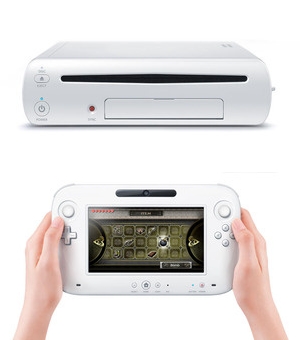
And look at that middle sentence in the quote from Iwata – Nintendo knows they would make profits on games released for iphone. Apparently Itawa thinks that development for iphone would only boost short-term profits though, and not mid and long term strengths. This is ridiculous in my mind – maybe 3DS sales would be hurt if every game was released concurrently with an iphone version (ok, they would definitely be hurt if that happened), but sales of games on the rest of Nintendo’s hardware would only be helped. The Wii U is coming out next year, and being the only major hardware company with a huge first-party game development team that cranks out instant classics is a huge strength compared to the other hardware makers, but maximizing that strength depends on Nintendo getting into the iphone market now.

Here’s what I envision being the best case for Nintendo – 3DS sales are mediocre (yep, that’s the best case), and resources shift to Wii U at and around launch. Nintendo takes advantage of their in-house development strengths by releasing games for the Wii U concurrently with iphone games that extend the experience to mobile and impact the console versions, a direction many console developers are already moving in. Nintendo, because of the strengths Iwata notes, is uniquely positioned to take advantage of a market where a console game and a mobile game interact – they have the developer prowess and some of the best IP (Mario, Starfox, Kirby, Zelda, etc.) on the planet to make it happen. The Wii U already has a damn ipad/iphone for a controller – let your hardware geniuses figure out how to match the controller up to interact with the user similarly to how an iphone interacts with the user, and then release mini-games for the iphone that report back to the game (maybe even grab a hot patent on that, while they are at it! Or pay Intellectual Ventures if they already have one…).

Let me put it another way: If you were Nintendo’s President and Apple came to you and said “we really want to release a phone that looks exactly like your console’s controller – we are going to manufacture it, get the wireless providers onboard, sell it in our stores, and foster a huge game development community for it, and all we want from you is to put some of your mini-games on it for our millions of customers to buy, are you in?”, would you say no? So far Nintendo has said no. Because they want to support their own in-house hardware team, and don’t want to give up on mobile. Seems like a huge missed opportunity.

There’s some larger context here in terms of Sega’s transformation into a third-party developer, and Nintendo not wanting to go that route (being the only purely-gaming company left to make hardware). And I LOVE Nintendo, but they need to unchain their game development from their hardware development if they are going to make it past this next console cycle. If they don’t, I predict the Wii U to be the last console release for the company. I’ll be glad to eat those words if I’m wrong, because I’ve been waiting for the next Smash Bros for years.

Leave a comment

Filed under Games, Social Games

Walmart makes lemonade in class action settlement, Twitter reveals user numbers, Patent reform to pass today

Random news from the day/week:

Walmart manages to settle a suit in a highly creative way that really hurts Netflix, if it goes through

Summary – Walmart is sued in a class action along with Netflix, with the suit claiming that the two conspired to split up the DVD market into retail and rental spaces. Maybe the settlement proposal would be good evidence in court that that ISN’T what Walmart had in mind – Walmart just acquired Vudu, a competitor to Netflix, and Walmart has recently proposed a settlement where Netflix customers will receive gift certificates for $40 at Walmart. Netflix has pointed out that this will incentivize people to switch to Walmart’s own streaming video service, using Netflix’s channels to market directly to the people most interested in streaming video! I don’t know a lot about the specific law behind class action settlements, but this would be a pretty amazing turn of events for Walmart if the settlement is approved early next year.

Twitter revealed their numbers today, strong user numbers, but is it really that impressive?

Numbers for Twitter: 100M monthly active users, 50M daily active users, 400M unique visitors per month. Some pretty crazy designer numbers too, such as every NFL team is on Twitter, 75% of NBA players, and 87% of the Billboard Top 100 artists. The bad news? 40% of those active users don’t tweet. Last I heard, this activity was generating roughly $150M in revenue for the year.

First off, I love Twitter and I defend it’s merits in the face of criticism all the time. But just for fun, look at CityVille’s stats. Zynga makes $600 million in revenue from Cityville, Empires & Allies, Texas Hold ’em and Farmville, which have a combined 186M monthly active users and 34M daily active users (Zynga actually makes $600M from all their games, but those 4 are the biggest). I’m not saying Zynga is analogous to Twitter – But Facebook gets 30% of Zynga’s revenue (haven’t checked the S-1 to see if that 600M is before or after Facebook takes the cut, but I imagine it’s after). These are definitely some back-of-the-napkin figures I’m spewing out, but even a conservative estimate would have Facebook collecting more just for hosting Zynga games than what Twitter makes on ads in a year.

I’ll admit that’s a little unfair and comparing Twitter to Facebook and Zynga is harsh – Facebook is a fully developed platform and the most popular social network in the country, Zynga a one-of-a-kind game company – but Twitter is probably approaching the climax of it’s growth and it can’t make more in revenue than Facebook gets from a social game company. It also has a ton of users that aren’t really active. Like I said, I love Twitter, it’s much more interesting to me than Facebook, but the monetization is lagging.

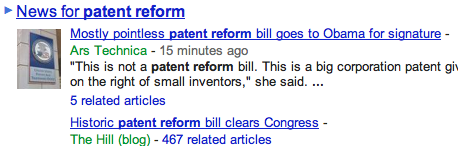
Patent “reform” passes today

A much-lauded and much-criticized (see conflicting reports in picture above) patent bill has passed Congress today, signaling the first significant shift in patent law in decades. Some say it does nothing, some might make comments about rearranging deck chairs on the Titanic, and both are right. The biggest change is the switch to a first-to-file from a first-to-invent system, which, while theoretically significant, probably won’t impact any of the major problems in patent law that industry criticizers frequently note. The next biggest changes are some dramatic adjustments in the way the USPTO can charge fees, opening the office up to raise a significantly larger amount of money by charging more. This might turn out to be the biggest practical change – an “activist” USPTO might consider raising fees for certain activities to discourage abuse. But one need not even pray that the USPTO turns activist to be optimistic that this change will trickle-down to improve other aspects of patent law – simply raising enough money to hire some more patent examiners might be enough to see an increase in the rate of rejected applications. There will be a deluge of articles in the next week detailing how much or how little this reform will change patent law, but until we see how the USPTO decides to utilize the fees they collect, we can’t really know.

1 Comment

Filed under Games, Law, Social Games

Diablo 3’s DRM : why I don’t like it

Blizzard announced last week that Diablo III will come with DRM that prevents players from playing the game unless they are online. Presumably this is an anti-pirating measure – being online will allow Blizzard to check your CD-Key against a database of CD-Keys, and thus prevent multiple people from using the same CD-Key simultaneously. But DRM is a terrible idea – As Sony found out this Spring, restricting what your consumer can do with a product they purchase can have tremendous consequences for a company. Blizzard is obviously unlikely to be attacked as viciously as Sony was, but the business and legal ramifications of bad DRM can be far-reaching even in the field of computer software where DRM is relatively common. EA saw a hard backlash against DRM in the game Spore a couple of years ago, with players harshly rating the game on Amazon to express their displeasure.

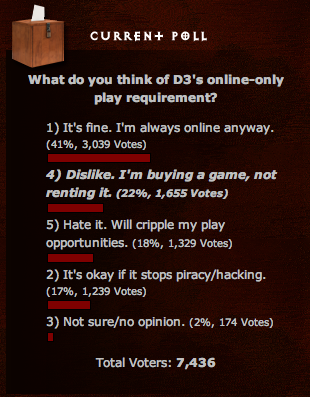
But back to Diablo III: Everybody who is looking forward to the game knows about this DRM by now – it’s garnered a tremendous amount of attention on websites of all varieties. A Diablo fan site recently conducted a poll, with the following results:

Obviously these aren’t the most scientific poll response choices, and the political science major/statistics guy in me is cringing at the double-barreled options on there (I hate the DRM but it definitely isn’t going to cripple my play opportunities), but clearly a lot of people don’t like the DRM. 40% either dislike or hate it.

Besides being interested in games, there is a legal component to this – when you buy Diablo III, you’ll be buying it under a lease agreement subject to a terms of use, which is how companies like Blizzard control and restrict the activity of a player. Doing this with software is nothing new, but let’s be honest – nobody reads those terms of use when they install a video game. Players have been clicking through those terms without thinking about the property rights (understandable, really) for years. Players simply assume that they purchased a game, that they are free to resell it, that they own it currently, and they can do what they want with it (except for a few things that will get them banned online, but that doesn’t usually enter the mind of a player as a limitation on a property right). As the phrasing of the “dislike” option in the results above shows, consumers really do think they “own” the games they purchase free from obvious limitations on things like copyright.

When a company like Blizzard makes a move like putting an online-only DRM onto a major release, it pushes the fact that the player doesn’t own the game into the player’s face. I’d argue that this isn’t a good thing for game developers – for better or for worse, players believe they own the games they purchase, even if that belief is somewhat incorrect. When that belief is disrupted by new, invasive DRM, players tend to get upset and generally pessimistic about the intent of the companies, who players view as punishing their paying customers.

I’m generally against putting DRM in a game for a few reasons:

For one, it isn’t a low cost for a developer.

Putting in traditional DRM like a CD-Key is cheap, but it also is incredibly easy to break, because hackers have had years of experience cracking existing DRM. For DRM to really work with computer software, a company needs to make something relatively customized, which usually involves hiring a security company. This isn’t going to be cheap, and the consumer gets to pay for that cost a lot of the time, though often indirectly through a diversion of resources away from making the game higher quality.

Second, it never works and doesn’t make financial sense.

I don’t have the stats to back that one up, but DRM doesn’t work. There’s something of an economic reason for it, so that will have to suffice for lack of empirical evidence. Think of the PC game economy as having 4 actors – there is the game developer, the paying user (“user”), the non-paying user (“pirate”), and the hacker. Putting DRM on a game has a cost – the initial payment is made by the game developer, but the cost is ultimately passed on to the paying user in the form of a lower quality game for the same price (since the developer diverted some resources away from making a higher quality game to put towards the development and testing of the DRM). The pirate bears none of the cost, because they aren’t paying anyway, and the hacker (who might also be a paying customer, a pirate, or even a developer in rare cases) is presumably motived by the desire to crack the game. This is actually a somewhat interesting point that I think is overlooked – hackers are naturally attracted to new challenges, and DRM is one place where an amateur hacker’s natural propensity for computers and likely shared affinity for games played on them leads to a cracking race. PC games are often cracked by the hacker community in less than a week, and major releases with new DRM tend to excite that community more than the simple CD-key crack, because new DRM brings some level of prestige to the first hacker to crack it. I can guarantee you that not only will Diablo III be cracked in a week after release, but it will be widely reported news because of Blizzard’s approach thus far. So hackers actually see new DRM as something of a gain, pirates are unaffected, and paying customers lose, while the developer is spending the same to put out an inferior product, which will likely sell worse. All the costs of DRM are born by the people already paying to play, and there’s mostly only an incentive on the side of the nonpaying pirates and hackers. The financial logic just isn’t there.

Third, it generates bad press, and burdens the paying customer more than any other party.

As the poll above and hundreds of other articles on the topic show, Blizzard has already paid a price for publicizing the DRM they are throwing on Diablo III. Will it hurt sales? Maybe not – it’s a multiplayer game that 90% of people want to play online anyway. But they basically just killed all of their single-player only sales, and limited the ability of some to enjoy the game entirely. I plan on buying the game, and now I’ll have a slight chip on my shoulder for having my play limited by Blizzard’s desire to cut back on activity that I don’t even engage in (though I’ll admit to having hacked Diablo II a vast number of times back in high school). If Blizzard wasn’t making a game that I’ve been waiting for for almost a decade, I’d actually consider avoiding the game. I’m sure less interested fans will be turned off completely.

Leave a comment

Filed under Copyright, Games

Protected: Vostu responds to Zynga’s copyright suit, some serious implications for social games and copyright are in play

This content is password-protected. To view it, please enter the password below.

Enter your password to view comments.

Filed under Copyright, Games, Law, Social Games

The used game market problem – Capcom tries what will inevitably be an unpopular solution

We are definitely in the midst of a shifting market in terms of video game pricing. Video game publishers are increasingly searching for ways to beat the used game market, where companies like Gamestop make over $600 million a year by buying newish games from consumers and reselling them to others. The activity is completely legal (the first sale doctrine of copyright allows you to sell a copyrighted work after you buy it), but game developers would love to get a piece of that $600 million; Gamestop is currently making their money by living in the pricing problem publishers have yet to solve, namely that publishers don’t want to drop the price of the game at release, but by the time the first price drop comes around, many who didn’t want the game at $60 have already bought the game on the used market for the price drop price.

Publishers have tried to deal with the problem in a number of ways:

Sell a license to the game – Software can be licensed rather than sold, alienating the consumer from the ability to resell it. Computer games have started to go that way, and combined with things like multiplayer accounts and CD keys, have largely reduced the amount of piracy, or at least reduced the amount of fun you can have with a pirated copy (But look up “Spore” for a cautionary tale). But reselling PC games has never been a huge industry partially for those reasons, and video games haven’t made the jump to a licensing approach, perhaps out of fear of shifting to something too dramatic. The first console game that comes out claiming to deny the consumer the ability to resell it will face a tremendous backlash from consumers, and it isn’t even clear how such a plan would work – no publisher wants to go around suing the consumer as a means to enforce the license, and suing Gamestop is just as unappealing (they might just drop your games from shelves entirely). But I wouldn’t put it past an aggressive publisher to try it. Chance this approach becomes popular with consoles: 20%

Extend the duration of time that the game has value to the first purchaser  – This has definitely become more popular, especially since it can make the developer money. Mass Effect 2 released a number of $10 expansion packs almost immediately after the game was released, in the hopes of convincing release price purchasers to hold on to the disc for a few more weeks. The Halo and Call of Duty series do the same with map packs, and really most major releases try to adopt some version of this approach now as a way of both milking the game for more revenue, and as a means of holding off a wave of discs from hitting the used market. Chance this approach becomes popular: 100%

Cut the price almost immediately – Portal 2 was possibly the first game to utilize such a dramatic version of this strategy – just a couple weeks after the game released, Valve slashed the price of Portal 2 almost in half. It’s not clear how much of this was motivated by slow sales, or possibly because of the PSN downtime that coincided with the game’s release, but I imagine it was driven at least in part by a desire to shunt the used market, which would have been especially hot for a game that was fully beatable in about 15 hours. The downside is, if every game you release takes this approach, you effectively just shift a large portion of your audience to that lower price point, because most people will wait a week to get $20 off (that is, after all, why the used game market exists in the first place). Chance this approach becomes popular: 5%

Ruin the experience for anybody trying to replay the game – This is a new strategy being used by Capcom in Resident Evil: The Mercenaries for 3DS. The game comes with a special feature, where saved data cannot be erased. While it will probably take the game’s release to discover what this actually means, it seems as if Capcom is limiting consumers to one playthrough of the game in “new” condition, and every subsequent playthrough will be tainted in some fashion by that original game – perhaps your character will stay overpowered, or will have access to amazing guns from the start, or other usual powerups received after beating a game for the first time. So if you try to sell the game to gamestop, the game will always retain these advantages, making a used copy rather unappealing to a new consumer. I expect the backlash on this to be pretty massive, and ruin any sales this (likely already bad) game would have had. Chance this approach becomes popular: 5%

Digital distribution – Steam’s success on the PC/MAC, combined with Blizzard’s success in releasing Starcraft II from their own site and the profitability of Xbox Live titles will likely lead some developers to consider full digital releases over Xbox Live and PSN in the future. Currently the hardware has some issues, namely that the consoles don’t have big enough hard drives to support holding many titles, but look for that to change in the next console cycle. Digital distribution is potentially extremely profitable simply for the ability to cut out the middle man, plus the game is impossible to resell in the that format. It also allows specific pricing control, with the developer able to lower the price whenever they want, perhaps even based on sales through the digital marketplace. Digital distribution has taken over on the computer, and it will be the future of consoles once the hardware can support large libraries of downloaded games. Chance this approach becomes popular: 80%

In the short term, expect most companies to follow the approach of releasing new content almost concurrently with the game’s release in an effort to prevent games from hitting the secondary market before the first price drop, perhaps mixed with some slightly earlier price drops, as a manner of taking some of the secondary market’s pie. In the long run, I expect most will move to digital distribution once the consoles themselves can support it. And look for a post on how poorly Capcom’s strategy will work in the near future.

1 Comment

Filed under Copyright, Games