Category Archives: Copyright

Sensationalist reporting of legal battles by Techcrunch continues with Oracle/Google

Google has been embroiled in a legal battle with Oracle for some time now, and the jury in the case is slowly releasing their verdicts on multiple issues. I haven’t written on it much here, because it’s being covered extensively by far more intelligent people elsewhere. The basics of the case are that Oracle has claimed that Google infringes on Oracle’s copyright in their Java APIs (37 API packages, specifically), as well as infringing on patents related to the same.

Though the story has been reported on quite extensively, the twitters and techmemes were abuzz yesterday when the jury in the case released their first verdict. The verdict? Well, they didn’t really reach one. The jury was instructed to assume the copyrightability of the Java APIs, and to come to a conclusion on whether Google’s use of the APIs was “fair use”. The jury instruction all but ensured that the jury would decide that Google infringed the API copyrights – the real issue in the case really ought to have been whether the APIs were indeed covered by copyright, but the judge has saved that determination for himself. The jury came back Monday with the statement of “we don’t know” on the issue of fair use.

How is that news being reported? This is Techcrunch’s Headline:

The Verdict Is In: Google Infringed On Oracle Copyrights

Correct, but completely misleading. Anybody following this story knew that the jury was going to find infringement (see here for one example), and anybody following the story also knew that the real issue was whether the jury would find the infringement to be fair use, and whether the court would find the APIs to be copyrightable. Techcrunch’s article is written as if the case is over. It’s not just Techcrunch – Wired is reporting today that “if” APIs are copyrightable (note: many legal pundits say that they are, and have been for a long time), then apparently the world will explode. The lead picture for the article is an atomic bomb. An atomic bomb? Really?

This isn’t the first instance of overzealous tech journalism, far from it, but Techcrunch’s (and other outlets’) coverage of major legal battles has sunk into the realm of tabloid sensationalism. Techcrunch recently reported on the Facebook v Yahoo patent fight by analyzing the patent abstracts, rather than the actual claims, to come to the ridiculous conclusion that “Facebook has the upper hand”. This is, obviously, months before any actual claim construction or significant developments in the case.

These are really important issues for the tech community to understand, but sensationalism and poor analysis only confuse the issues for readers. If Techcrunch wants to help educate on these issues, the least they could do is have a reputable source write a guest post.

Leave a comment

Filed under Copyright, Law

Copyright in social games drama as Nimblebit takes to Twitter to vilify Zynga

Copyright in social games is one of my favorite hot IP issues – back in the day, people sued Zynga for copying their games (though, admittedly and perhaps tellingly, not for copyright infringement). Then, Zynga sued other people for copying Zynga’s games, and those people defended themselves by saying that they both copied the games from somebody else. Now, eschewing the legal system, a small developer is taking to the streets (ie Twitter) to spread the word that Zynga is copying their game, Tiny Tower. Zynga has good reason to copy Tiny Tower, as the game was named iPhone game of the year by Apple. But the copying is pretty blatant, as can be seen by some side-by-sides created by the Tiny Tower developer (Nimblebit).

The whole thing is great theater and it inspired a field day on Reddit, but what does it mean? Would Zynga be liable for infringement if Nimblebit chose to sue? (Note to all small game developers reading at home: Don’t warn an infringer like this if you want the option to sue, ever. /end lawyerish). I wrote pretty extensively about the gray area in copyright in social games back when Zynga sued Vostu, because the issues are in some respects totally unique. For one, while any single game is clearly eligible for copyright protection, it’s not clear how far that extends in the context of a game – straight copy and paste of the art from one game would clearly be infringement, but what if you just have your own artists and engineers reproduce the basic elements of the game, the UI/UX, and the mechanics? Now you are moving from the realm of copyrightable creative content to uncopyrightable genres and ideas, which games in general have been building on for years. As Vostu noted in their defense, the big games on Facebook are largely paying homage (to put it nicely) to a PC or Game Boy game (remember when game boy was “mobile games”?). Secondly, copyright law has been seldom deemed to protect the menus and interfaces of computer software, but that’s largely what most of the copying allegations in the social game space point to as evidence of copying. To really get into some common copyright terminology, it is often stated that copyright protects the “expression” and not the “idea” – in this context, both genres and user interfaces fall more on the “idea” side.

An excerpt from Nimblebit's anti-Zynga screed

Anyway, the short answer to the Nimblebit lawsuit hypo is that they probably wouldn’t win, but I’d love to see the issue of copyright in social games tested more thoroughly in court. There’s two dimensions to the issue as I see it, one non legal and one legal:

Does game copying hurt consumers? 

The issue of copyrightability as between two game developers never came up often in the context of console games, the basis for what we have in terms of precedent, because the production and distribution cycles made it practically difficult to see a successful game and push out an identical competitor before it was too late to capitalize on the popularity of the original. Now, game production cycles on web and mobile are so fast and iterating happens so quickly that games are experiencing duplication as a threat like never before. Companies like Nimblebit can spend a ton of time and money creating a game that another company (ahem) can copy in a matter of days. Full disclosure: I really like Zynga and I’m sitting on the couch of a friend who works for Zynga as I write this. But Zynga isn’t the bad guy here regardless – it really isn’t clear where the line is between paying homage to a game and infringing the game’s copyright. Zynga adds a lot of value to a game beyond the graphics and game mechanics in the form of an extensive network of users and a level of polish that only a public company can provide. To put it another way, no matter how many different Scrabble clones there might be out there, the free market is inevitably going to settle on one as the network effects push users to the game where there friends are, until everybody is playing Words With Friends. Users aren’t necessarily hurt by the copycat culture in social games, because network effects will push people to one platform anyway, and the art isn’t usually what’s drawing people to the game in the first place.

Is the copying we are seeing now a violation of copyright law?

Maybe, maybe not. Okay, probably not. It’s a weird issue, because to say there is no copyright in social games, or more specifically that copyright only protects against exact replication of graphic assets, is to say that social games have really no effective IP protection at all beyond unauthorized reproduction. To say that copyright protects more, however, would be to extend copyright protection to the area of a genre, something more akin to an idea than an expression of an idea. It would also be a complete disaster for the game industry in many respects if a court ruling gave more than cursory copyright protection to game developers over entire genres, as there has been an implicit understanding that genres aren’t copyrightable since the the first Wolfenstein clone. But as computers become more and more a part of our lives, and as games on those computers become more and more valuable, is the network effects + limited consumer harm enough of a rationale to support an environment where Zynga should inevitably push out every competitor through copying as soon as that competitor hits on a strong genre? (I hate ending a long post with this, but it’s true in this circumstance) – only time will tell. For the most part the big companies aren’t going to push the issue because the stakes are too high and the companies are doing fine in the current environment.

Update: Of course, just a few hours after writing this, Spry Fox sued 6waves lolapps over the cloning of their popular new game, Triple Town. I’ll read the complaint and write more if it gets interesting, though with Spry Fox being a rather young company, I’d be surprised if they rejected any reasonable settlement offer to pursue litigation.

Leave a comment

Filed under Copyright, Games, Law, Social Games

MegaUpload, SOPA, and the DOJ

Forgive me focussing on SOPA and the DOJ seizures so obsessively on this blog, but I truly believe we are at a turning point in the history of the internet, and it would be a shame to not write about it. Here’s the background for this article:

  • The DOJ has shown a desire to become more active in the domain seizure game (see my last post on the topic)
  • SOPA rallied the internet to mass protest earlier this week (Google & Wikipedia gaining most of the attention with their blackouts, Wikipedia’s which actually limited use of the site), and the bill is probably dead in it’s current form
  • and the big one, the day after the SOPA protest, the FBI / DOJ seizes MegaUpload (a popular file locker/sharing site) and has the owners arrested

We are about to see fully what MegaUpload’s use trends really look like, and so far all we have is an overloaded justice department indictment that is currently inaccessible due to server demand (or Anonymous attack, who knows…). What bothers me: How is MegaUpload different from YouTube, which it seems clear is legally operating under the DMCA safe harbor provisions? If MegaUpload’s service was violating the DMCA, which is the law on copyright infringement on the internet, why were the owners instead brought up on charges under the criminal provisions of Title 17, Chapter 5?

My worry is that with SOPA seemingly dead, where SOPA would have given private companies a right to move against sites with infringing content, the government is quickly moving to fill the void of regulations that SOPA was hoping to close. This is just ridiculous timing – the DOJ looks like they have already determined that SOPA was a proper piece of legislation, and they are endorsing stronger enforcement of copyright over the will of the country, before Congress even votes on the bill. Congress probably won’t vote on SOPA after the recent protests, making the DOJ’s action seem like a unilateral decision to enforce the notion behind the bill anyway. Again, we don’t seem to need SOPA if the DOJ can seize the property and arrest the owners of a content hosting site like they’ve done here.

The case against the MegaUpload owners itself seems weak, and begs an obvious question – if MegaUpload is indeed covered by the DMCA safe harbor, but a court finds them guilty of criminal copyright infringement, where does that leave the DMCA as an effective shield for legitimate service providers?

Leave a comment

Filed under Copyright, Law

If the DOJ can already seize “rogue” websites, what does SOPA add besides liability for bystanders?

The Stop Online Piracy Act (SOPA) is generating quite a lot of mainstream press lately, now that plenty of large companies and interest groups are starting to come out against it. For the uninitiated, SOPA (and it’s somewhat related cousin bill, Protect IP) sought to provide better enforcement mechanisms against “rogue” copyright infringement websites. In theory, it isn’t the worst idea – as a relatively poor twenty-something, I’m well aware of how many sites there are that exist solely for the purpose of hosting infringing content. The most recent prior law on copyright and the internet, the Digital Millenium Copyright Act (DMCA), provided effective enforcement against truly infringing, major, US-based websites, but it stopped short of sites like YouTube (which I’m fine with) and did nothing for content creators in regards to foreign websites. The problem presented by “rogue” websites is well stated by Terry Hart, author of the pro-copyright leaning blog ‘CopyHype’, here, and the general consensus of the rest of the internet by Mike Masnick, the standardbearer of the more liberal copyright movement, here.

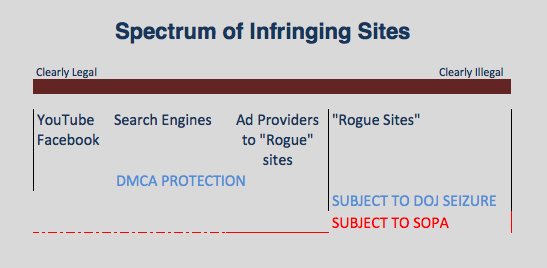
The real problem with SOPA, as far as I see it, is that it doesn’t solve a real problem. On the spectrum of infringing sites, you have sites which generate infringing content as a result of random user activity clearly protected by the DMCA, you have “rogue” sites on the other end that exploit other copyrights illegally for fun and profit, and then you have sites in the middle that profit indirectly from both sorts of sites, such as search engines and ad providers. Have a look at this handy, rather ugly chart I just whipped up:

Basically, the arguments in support of the SOPA have centered on lackluster enforcement tools for content creators against the rogue sites that sit on the right side of the spectrum. This argument would make sense, except for the fact that the DOJ has made it clear that they will seize the domains of these sorts of sites pretty frequently. Today, the DOJ for the second year in a row seized domain names leading up to Cyber Monday (the name for the Monday following Thanksgiving, a big day in online sales). Last year the DOJ generated quite the controversy when they initiated this practice, with many decrying the lack of due process shown by an agency purportedly out to protect justice. It was those seizures that inspired the SOPA and Protect IP acts to some extent, as at least one of the domain seizures generated a lawsuit questioning the authority of the DOJ to take such actions without a court order. SOPA would presumably make it clear that the DOJ has such authority.

But with the DOJ facing just one lawsuit as a result of the 82 seizures last year, and with the DOJ taking down another 130 domains today, it’s becoming clear that the DOJ is going to keep doing this until a court specifically tells them it can’t. Practically, though, if the DOJ takes down only “rogue” sites, who is going to sue them?  What’s more, it’s clear from the list of seized domains that private companies are having a say in what the DOJ goes after already – more than half of the domains seized sell professional sports jerseys, with a small contingent of sites selling name brand clothing and apparel and infringing DVDs. If this is a sign that the DOJ is feeling comfortable with the legal standing of their takedowns, I’d expect more private companies to start dumping lists of “rogue” sites with the DOJ pretty soon, and more takedowns to follow. (I will admit that the list reflects a heavy dose of sites that infringe trademark, rather than copyright, and a skeptic might wonder if the DOJ is worrying that sites they took down last year were protected by the DMCA).

The DOJ’s willingness to seize domains begs the question – why do we need SOPA anymore? The main target of SOPA is the “rogue” sites that the DOJ took down last year, but clearly the DOJ is feeling like they have the authority to take down those sites even without SOPA. If that’s the case, SOPA really only extends potential enforcement power as against sites which are currently protected by the DMCA, like sites that benefit indirectly from infringement through ads, be it the search engines that lead users to those sites or the ad networks that serve ads to those sites. These sites, though, are clearly not at the root of the problem, and if the DOJ continues the domain seizure practice then the amount of money these sites generate from infringement as opposed to legitimate content (already a small percentage) will further shrink. Adding liability to sites like search engines and ad networks will do nothing to stop copyright infringement on a large scale, and it just adds headache for legitimate businesses. But if the DOJ can already seize the domains of rogue sites, adding liability and headache to legitimate business is all SOPA is likely to do.

1 Comment

Filed under Copyright, Law

Breaking my hiatus with a flurry of random thoughts

After a long hiatus for some personal reasons, I’m back! But, this means I have a store of ideas that I didn’t write about. Some of those ideas are now no longer worth covering because they’ve been beaten to death by other sites, but the ones that are still interesting I’m just gonna run through right now to get it out of my system, no rhyme or reason, and little theme besides being among the topics I frequently write about. Let’s get going:

Arkham City is great, but the initial user experience is flawed, and the game outlines a problem with comics-as-broad release media

Loved Arkham City. Played a LOT of it last weekend, probably only possible because my girlfriend is out of the country at the moment. Arkham City launched with a pretty bold, but increasingly common plan to increase sales and profits. Sales, by offering a ton of extra content for new game purchasers (as opposed to used game purchasers), and profits, by having a ton of extra downloadable content to squeeze a few extra bucks out of hardcore fans. It’s hard to fault Rocksteady, the studio behind the game (or any of the other members of the supply chain), for this approach – the used game market is a constant concern for studios, especially during a recession, and providing lots of bonus content both incentivizes new game purchases (by including the content for free with new games), and giving the studio a way to make money on the used games (through the customers then paying for downloadable content). I’ve ranted about terrible DRM as a system that only punishes good customers on my blog before, so I should be in favor of this setup, right?

The problem is, the customer is still the loser here. I bought the game (in fact, I pre-ordered it!), and my reward was that the first time I sat to play the game, I had to enter 3 separate 16 digit codes into the Playstation Network, wait for each of those 3 packages of content to download, and then wait for each of those packages to install. So I spent 15-20 minutes downloading and installing the content I paid for before I even got to fire up the game. Loading screens are obviously a problem for any game with downloadable content, and installation is unavoidable in some situations (PC games in particular) – but having your big blockbuster piece of work open with 20 minutes of downloading and installing is not exactly a killer introduction to the product. Is it better than a lot of DRM? Definitely, because at least it rewards the honest customer with more content rather than punishing them with potentially invasive bloatware. But it’s still a pain, and there must be a better way.

In another unrelated complaint, of the many reviews for Arkham City I saw this week, only one (Kotaku) mentioned a major gripe I had with the game – it doesn’t really push the Batman plot anywhere. This is a problem with any comic-based mainstream story at this point, in that the non-comic media is often limited to stories drawn from the official “canon” of the lore as told in the comics. Put another way, Batman can’t die unless he dies in the comic. Obviously nobody is going to kill Batman anyway, but this mostly holds true for every plot element – none of the villains can die unless they die in the comics. So they are stuck rehashing events that comic fans would already know, and they can’t deviate far from the story as outlined in the comics. This has basically been an issue for every single superhero movie in the recent wave of superhero movies, and while it hasn’t hurt box office numbers much, it might in the future as the limitation plays out over sequels. I’d love to see more companies take the JJ Abrams/Star Trek approach with their IP, giving full reign to a new retelling of an old story keeping just the characters and breaking canon.

Seed stage funding bubble, part II of my post on regulating securities of private companies rumored to come soon

Basically everybody reported on a WSJ article that claimed there was a dearth of funding out there for seed stage companies. It was vigorously responded to, mostly by people refuting the sentiment. My opinion is that while the data the WSJ looked at seems to match historical, quarterly variations in funding statistics, it still seems obvious that new technology has been making it easier to invest, while not making it quite as easy to gain liquidity and get out. Assuming there is a class of people who only want to invest in the seed stage (the angels), then those people have had an easy time of late finding companies to invest in, without finding an easy way to get liquidity from even successful early investments. Angel.co has made finding companies to invest in quite easy, but the time it takes to get money out of those investments hasn’t been quickened in any respect (in fact, given the many delayed IPOs and general malaise of the economy, it’s probably harder than it has been in the past). SecondMarket is definitely doing something to help liquidity for pre-IPO company stock, but it is probably being utilized by employees more than investors, and it’s still a relatively small group of companies compared to the number of companies on Angel.co. So, to me, it seems quite natural that there would be a slowdown in seed funding, and that companies who found plenty of seed investors would have trouble finding Series A and B money. Tech is also prone to bubbles, but that’s for my future, upcoming post on private company regulation.

Tale of two major branding efforts of social games, with very different results

Probably the two most anticipated social game releases on Facebook this year were by traditional console/PC powerhouses new to the Facebook platform. I’m talking about EA’s Sims Social, and Firaxis’s CivWorld. Both were closely watched, as they both were backed by major studios, utilizing the full force of their IP, hoping to break into the Facebook social game scene. Obviously there is a major difference between the studios in that Electronic Arts has 45 titles on Facebook right now, and they’ve spent hundreds of millions of dollars on acquisition like Popcap and Playfish to become a force in the social game market, whereas Firaxis has just the one title, CivWorld, and no experience on Facebook (parent company Take-Two also has no titles on the platform). Both games have been out for a while now (CivWorld in July, Sims Social in August), so it’s safe to make some conclusions about how the efforts went.

Who won? Sims Social by a landslide. Sims Social reached an all-time high of 65 million monthly users (though they took a 20 million hit when Facebook updated their user calculation algorithm), and they are currently cruising along with about 8 million daily users. CivWorld, on the other hand, completely crashed. The all-time high for CivWorld was only half a million monthly users, and they’ve since slid quickly to less than 100,000 monthly users and only 10,000 daily users. I haven’t played either game enough to know if there was some sort of specific disaster with CivWorld, but I played both and they were both solid efforts. Reviews were mixed for both (nobody knows how to review a social game yet, though), but obviously the results were dramatically different.

There are probably numerous takeaways here, but the big one is that having a strong IP, with lots of buzz, and even a strong game itself, isn’t enough on Facebook. The Firaxis team just simply doesn’t have the experience that the EA team has, and obviously those Playfish and Popcap acquisitions are paying off in some fashion. EA knows how to make social games now, and Firaxis doesn’t. Lots of factors go into that – the ability to effectively cross-promote with other games in the network is obviously a huge advantage for EA, but one would have thought that the amount of exposure CivWorld was getting could have made up for that. Now we know that no amount of exposure can make up for a huge installed user base and multiple games to draw experience from. Zynga has probably known that for years, but if there was any question, CivWorld’s flop may have settled it. People may look at EA’s success as a sign of weakness for Zynga, but that’s overlooking the fact that EA spent over a billion dollars to acquire two huge social game studios to reach a point where it could leverage it’s IP into fans on the platform. A billion dollar barrier to entry is pretty solid protection for Zynga’s business model.

Leave a comment

Filed under Copyright, Funding, Games, Social Games

Diablo 3’s DRM : why I don’t like it

Blizzard announced last week that Diablo III will come with DRM that prevents players from playing the game unless they are online. Presumably this is an anti-pirating measure – being online will allow Blizzard to check your CD-Key against a database of CD-Keys, and thus prevent multiple people from using the same CD-Key simultaneously. But DRM is a terrible idea – As Sony found out this Spring, restricting what your consumer can do with a product they purchase can have tremendous consequences for a company. Blizzard is obviously unlikely to be attacked as viciously as Sony was, but the business and legal ramifications of bad DRM can be far-reaching even in the field of computer software where DRM is relatively common. EA saw a hard backlash against DRM in the game Spore a couple of years ago, with players harshly rating the game on Amazon to express their displeasure.

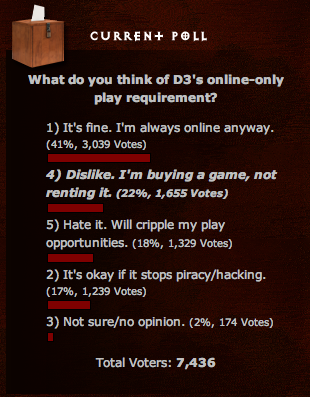
But back to Diablo III: Everybody who is looking forward to the game knows about this DRM by now – it’s garnered a tremendous amount of attention on websites of all varieties. A Diablo fan site recently conducted a poll, with the following results:

Obviously these aren’t the most scientific poll response choices, and the political science major/statistics guy in me is cringing at the double-barreled options on there (I hate the DRM but it definitely isn’t going to cripple my play opportunities), but clearly a lot of people don’t like the DRM. 40% either dislike or hate it.

Besides being interested in games, there is a legal component to this – when you buy Diablo III, you’ll be buying it under a lease agreement subject to a terms of use, which is how companies like Blizzard control and restrict the activity of a player. Doing this with software is nothing new, but let’s be honest – nobody reads those terms of use when they install a video game. Players have been clicking through those terms without thinking about the property rights (understandable, really) for years. Players simply assume that they purchased a game, that they are free to resell it, that they own it currently, and they can do what they want with it (except for a few things that will get them banned online, but that doesn’t usually enter the mind of a player as a limitation on a property right). As the phrasing of the “dislike” option in the results above shows, consumers really do think they “own” the games they purchase free from obvious limitations on things like copyright.

When a company like Blizzard makes a move like putting an online-only DRM onto a major release, it pushes the fact that the player doesn’t own the game into the player’s face. I’d argue that this isn’t a good thing for game developers – for better or for worse, players believe they own the games they purchase, even if that belief is somewhat incorrect. When that belief is disrupted by new, invasive DRM, players tend to get upset and generally pessimistic about the intent of the companies, who players view as punishing their paying customers.

I’m generally against putting DRM in a game for a few reasons:

For one, it isn’t a low cost for a developer.

Putting in traditional DRM like a CD-Key is cheap, but it also is incredibly easy to break, because hackers have had years of experience cracking existing DRM. For DRM to really work with computer software, a company needs to make something relatively customized, which usually involves hiring a security company. This isn’t going to be cheap, and the consumer gets to pay for that cost a lot of the time, though often indirectly through a diversion of resources away from making the game higher quality.

Second, it never works and doesn’t make financial sense.

I don’t have the stats to back that one up, but DRM doesn’t work. There’s something of an economic reason for it, so that will have to suffice for lack of empirical evidence. Think of the PC game economy as having 4 actors – there is the game developer, the paying user (“user”), the non-paying user (“pirate”), and the hacker. Putting DRM on a game has a cost – the initial payment is made by the game developer, but the cost is ultimately passed on to the paying user in the form of a lower quality game for the same price (since the developer diverted some resources away from making a higher quality game to put towards the development and testing of the DRM). The pirate bears none of the cost, because they aren’t paying anyway, and the hacker (who might also be a paying customer, a pirate, or even a developer in rare cases) is presumably motived by the desire to crack the game. This is actually a somewhat interesting point that I think is overlooked – hackers are naturally attracted to new challenges, and DRM is one place where an amateur hacker’s natural propensity for computers and likely shared affinity for games played on them leads to a cracking race. PC games are often cracked by the hacker community in less than a week, and major releases with new DRM tend to excite that community more than the simple CD-key crack, because new DRM brings some level of prestige to the first hacker to crack it. I can guarantee you that not only will Diablo III be cracked in a week after release, but it will be widely reported news because of Blizzard’s approach thus far. So hackers actually see new DRM as something of a gain, pirates are unaffected, and paying customers lose, while the developer is spending the same to put out an inferior product, which will likely sell worse. All the costs of DRM are born by the people already paying to play, and there’s mostly only an incentive on the side of the nonpaying pirates and hackers. The financial logic just isn’t there.

Third, it generates bad press, and burdens the paying customer more than any other party.

As the poll above and hundreds of other articles on the topic show, Blizzard has already paid a price for publicizing the DRM they are throwing on Diablo III. Will it hurt sales? Maybe not – it’s a multiplayer game that 90% of people want to play online anyway. But they basically just killed all of their single-player only sales, and limited the ability of some to enjoy the game entirely. I plan on buying the game, and now I’ll have a slight chip on my shoulder for having my play limited by Blizzard’s desire to cut back on activity that I don’t even engage in (though I’ll admit to having hacked Diablo II a vast number of times back in high school). If Blizzard wasn’t making a game that I’ve been waiting for for almost a decade, I’d actually consider avoiding the game. I’m sure less interested fans will be turned off completely.

Leave a comment

Filed under Copyright, Games

Protected: Vostu responds to Zynga’s copyright suit, some serious implications for social games and copyright are in play

This content is password-protected. To view it, please enter the password below.

Enter your password to view comments.

Filed under Copyright, Games, Law, Social Games

Copyright & Photography – Why not have mechanical licenses for photographs?

Compared to most areas of law, copyright is a rather polarizing issue for people. It’s a perfect storm of sorts – Copyright pertains to just about every creative work authored by man in our country, so most everybody has some opinion on how it should work, because it probably impacts them in some way.

One of the strangest problems in copyright to me is that around fair use. Thinking about the topic, I’m reminded of how a Professor framed the issue for the class – Copyright is about whether you have to ask, and whether you have to pay (a rather realistic approach). With most works, and with most potential infringement, the answer is that the person seeking to exploit/further the original work has to ask, and probably has to pay (unless the original artist grants the license for free). If the use is “fair use”, then the new artist doesn’t have to ask, and doesn’t have to pay. For most situations then, the new artist either asks and pays, or doesn’t ask and doesn’t pay.

There is one rather unique situation in copyright though, where a new artist doesn’t have to ask for permission to use an original work, regarding covers in music. New artists seeking to rerecord a song already released by another artist need not ask that original artist for permission, they only have to pay a statutory license. It’s been the law of the land since 1908, when Congress was pushed to add the mechanical license by piano roll manufacturers who feared a monopoly by a major player in the piano roll market. Can’t make that stuff up.

If you really think about it, the exception for covers of musical compositions is exceedingly strange, and it casts some doubt on a lot of the justifications you hear for copyright law in other areas. It’s kind of like fair use, where we have agreed that there are some instances where the new use is so valuable for society that we don’t want to give the original artist the right to disapprove and shut it down. Fair use is typically found when a copyrighted work is used for something like research, parody, teaching, or the like, and the two main factors the court looks at are both economic, asking whether the new work is commercial in use, and whether the new work is likely to displace the older one in the marketplace. If covers in music weren’t protected by statute, however, they definitely would fail the fair use analysis – when a band releases a cover of an older song, they almost always are doing so for commercial gain, and the new version is likely to compete with the old version for ears. The license, though, solves these worries – every play of the cover generates some revenue for the artist of the original, and thus, everybody wins.

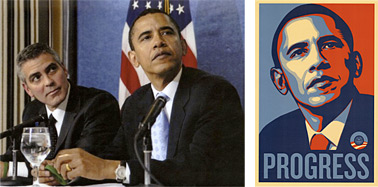
A compulsory license would have definitely been an economically efficient outcome for Fairey and the AP, who fought a high cost legal battle over the above images

Photography, on the other hand, seems to have reached something of an impasse of late. I wrote a post on the topic recently, and to summarize, what has happened in photography is that artists just end up taking work by prior artists for use in their new art, hoping to win the lottery on a nuanced piece of language in the law that has driven courts to rule in two different ways. Basically, artists are forced to decide if their use of the photo will be “transformative” under one of two different definitions embraced by different courts, in the hopes that a judgement in their favor will exempt them from seeking permission by qualifying their use as “fair use”. In practice, neither the original photographer nor the new artists have any idea whether a use is going to be deemed transformative and thus “fair” except in the most extreme cases, so the industry sees a chilling effect. Which system sounds easier and clearer to you, the system that photographs operate under, or the system that music operates under?

I’m not the first to suggest that photographs should be subject to a compulsory license, though the idea doesn’t seem to come up a lot. Mechanical licenses would be easy – just as in music, an agency would likely arise in the market that would make the transactions easy, and provide a way to connect a new artist to the original photographer. If the original photographer can’t be found by the new artist, then they can go ahead and continue without fear of a costly copyright infringement suit later, knowing that the maximum amount of risk they will take on is the cost of paying a mechanical license if the photographer comes out of the woodwork. It would be a smarter system, and I’m not sure why it hasn’t gained more traction.

Leave a comment

Filed under Copyright, Law

The used game market problem – Capcom tries what will inevitably be an unpopular solution

We are definitely in the midst of a shifting market in terms of video game pricing. Video game publishers are increasingly searching for ways to beat the used game market, where companies like Gamestop make over $600 million a year by buying newish games from consumers and reselling them to others. The activity is completely legal (the first sale doctrine of copyright allows you to sell a copyrighted work after you buy it), but game developers would love to get a piece of that $600 million; Gamestop is currently making their money by living in the pricing problem publishers have yet to solve, namely that publishers don’t want to drop the price of the game at release, but by the time the first price drop comes around, many who didn’t want the game at $60 have already bought the game on the used market for the price drop price.

Publishers have tried to deal with the problem in a number of ways:

Sell a license to the game – Software can be licensed rather than sold, alienating the consumer from the ability to resell it. Computer games have started to go that way, and combined with things like multiplayer accounts and CD keys, have largely reduced the amount of piracy, or at least reduced the amount of fun you can have with a pirated copy (But look up “Spore” for a cautionary tale). But reselling PC games has never been a huge industry partially for those reasons, and video games haven’t made the jump to a licensing approach, perhaps out of fear of shifting to something too dramatic. The first console game that comes out claiming to deny the consumer the ability to resell it will face a tremendous backlash from consumers, and it isn’t even clear how such a plan would work – no publisher wants to go around suing the consumer as a means to enforce the license, and suing Gamestop is just as unappealing (they might just drop your games from shelves entirely). But I wouldn’t put it past an aggressive publisher to try it. Chance this approach becomes popular with consoles: 20%

Extend the duration of time that the game has value to the first purchaser  – This has definitely become more popular, especially since it can make the developer money. Mass Effect 2 released a number of $10 expansion packs almost immediately after the game was released, in the hopes of convincing release price purchasers to hold on to the disc for a few more weeks. The Halo and Call of Duty series do the same with map packs, and really most major releases try to adopt some version of this approach now as a way of both milking the game for more revenue, and as a means of holding off a wave of discs from hitting the used market. Chance this approach becomes popular: 100%

Cut the price almost immediately – Portal 2 was possibly the first game to utilize such a dramatic version of this strategy – just a couple weeks after the game released, Valve slashed the price of Portal 2 almost in half. It’s not clear how much of this was motivated by slow sales, or possibly because of the PSN downtime that coincided with the game’s release, but I imagine it was driven at least in part by a desire to shunt the used market, which would have been especially hot for a game that was fully beatable in about 15 hours. The downside is, if every game you release takes this approach, you effectively just shift a large portion of your audience to that lower price point, because most people will wait a week to get $20 off (that is, after all, why the used game market exists in the first place). Chance this approach becomes popular: 5%

Ruin the experience for anybody trying to replay the game – This is a new strategy being used by Capcom in Resident Evil: The Mercenaries for 3DS. The game comes with a special feature, where saved data cannot be erased. While it will probably take the game’s release to discover what this actually means, it seems as if Capcom is limiting consumers to one playthrough of the game in “new” condition, and every subsequent playthrough will be tainted in some fashion by that original game – perhaps your character will stay overpowered, or will have access to amazing guns from the start, or other usual powerups received after beating a game for the first time. So if you try to sell the game to gamestop, the game will always retain these advantages, making a used copy rather unappealing to a new consumer. I expect the backlash on this to be pretty massive, and ruin any sales this (likely already bad) game would have had. Chance this approach becomes popular: 5%

Digital distribution – Steam’s success on the PC/MAC, combined with Blizzard’s success in releasing Starcraft II from their own site and the profitability of Xbox Live titles will likely lead some developers to consider full digital releases over Xbox Live and PSN in the future. Currently the hardware has some issues, namely that the consoles don’t have big enough hard drives to support holding many titles, but look for that to change in the next console cycle. Digital distribution is potentially extremely profitable simply for the ability to cut out the middle man, plus the game is impossible to resell in the that format. It also allows specific pricing control, with the developer able to lower the price whenever they want, perhaps even based on sales through the digital marketplace. Digital distribution has taken over on the computer, and it will be the future of consoles once the hardware can support large libraries of downloaded games. Chance this approach becomes popular: 80%

In the short term, expect most companies to follow the approach of releasing new content almost concurrently with the game’s release in an effort to prevent games from hitting the secondary market before the first price drop, perhaps mixed with some slightly earlier price drops, as a manner of taking some of the secondary market’s pie. In the long run, I expect most will move to digital distribution once the consoles themselves can support it. And look for a post on how poorly Capcom’s strategy will work in the near future.

1 Comment

Filed under Copyright, Games

Fair use in photography, art, and copyright – Two trends in lower courts

WordPress tells me that the most popular search leading to my blog relates to fair use in photography, telling me that a whole lot of people don’t understand what the law in the area is on the issue. My last post on the topic covered Richard Prince’s fight with a photographer, from whom he borrowed/stole/was inspired by/copied photographs of rastafarian men and added little flourishes before displaying the art in a gallery. Below is the picture, which I “stole” from a blog:

Prince lost the case in the lower court (more on that in a minute), but for us copyright watchers, that opinion doesn’t really matter, because he is appealing, and he is appealing BIG TIME. Boies, Schiller & Flexner, the firm started by David Boies, is taking the case. BSF is a top-flight litigation boutique, and they probably took the case because it could go to the Supreme Court, so IT’S ON. This case won’t be over anytime soon, and will probably redefine fair use by the time it ends.

But back to the lower court – Prince lost primarily because the lower court judge decided that the nature of the use wasn’t “transformative” (if Prince makes it to the Supreme Court, this will be the crux of the case). [Prince also shot himself in the foot by making all sorts of court unfriendly comments, like saying that it never occurred to him to ask Patrick Cariou, the photographer, for permission and that he would have taken the imagery even if explicitly told not to, and that even with Cariou’s work removed his art would be valuable and Cariou’s worthless.] This is only one factor in the four factor test, but it is a really important one, and possibly the one in the most flux as the law goes. Without going all law review article in this post, there are two trends in the determination of “transformative” that the Supreme Court would have to settle if Prince’s case makes it to the Supreme Court.  These two approaches vary based on how much they pay homage to the moral rights of the author, or the author’s right to be attributed as the author even in criticism. We don’t have moral rights to copyrighted works in the US, but the concept is inescapable, popular in other countries, and I feel quasi- moral rights drives the two trends, detailed here:

I. Transformative / preserves attribution – Some think that based on the language of the statute, a work is only “transformative” if it comments ON the original in some way, as for the purposes of criticism, research, or scholarship. This was where the lower court decided in favor of Cariou, the photographer who took the pictures that Prince copied. The lower court said that the problem with Prince’s activity was:

Prince’s Paintings are transformative only to the extent that they comment on the Photos; to the extent they merely recast, transform, or adapt the Photos, Prince’s Paintings are instead infringing derivative works.

Prince testified that he doesn’t “really have a message” he attempts to communicate when making art.

The idea is that “transformative” means something like “having the purpose of commenting on”, rather than just changing the message. Commentary that uses a piece as a point of reference is fair use because it preserves the original authors identity. Parody, while not necessarily as explicit on original authorship, is fine as well and this camp would likely also keep the traditional exceptions intact for scholarship, teaching and research for similar reasons.

Reproduction of Cariou’s pictures would be fair use only if they were in a book critiquing something about the work, such as an article on composition that believed Cariou poorly framed a subject, or for use in a class on a similar topic. An article commenting on our society’s fascination with Rasta culture could probably safely print a reproduction of Cariou’s picture as well.

The line is drawn with the second approach where the original work is used as a mere vehicle for commentary, but the commentary doesn’t actually relate to the original work itself. If I reprint Cariou’s work with the words “George Bush sucks” in small font, that’s not going to be fair use (it’s also not very topical). I say moral rights drive this camp’s opinion because they are fine with any transformation that maintains the integrity of the original author as an author of the work, even if the transformation is ultimately a critique.

II. Transformative / doesn’t preserve attribution – Others think that use of another’s work should be protected even when it doesn’t preserve authorship, such as what Prince did to Cariou’s works. The focus on attribution drops away, and the question becomes whether the new work added something new or merely supplants the old work. It’s Supreme Court case law that the more the work is transformed, the more the other factors of the analysis become less important, indicating that a truly radical change in an image, for example, should weigh heavily in favor of a transformation (and fair use). The way the first and ninth circuits have interpreted that, the focus should be on the functionality of the new work as compared to the old – if the new use has a different function, it should weigh in favor of fair use, even without attribution. The problem is, any lawyer can come up with ways in which a use is functionally different from another; Cariou’s pictures were used by Cariou in a book about the history of Rastafarian culture in a coffee table marketed to people looking for coffee table books, whereas Prince’s work is displayed as modern art in art galleries and valuable primarily because he had a hand in making it. See, it’s that easy! Other translations of this camp come out with “is something new added to the original work, which is used as a raw material”, which ends up operating similarly; Prince added his touch to anywhere from 20-30% of the visible canvas. This camp holds that such a simple distinction is fine, because the point of copyright is to protect the original author’s chance to collect profit from his works in the market he might sell the work in – Cariou was unlikely to make the alterations that Prince made and sell them in art galleries. This approach is very market driven in that way, unconcerned with the moral rights of the author.

It is worth noting that I is narrower, in that II encompasses the uses considered fair under I as well. All of the uses deemed fair under I are fine under II because commentary and critique are markets where the original author is unlikely to enter.

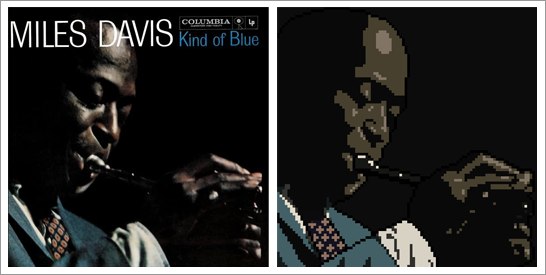
So which is the real answer to transformative use? Courts have ruled both ways. As evidenced in the Prince case, some courts think that a transformation can’t be protected unless it is making a commentary on the original work itself, such as for critique or scholarly purposes. Other courts have held to something closer to version two, that to transform the new work must merely add something new. I’m personally in the latter camp – Functionally, the current system puts a big burden on the person making a transformative work. A story recently gained traction about an artist who remixed the cover of a Miles Davis album for his own remixed Miles Davis music. He licensed the music, but didn’t license the cover, because he transformed the cover picture from a normal piece of art to a pixelized version. Here’s the comparison the artist posted on his blog:
He got sued, and had to settle despite feeling that he had substantially transformed the art, because the legal costs of even a successful defense would have significantly outweighed the costs of a settlement. The artist was probably fine under Transformative II, but not under I. The author has a great series of pictures at the bottom of his blog where he pixelizes the picture further and further until it is just 4 color squares, asking, with desperation, “Where would you draw the line?”.

The artist’s plight underlines the problem with approach I, and with the currently murky legal landscape. It puts a huge burden on artists to try and navigate the legal definition of fair use, a definition which isn’t even clear to legal scholars, rather than letting them work on their art. The Supreme Court needs to clarify the fair use issue, and needs to do so in a way that lets transformative works flourish – the definition needs to be clear enough that photographers will be discouraged from filing lawsuits against transformative works. We need a bright line rule on the issue one way or another, but so far we haven’t gotten one.

1 Comment

Filed under Copyright, Law