The value of a software patent, why Twitter voluntarily forfeiting a property right isn’t crazy

You can look at Twitter’s move to their new invention assignment agreement (they are calling it an Innovator’s Patent Agreement, which has a fittingly unlegalese ring to it) from a number of different angles.

For one, it signals a growing movement in the technology space to do SOMETHING about software patents. To put it bluntly, many feel that things are out of control. You don’t have to pay too much attention to the industry to have heard about the battles between every major technology company. Patent holding companies are making a fortune off of licensing, and companies are abandoning their Business Plans! in favor of Patent Trolling!. Hell, companies are forming with business plans that consist of Step 1 Acquire Patent Step 2 Sue People. If you are into the efficient allocation of resources (and who isn’t, these days?), let’s put it this way: Nathan Myrvold is currently using his time to buy and license and sue over other people’s inventions. The patent problem is skewing incentives for the economy, luring our greatest minds from more productive innovation! Silicon Valley and it’s bevy of engineers knows something is wrong, and as the inventors of 90% of the problem patents in the country, Twitter is empowering them to do something about it. Or at least, Twitter is saying they will and taking a step towards that end.

On the other hand, think about Twitter from the business aspect. This is a company that is criticized for lacking a revenue plan. It’s the weakest “business” of the major social networks, and it’s seen many changes at the top over the past few years, plus it’s sat on the sidelines while Zynga, Groupon, LinkedIn, Yelp, Pandora, and soon Facebook have gone public. Twitter has some of the highest average salaries in the scene, and it’s a place engineers want to work, yet it has weak ad revenue compared to the company it will always be compared to in Facebook. With patents being so valuable, and social networks becoming so prevalent, and Twitter being a social network with a strong engineering team, one might think that a strong strategy for Twitter to boost revenue would be to start firing off licensing efforts of their own. Here’s the thing though: They only have one granted patent (though it’s a good one that probably reads on all mobile devices and many mobile apps). If a patent nuclear war started yesterday (oh, wait, it started months ago), they are the Melians to the Facebook/Yahoo!/Microsoft Athenians. Twitter is clearly at a bit of a competitive disadvantage in a world where patents are incredibly valuable.

So for Twitter to take this step of limiting the downstream value of their patents (ensuring that the Coase theorem dictates the patents remain with Twitter, though I’m torturing the Coase theorem a bit there [another shout-out to my resource efficiency homies!]), while also potentially cutting off current licensing revenue potential… well, it’s a tiny bit noble, but a whole lot more a Trojan horse for the rest of the patent-holding technology companies of the world. Very clever, really. Twitter is politely asking everybody to sign a non-proliferation treaty, and making a nice gesture by signing it first, but that would be like Switzerland looking to end World War II by being the first to sign a peace treaty. Twitter is hoping this international relations metaphor is a bit more Gramsci and a bit less Hobbes (If I haven’t shaken you yet with all these political theory references, then congratulations). They would love nothing more than for every company that has already invested millions of dollars in patents to sign the treaty for Twitter’s own protection as much as they would like them to for their edification. So Twitter makes this big PR gesture, they will be hailed as saviors by the anti-software patent crowd, engineers will claim this as a great reason to work for Twitter, and Twitter gets to step back and hope others give up more to gain less by doing the same.

So there you go. I’ve successfully told you why Twitter’s move today is great for software patents generally, pretty clever by Twitter itself, and not really a big loss for them in terms of what they had to give up to get some amazing PR and recruiting, all while hitting you with multiple resource efficiency, political science, and international relations references. Hopefully more entertaining than self-indulgent, but the blog does have my name at the top so maybe I can take that luxury every once in a while.

(Some other articles that helped form my thoughts for this article: 1. 2. )
Leave a comment

Filed under Law, Patent

The JOBS Act Part I – Crowdfunding.

The JOBS Act has passed both House and Senate, and all signs point to it being signed into law sometime this week. The JOBS Act does a few things, but the two big ones that will be widely publicized are 1). it allows companies to “crowdfund” by selling securities to nonaccredited investors for total funding amounts below $2 million, and 2). it raises the number of shareholders that trigger a company to file SEC disclosures from 500 to 2000.

First off, let’s get one thing out of the way: This isn’t going to create many JOBS. Despite the title, this is not a “jobs” bill. No money is being spent on anything (you can imagine the pitch and see why it passed: will you vote for this bill that has JOBS in the title but doesn’t increase the deficit or raise taxes?). The crowdfunding portion of the act will likely increase the misallocation of money in the economy, and the increase in the shareholder limit doesn’t have any clear connection to increasing jobs at all. So ignoring the blatant pandering by the Act’s title, is it a good law?

I’m going to focus on the crowdfunding portion of the bill for now, and save the shareholder number increase for another time. I’m also only going to talk about equity – crowdfunding small business loans will likely catch on as well, but people seem to be more interested in the equity side of the equation. Anyway, two obvious questions spring to mind:

What sort of company will raise money this way?

Not the Facebooks of the world. The startup/technology world probably won’t go the crowdfunding route very often. There is already plenty of angel and VC money available to promising startups in major cities, and startups tend to burn through cash pretty quickly before they become profitable, so few will have a business plan where $2 million is sufficient to get them to profitability. Furthermore, raising 100k from 100 people is going to be less attractive than raising it all from 1 angel who can add some value through expertise and connections. It’s also not going to be pretty to raise a Series A after taking investments from a few hundred random people, and VCs will probably be less than excited to get onboard with that cap table. I wouldn’t be surprised if mainstream VCs never back crowdfunded businesses. So forgetting startups, that leaves your regular ye olde small business, and they are probably the sort most likely to avail themselves to crowdfunding. But….

Who wants to invest in crowdfunded companies?

In an era of Shark Tank and The Social Network, it is no surprise that everyday people want to invest in young companies. But keep in mind, these aren’t going to be the sexy startups that regular Joe American has heard about. The companies that pursue a crowdfunding route will either be less-known startups that are struggling to raise money through traditional channels (which you’d think would lower the potential IRR for a portfolio of such companies, but more on that in a second), and small businesses. I’m no expert on the state of small businesses in the majority of the country, and I can’t say I really have a clue whether this crowdfunding option will be appealing to them as an alternative to other fundraising options. But I just have this gut feeling that if you want to start a small restaurant in a suburban neighborhood, it’s gonna be really really hard to convince a random person on the internet to care, let alone invest. The business plan on the investor side just doesn’t make a lot of sense: investors in startups (Angels and VCs) have one basic premise – if you invest broadly in enough startups, you’ll get a solid return by losing money on 80% of them, breaking even on 10-15% of them, and hitting homeruns (10x+++ returns) on 5-10%. The ability to get the homerun return is absolutely essential to a portfolio where 80% of the investments go bankrupt, but what small business can reasonably project a world where they offer their investors those kind of returns? The local restaurant/crafts store/yoga studio sure can’t.

This is the main problem I have with the crowdfunding plan: In a few years, we will probably say that no rational investor should invest in companies this way. The Act offers low net-worth investors the chance to make small investments in a number of small companies. This is essentially what high net worth investors do at the angel stage for startups, but the companies in the crowdfunding portfolio are 1) less likely to be wildly profitable, as most small businesses can’t even project 10-15x returns with a straight face, and are 2) more likely to be fraud [and this isn’t being alarmist – states first passed securities regulations specifically to combat fraud]. Oh, and the portfolio is even less liquid than an angel portfolio, because angel portfolio companies will be acquired or go public with some frequency, something no small business will do. Plus small businesses fail at an extremely high rate. What rational investor would take this portfolio of high-to-extremely-high risk, low upside, illiquid investments over a 5-year treasury? When the stock market is doing well, I just can’t imagine this being an attractive way to invest money.

In conclusion, I think the sale of equity through crowdfunding platforms just won’t catch on. I don’t think investors will want to put money into the sorts of businesses that will use the platforms, and over the long run those investors that do will realize they aren’t making a reasonable return. Maybe debt financing through crowdfunding will take off, but I just can’t see the equity side ever becoming popular.

Leave a comment

Filed under Funding

SharesPost gets a slap on the wrist from the SEC

I’ve been surprised with the level of activity on SharesPost and SecondMarket over the last year – more specifically, I’ve been surprised that the activity hasn’t drawn more scrutiny from regulatory bodies. While I think that giving liquidity to large private companies is theoretically a justifiable goal on market efficiency grounds, many people had questions about how the SEC would view these transactions, which by their nature encourage speculation in companies that have not gone through the exhaustive IPO process.

Today the SEC finally took some action against SharesPost, though by all accounts the action was relatively innocuous and will do little to stem investor enthusiasm in these new pre-IPO markets. The SEC announced fines for SharesPost and the CEO, but the total cost is only $100,000. For some context, J.R. Smith, a professional basketball player, was recently fined $25,000 for tweeting a picture of his girlfriend’s scantily clad behind. Insert comment about America’s priorities here. The complaint is particularly interesting if you want to get a peak into how SharesPost grew into what it is today, and it also reveals that SharesPost has been a registered broker-dealer since December of 2011, making the fines today something of a retroactive punishment.

In a sense, this is a huge victory for both SharesPost and SecondMarket – after a long investigation into the markets for shares of stock in private companies, the SEC did no more than slap SharesPost on the wrist, charging them what the NBA would charge one of their players for four tweetpics of a girlfriend in a thong. Maybe this is just the first step in formally eliminating the 500 shareholder rule, something many pundits have been speculating about since the Facebook IPO was just a glimmer on the horizon.

Leave a comment

Filed under Funding, Law

Zynga’s Off-Facebook Platform and Why it’s Important (but probably not lucrative for a while)

Zynga recently launched Zynga.com, to much fanfare and apparent approval by Wall Street. Shares rose 10% on the announcement, and settled at about that heading into the weekend – a big move considering there was no other news on the company. This is a huge step, and it was inevitable because now-public Zynga needs to increase revenues somehow to drive that share price up. There seem to be three major conclusions people have drawn from Zynga.com regarding Zynga’s ability to generate revenue going forward. Let’s break them down and see what’s likely and unlikely to play out:

Users on Zynga.com will generate more revenue from virtual good sales than users on Facebook

Initially this looks like a giant amount of potential revenue: Facebook’s IPO docs revealed that they get about $400 million from Zynga’s virtual goods sales, for doing pretty much nothing besides making the Credits system available. If Zynga could get all that back by moving off Facebook, it would increase revenue by 25-30%, a huge number. But one point that is being overlooked in casual discussion of this story is Zynga’s continued commitment to Facebook Credits, even off-Facebook. Zynga committed to using Facebook credits in a 5-year deal they made with the social network back in Fall of 2010. No criticism whatsoever of that deal – it likely played a key role in moving Zynga from strongly positioned to dominant market leader on Facebook, but now comes the downside for Zynga. Any work they put into moving users over to Zynga.com is in some regard wasted, because Facebook still gets the same cut of the revenue until 2015. As it pertains to the stock price, that 30% increase in revenue from virtual goods will definitely be significant down the road, but discounting those cash flows to today, and being unsure what percentage of users will be transitioned to Zynga.com anyway, this alone shouldn’t account for much of the stock’s movement. So in summary, while this user migration will help revenue from virtual goods eventually, Zynga won’t really see those benefits for 3.5 years.

Zynga will generate ad revenue from Zynga.com

This one has some merit and is what I would be looking at if I was a stockholder (I’m not as of writing, in case that was unclear). Let’s do some back of the napkin calculations: Facebook sees roughly 89% of it’s revenue from ads, or about $3.2 billion. Yep, that’s a lot of money, but Facebook also has 845 million users, around 500 million who return daily (DAU). That’s roughly $6.5 per year/per DAU, or $3.8 per year/per monthly active user. Zynga, by contrast, has about 59 million DAU. Let’s assume Zynga.com can get 25% of those users (~15 million) to visit their platform each day, and can generate ad revenue at the average of Facebook’s two rates, or $5.15 per user – that would generate about $76 million in revenue over the course of a year for Zynga. That’s probably a solid target for next year for Zynga, but in context it isn’t a lot of money for the company, which raked in revenue of about $300 million last quarter. So while Zynga.com might get to the point where it’s generating $76 million in ad revenue in a year, that amount is only 6% of the company’s annual revenue. Definitely a revenue stream to go after, but probably not something that should drive the stock price up 10%.

Zynga.com will turn Zynga into a game publisher

This one is admittedly tough to gauge, because there are two huge questions which will need to be answered that get in the way of accurately valuing this revenue stream: 1. Will developers trust Zynga? 2. What benefits can Zynga offer a developer that Facebook can’t?

Zynga has been accused of cloning other developer’s games throughout their short history, and developers may consequently be hesitant to support Zynga’s platform, or may not trust Zynga with their user data. On the other hand, a dedicated social network comprised of virtual good purchasers may offer developers some advantages over Facebook’s network. The advantage for Zynga is that they can take some cut of the revenue other developers generate. Sounds nice, but what company could buy in enough to generate significant revenue for Zynga in the first place? It’s unlikely EA will be jumping to join Zynga, as EA has emerged as their primary rival. Of the top 15 games on Facebook, excluding Zynga and EA, Wooga has about 10 million DAU, King.com has about 6 million, Tetris has 3.7 million, and a foreign title (no offense foreign title lovers!) has 2.5 million. That’s a combined ~23 million DAU. If ALL of those games jumped on to Zynga.com and took 25% of their users, that would only be about 4 million users. That’s nice, but Zynga has SIX games with more users than that each, and Zynga would only be taking a small cut of whatever revenue those users generated (plus some ad revenue!). That’s chump change for Zynga. So while publishing other games may be a revenue stream someday down the line, it’s probably not going to be a very large one anytime soon.

In summary, Zynga’s new platform is an important step for social games, and with relatively flat user numbers the company is feeling pressure to develop new revenue streams – but none of the revenue streams alone seem significant, at least until the Facebook deal expires in 2015.

(And on the other side of the gaming planet, Journey comes out in 2 days)

Leave a comment

Filed under Social Games

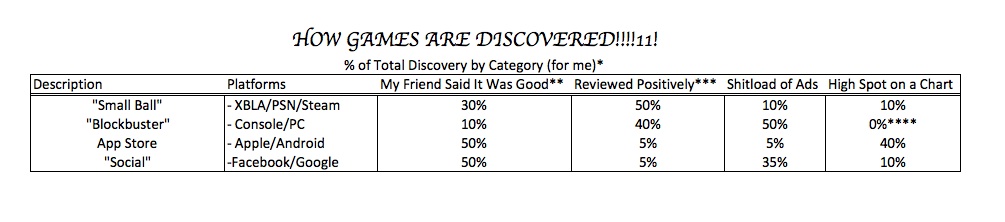
Discovery of games by platform (for me)

This post started off as a reflection on the importance of the Kickstarter/Double Fine fundraising event in the history of the game industry – but then I got bogged down in thinking about all sorts of other issues associated with small game developers in general. So, as background to my awesome reflections on whether Kickstarter is going to change the world of game financing, here’s a slightly different topic: how does a consumer actually discover a game? 

This might not sound novel – in fact, I’m sure it’s not (but what on the internet is?). Discovery is a popular topic, indeed a buzzword, in the social/mobile game development universe. Putting your game in front of more consumers is key, and Tapjoy made a lot of money doing just that before Apple shut their main monetization strategy down. User acquisition moves mountains of money and gets lots of attention in social/mobile, and though it is less frequently discussed in the technology/video game blogosphere, similar mountains of money move to do the same in other game platforms, albeit with altered terminology.

Below is my chart of how I personally discover games. Behold!

Hmm, it’s deceptively small, so click it! Anyway, here’s my notes on the subject:

* Obviously this is overly-simplifying a lot of interactions – if something is reviewed positively, I’m more likely to hear about it from a friend, and it’s more likely to be on a chart in a favorable spot. But the basic gist of this chart is how much of my personal knowledge of a game’s existence and quality comes from various categories. I almost never become aware of games on Facebook, for example, based on a review, whereas I almost always become aware of a “Small Ball” game because of a review.

**“My Friend Said it was good”: This is straight, old-school virality. I end up buying a rather large portion of my apps because friends say they are good. If I trust a friend’s opinion, I’ll buy almost anything they suggest in mobile. For blockbuster games, by contrast, the market is so large and I know so many people who play games, I give little credence to one friend saying the game was good. I’m sure you DID like Infamous 2… but I don’t care. I probably already know about the game and its quality by the time most friends have a chance to recommend it.

***“Reviewed Positively”: “Small Ball” games rarely have the ad-spend to raise awareness of their existence, so a lot of the legwork is done by positive reviews and old-school virality. I heard about Trenched/Iron Brigade (I hear you out there Mr. “Omg Double Fine talk about them more” – don’t worry, I’ll get to you) from a friend, so I bought it. Good reviews on Limbo and Braid probably drove the majority of their initial sales. For the other platforms – Blockbuster games are frequently seen as getting de facto positive scores from review sites, in part because they spend that “shitload on ads” at the very places that review them, a conflict of interest that savvy media consumers like myself are slow to forgive. I’m probably starting to conflate knowledge of game with likelihood of purchasing game here, as a positive review of a small ball game leads to a buy from me way more than a positive review of a blockbuster does, but oh well, it’s my chart!

*****“High Spot on Chart”: Lastly I want to point out that this category drives discovery disproportionately for App store / mobile right now, something that must change eventually if the medium catches up with other platforms. And for Blockbusters, nobody reads sales charts unless they are really into the industry and frequently visit Gamasutra, at which point the person probably knew about every game beforehand anyway.

That’s all for now – next post, I’ll stay on this games tangent and talk a bit about Kickstarter and try to connect the dots with this post.

Leave a comment

Filed under Games, Social Games

CAFC judge tells lower courts to punt Section 101 issues (Dealertrack v Huber)

After a string of recent, conflicting decisions on software patents, Judge Plager of the Court of Appeals for the Federal Circuit (CAFC) wrote this in dissent in Dealertrack v Huber:

[A]s a matter of efficient judicial process I object to and dissent from that part of the opinion regarding the ‘427 patent and its validity under §101, the section of the Patent Act that describes what is patentable subject matter.  I believe that this court should exercise its inherent power to control the processes of litigation,Chamberes v. NASCO, Inc., 501 U.S. 32, 43 (1991), and insist that litigants, and trial courts, initially address patent invalidity issues in infringement suits in terms of the defenses provided in the statute: “conditions of patentability,” specifically §§102 and 103, and in addition §§112 and 251, and not foray into the jurisprudential morass of §101 unless absolutely necessary. (emphasis added).

For some context, the recent conflicting decisions I referenced above are CyberSource and Ultramercial, opinions where the same court came to seemingly opposite conclusions on whether patents on computer-aided software functions were within the scope of Section 101 and thus patentable. In CyberSource, the CAFC described a software patent as covering purely mental steps, where the attachment to a computer was essentially superfluous. In Ultramercial, by contrast, the CAFC described a rather similar patent as good for describing a controlled interaction with a user over the internet. This all follows the infamous Bilski decision, where the Supreme Court declined to issue any concrete guidance on subject matter eligibility.

It’s pretty shocking that a judge for the CAFC, the court with jurisdiction over all patent appeals, would tell lower courts to ignore section 101 and litigate other issues instead. As the “101” might indicate, that section of the patent act is the most basic description of what is eligible for patent – a topic that has been vigorously debated in recent years, not coincidentally corresponding to a proliferation of patents in software and business methods. Now, obviously this isn’t binding – no party will be getting out of a Section 101 issue by citing this language to a District Court. But it shows the sad state of affairs of Section 101 – even a judge on the CAFC thinks Section 101 has turned into a total mess.

One other thing to consider – how do you value a patent as a company in this sort of climate? Policy advocates on every side of an issue (I’m thinking things like ACTA and SOPA recently) like to throw out numbers in terms of values and investments and jobs, but in a world where the the very concept of what is protected is still in play at the highest level, you have to question how accurate any sort of valuation on that sort of protection can possibly be.

Leave a comment

Filed under Law, Patent

Copyright in social games drama as Nimblebit takes to Twitter to vilify Zynga

Copyright in social games is one of my favorite hot IP issues – back in the day, people sued Zynga for copying their games (though, admittedly and perhaps tellingly, not for copyright infringement). Then, Zynga sued other people for copying Zynga’s games, and those people defended themselves by saying that they both copied the games from somebody else. Now, eschewing the legal system, a small developer is taking to the streets (ie Twitter) to spread the word that Zynga is copying their game, Tiny Tower. Zynga has good reason to copy Tiny Tower, as the game was named iPhone game of the year by Apple. But the copying is pretty blatant, as can be seen by some side-by-sides created by the Tiny Tower developer (Nimblebit).

The whole thing is great theater and it inspired a field day on Reddit, but what does it mean? Would Zynga be liable for infringement if Nimblebit chose to sue? (Note to all small game developers reading at home: Don’t warn an infringer like this if you want the option to sue, ever. /end lawyerish). I wrote pretty extensively about the gray area in copyright in social games back when Zynga sued Vostu, because the issues are in some respects totally unique. For one, while any single game is clearly eligible for copyright protection, it’s not clear how far that extends in the context of a game – straight copy and paste of the art from one game would clearly be infringement, but what if you just have your own artists and engineers reproduce the basic elements of the game, the UI/UX, and the mechanics? Now you are moving from the realm of copyrightable creative content to uncopyrightable genres and ideas, which games in general have been building on for years. As Vostu noted in their defense, the big games on Facebook are largely paying homage (to put it nicely) to a PC or Game Boy game (remember when game boy was “mobile games”?). Secondly, copyright law has been seldom deemed to protect the menus and interfaces of computer software, but that’s largely what most of the copying allegations in the social game space point to as evidence of copying. To really get into some common copyright terminology, it is often stated that copyright protects the “expression” and not the “idea” – in this context, both genres and user interfaces fall more on the “idea” side.

An excerpt from Nimblebit's anti-Zynga screed

Anyway, the short answer to the Nimblebit lawsuit hypo is that they probably wouldn’t win, but I’d love to see the issue of copyright in social games tested more thoroughly in court. There’s two dimensions to the issue as I see it, one non legal and one legal:

Does game copying hurt consumers? 

The issue of copyrightability as between two game developers never came up often in the context of console games, the basis for what we have in terms of precedent, because the production and distribution cycles made it practically difficult to see a successful game and push out an identical competitor before it was too late to capitalize on the popularity of the original. Now, game production cycles on web and mobile are so fast and iterating happens so quickly that games are experiencing duplication as a threat like never before. Companies like Nimblebit can spend a ton of time and money creating a game that another company (ahem) can copy in a matter of days. Full disclosure: I really like Zynga and I’m sitting on the couch of a friend who works for Zynga as I write this. But Zynga isn’t the bad guy here regardless – it really isn’t clear where the line is between paying homage to a game and infringing the game’s copyright. Zynga adds a lot of value to a game beyond the graphics and game mechanics in the form of an extensive network of users and a level of polish that only a public company can provide. To put it another way, no matter how many different Scrabble clones there might be out there, the free market is inevitably going to settle on one as the network effects push users to the game where there friends are, until everybody is playing Words With Friends. Users aren’t necessarily hurt by the copycat culture in social games, because network effects will push people to one platform anyway, and the art isn’t usually what’s drawing people to the game in the first place.

Is the copying we are seeing now a violation of copyright law?

Maybe, maybe not. Okay, probably not. It’s a weird issue, because to say there is no copyright in social games, or more specifically that copyright only protects against exact replication of graphic assets, is to say that social games have really no effective IP protection at all beyond unauthorized reproduction. To say that copyright protects more, however, would be to extend copyright protection to the area of a genre, something more akin to an idea than an expression of an idea. It would also be a complete disaster for the game industry in many respects if a court ruling gave more than cursory copyright protection to game developers over entire genres, as there has been an implicit understanding that genres aren’t copyrightable since the the first Wolfenstein clone. But as computers become more and more a part of our lives, and as games on those computers become more and more valuable, is the network effects + limited consumer harm enough of a rationale to support an environment where Zynga should inevitably push out every competitor through copying as soon as that competitor hits on a strong genre? (I hate ending a long post with this, but it’s true in this circumstance) – only time will tell. For the most part the big companies aren’t going to push the issue because the stakes are too high and the companies are doing fine in the current environment.

Update: Of course, just a few hours after writing this, Spry Fox sued 6waves lolapps over the cloning of their popular new game, Triple Town. I’ll read the complaint and write more if it gets interesting, though with Spry Fox being a rather young company, I’d be surprised if they rejected any reasonable settlement offer to pursue litigation.

Leave a comment

Filed under Copyright, Games, Law, Social Games

MegaUpload, SOPA, and the DOJ

Forgive me focussing on SOPA and the DOJ seizures so obsessively on this blog, but I truly believe we are at a turning point in the history of the internet, and it would be a shame to not write about it. Here’s the background for this article:

  • The DOJ has shown a desire to become more active in the domain seizure game (see my last post on the topic)
  • SOPA rallied the internet to mass protest earlier this week (Google & Wikipedia gaining most of the attention with their blackouts, Wikipedia’s which actually limited use of the site), and the bill is probably dead in it’s current form
  • and the big one, the day after the SOPA protest, the FBI / DOJ seizes MegaUpload (a popular file locker/sharing site) and has the owners arrested

We are about to see fully what MegaUpload’s use trends really look like, and so far all we have is an overloaded justice department indictment that is currently inaccessible due to server demand (or Anonymous attack, who knows…). What bothers me: How is MegaUpload different from YouTube, which it seems clear is legally operating under the DMCA safe harbor provisions? If MegaUpload’s service was violating the DMCA, which is the law on copyright infringement on the internet, why were the owners instead brought up on charges under the criminal provisions of Title 17, Chapter 5?

My worry is that with SOPA seemingly dead, where SOPA would have given private companies a right to move against sites with infringing content, the government is quickly moving to fill the void of regulations that SOPA was hoping to close. This is just ridiculous timing – the DOJ looks like they have already determined that SOPA was a proper piece of legislation, and they are endorsing stronger enforcement of copyright over the will of the country, before Congress even votes on the bill. Congress probably won’t vote on SOPA after the recent protests, making the DOJ’s action seem like a unilateral decision to enforce the notion behind the bill anyway. Again, we don’t seem to need SOPA if the DOJ can seize the property and arrest the owners of a content hosting site like they’ve done here.

The case against the MegaUpload owners itself seems weak, and begs an obvious question – if MegaUpload is indeed covered by the DMCA safe harbor, but a court finds them guilty of criminal copyright infringement, where does that leave the DMCA as an effective shield for legitimate service providers?

Leave a comment

Filed under Copyright, Law

Riot games plans anti-SOPA awareness campaign for LoL

SOPA, the broad bill being considered by Congress which would expand liability for content hosts if users post infringing content, is generally supported by content creator groups and generally opposed by internet and technology groups. This puts game industry companies in a strange spot, at least theoretically – game companies obviously create content and make their money primarily through sales of that content, so if they fell in line with the rest of content creators, they should complain about piracy and join the ranks of the SOPA supporters. Indeed, many of them are implicitly supporting SOPA through their membership in the Entertainment Software Association, which is lobbying support for the bill. But game companies also increasingly make their money over the internet, taking advantage of many of the networks that SOPA would hinder to both sell virtual goods and build communities (games also increasingly have some unique built-in DRM, but let’s ignore that for now). So where are these companies falling as the battle lines are drawn?

Riot Games, maker of League of Legends (LoL), came out yesterday in strong opposition to SOPA on their forums. Brandon Beck, CEO of Riot Games, wrote rather briefly saying that SOPA would kill streaming, threaten content creation, hurt the community of LoL, and more. The post was popular to say the least, and it’s already garnered 2,196 posts in slightly over 24 hours. Even cooler, an attorney at Riot Games took to Reddit to answer questions about SOPA and whatever else people wanted to know about relating to Riot Games, IP, and the proposed act itself. While the entire thread is worth a glance, the quote I think worth highlighting is where he says that based on the response, Riot Games will be taking more public actions against SOPA later:

Yeah, we’re definitely doing more beyond just this announcement. Some of it will be public-facing, some of it is more calculated to maximize legislative impact against this bill (and is far less interesting to the public at large). But yeah, we’re not just saying “we hate SOPA!” and going away.

Riot Games is already one of my favorite companies – They are making a free-to-play game that monetizes by building a compelling product, and it’s working, which is awesome enough. They also have a great sense of humor, and now they are taking a stance against SOPA. Plus they apparently employ awesome lawyers! Sign me up.

Leave a comment

Filed under Games, Law

Site reveals every public torrent any IP address has downloaded

I’m no html genius so this banner is probably going to get cut off, but the story behind it is that it (hopefully) shows the publicly listed torrents that were downloaded from your IP address. It’s from this site, which is making the rounds on tech and privacy blogs this week. It’s only got one torrent for my IP address, one which I’m relatively certain my roommate or a prior resident downloaded, but I’ve heard anecdotally that for many people/IP addresses it has an entire and possibly embarrassing list of files. Rather shocking how much is publicly available, and TorrentFreak has already turned the microscope towards the big media companies to see what files IP addresses associated with those companies reveal. Just a reminder that precious little of your internet existence is truly private.


Update: Though no html genius, the banner is down not for lack of smarts on my part but because the host site has been taken down. It is claimed to be temporary, so I’m going to leave this post as-is in the hopes that the very interesting webtool is revised and published again.

Leave a comment

Filed under Misc