The Stop Online Piracy Act (SOPA) is generating quite a lot of mainstream press lately, now that plenty of large companies and interest groups are starting to come out against it. For the uninitiated, SOPA (and it’s somewhat related cousin bill, Protect IP) sought to provide better enforcement mechanisms against “rogue” copyright infringement websites. In theory, it isn’t the worst idea – as a relatively poor twenty-something, I’m well aware of how many sites there are that exist solely for the purpose of hosting infringing content. The most recent prior law on copyright and the internet, the Digital Millenium Copyright Act (DMCA), provided effective enforcement against truly infringing, major, US-based websites, but it stopped short of sites like YouTube (which I’m fine with) and did nothing for content creators in regards to foreign websites. The problem presented by “rogue” websites is well stated by Terry Hart, author of the pro-copyright leaning blog ‘CopyHype’, here, and the general consensus of the rest of the internet by Mike Masnick, the standardbearer of the more liberal copyright movement, here.
The real problem with SOPA, as far as I see it, is that it doesn’t solve a real problem. On the spectrum of infringing sites, you have sites which generate infringing content as a result of random user activity clearly protected by the DMCA, you have “rogue” sites on the other end that exploit other copyrights illegally for fun and profit, and then you have sites in the middle that profit indirectly from both sorts of sites, such as search engines and ad providers. Have a look at this handy, rather ugly chart I just whipped up:
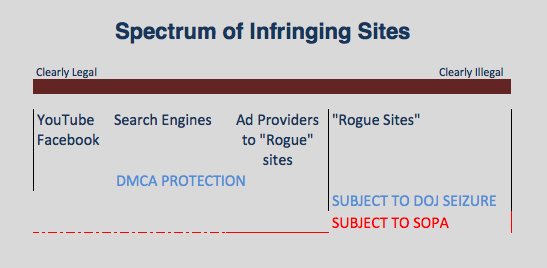
Basically, the arguments in support of the SOPA have centered on lackluster enforcement tools for content creators against the rogue sites that sit on the right side of the spectrum. This argument would make sense, except for the fact that the DOJ has made it clear that they will seize the domains of these sorts of sites pretty frequently. Today, the DOJ for the second year in a row seized domain names leading up to Cyber Monday (the name for the Monday following Thanksgiving, a big day in online sales). Last year the DOJ generated quite the controversy when they initiated this practice, with many decrying the lack of due process shown by an agency purportedly out to protect justice. It was those seizures that inspired the SOPA and Protect IP acts to some extent, as at least one of the domain seizures generated a lawsuit questioning the authority of the DOJ to take such actions without a court order. SOPA would presumably make it clear that the DOJ has such authority.
But with the DOJ facing just one lawsuit as a result of the 82 seizures last year, and with the DOJ taking down another 130 domains today, it’s becoming clear that the DOJ is going to keep doing this until a court specifically tells them it can’t. Practically, though, if the DOJ takes down only “rogue” sites, who is going to sue them? What’s more, it’s clear from the list of seized domains that private companies are having a say in what the DOJ goes after already – more than half of the domains seized sell professional sports jerseys, with a small contingent of sites selling name brand clothing and apparel and infringing DVDs. If this is a sign that the DOJ is feeling comfortable with the legal standing of their takedowns, I’d expect more private companies to start dumping lists of “rogue” sites with the DOJ pretty soon, and more takedowns to follow. (I will admit that the list reflects a heavy dose of sites that infringe trademark, rather than copyright, and a skeptic might wonder if the DOJ is worrying that sites they took down last year were protected by the DMCA).
The DOJ’s willingness to seize domains begs the question – why do we need SOPA anymore? The main target of SOPA is the “rogue” sites that the DOJ took down last year, but clearly the DOJ is feeling like they have the authority to take down those sites even without SOPA. If that’s the case, SOPA really only extends potential enforcement power as against sites which are currently protected by the DMCA, like sites that benefit indirectly from infringement through ads, be it the search engines that lead users to those sites or the ad networks that serve ads to those sites. These sites, though, are clearly not at the root of the problem, and if the DOJ continues the domain seizure practice then the amount of money these sites generate from infringement as opposed to legitimate content (already a small percentage) will further shrink. Adding liability to sites like search engines and ad networks will do nothing to stop copyright infringement on a large scale, and it just adds headache for legitimate businesses. But if the DOJ can already seize the domains of rogue sites, adding liability and headache to legitimate business is all SOPA is likely to do.
 danielmarkmiller.net
I don’t agree with them 99.999% of the time, but on this one they got it right. The following is the quote from the article.
“Given this track record, it is hardly surprising that a bill that would require every website in the country to become unpaid copyright enforcement officers for Time Warner, Disney, and the Washington Post comes packaged as the “Stop Online Piracy Act.” While the name may lead the public to believe that Congress is trying to keep our email pure and our computer screens safe, the real story is that the 1 percent are again trying to rig the rules so that they get as many dollars as possible from the rest of us.
The Stop Online Piracy Act (SOPA) would place an enormous burden not just on Internet giants like Google and Facebook, but any website that allows people to post content or includes links to other sites. An owner of copyrighted material would be able to go the Justice Department and claim infringement and request that the whole site be taken down.”
This is important to me, because as a small start up ISP it will cost me tens of thousands of dollars that I don’t have, to be THEIR POLICEMAN so THEY can make EVEN MORE MONEY!!
Feeling sorry for them and the loss of money that is hurting their industry? Well DON’T? Bellow is the list of the gross profits reported by MPAA themselves for the years 2006 – 2010.
Gross Profits in Billions of Dollars:
U. S. A International Total
2006 $9.2 $16.3 $25.5
2007 $9.6 $16.6 $26.3
2008 $9.6 $18.1 $27.7
2009 $10.6 $18.8 $29.4
2010 $10.6 $21.2 $31.8
Since we know that the industry is in it for the money lets look at the RIAA the quote below is from the RIAA’s website. Remember the RIAA is doing this for everyone else right. To save employee’s and artists. Below is a quote from their website.
“One credible analysis by the Institute for Policy Innovation concludes that global music piracy causes $12.5 billion of economic losses every year, 71,060 U.S. jobs lost, a loss of $2.7 billion in workers’ earnings, and a loss of $422 million in tax revenues, $291 million in personal income tax and $131 million in lost corporate income and production taxes.”
Let’s do the math. $12.5billion – $2.7billion leaves the poor RIAA with a loss from their pockets of $9.8billion.
We need to look deeper.
This from the IFPI publishes Recording Industry in Numbers 2010
“Global recorded music sales for 2009 show a mixed picture. Trade revenues to record companies fell by 7.2% to US$17 billion, with the world’s two biggest markets, the US and Japan, making up 80% of the decline. The worldwide fall in revenues outside the US and Japan in 2009 was 3.2%. Physical sales fell by 12.7% globally.
There are key areas of market growth, however. Digital music sales rose by 9.2% to US$4.3 billion, more than ten times the digital market value in 2004. Digital channels now account for 25.3% of all trade revenues to record companies. In the US, digital sales account for nearly half – 43% – of the recorded music market. More than 30 countries saw double-digit growth rates in digital sales, and 17 markets, including Argentina, Australia, Austria, Denmark, Finland, Singapore, Sweden and UK, saw digital sales grow by more than 40%.”
The physical sales of CD’s is what they are screaming about as the loss of revenue due to piracy, but look at the digital sales. In the US alone they made $4.3 BILLION and that is a 9.2% increase over 2009. So lets take the $4.9B off of the $12.5B they used earlier and you have a loss of $7.6B. They also don’t show that the $12.5 Billion is Global figures.
It is about class warfare and that is all this is about. The Helicopter wealthy screaming about not being able to crush the small people for every single penny.