Why don’t people like software patents?

Software patents are one of the most contentious areas of intellectual property. Check out this famous article or this website or this NPR piece, or just google the words “software patent” for a small sampling of ire towards the monopoly that is the software patent. No other type of patent draws quite the criticism that software patents draw, and it’s rather shocking how often the topic is discussed relative to how infrequently other sorts of intellectual property debates enter the public discourse.

So why is it that our society, one which generally loves the concept of property (though the music and movie industries might disagree), has such a strong aversion to patents in this specific realm? I have a few ideas:

Culturally, the creators of the subject matter covered by software patents are not considered “inventors” in the classic American sense.

When you think of American inventors, images of Henry Ford and Thomas Edison come to mind. Maybe Alexander Graham Bell, even if you forget that he was Scottish. Regardless, the cultural perception of “inventors” tends to direct our focus to, well, white men who make physical objects. They are invaluable, nonfungible assets. The adjective “inventive” implies creativity, and the concept of the inventor as a creative entity is actually captured in various parts of patent law itself. The things inventors create are tangible, useful, and sometimes amazing.

Software, on the other hand, is basically a meaningless word to most people – essentially everything that happens on a computer screen is a result of this mysterious software. And the software engineer is perhaps the most commonly misunderstood profession to the majority of Americans, with few people outside the practice really understanding what C++, Java, or Ruby on Rails even are. Ask yourself – Who are the famous software engineers of our time, and are they considered inventors? Mark Zuckerberg is hardly referred to as a famous inventor, despite Facebook’s 46 patent filings. Bill Gates isn’t usually described as an inventor either. Steve Jobs, perhaps, but only in the sense that he designed rather than coded.

And this sentiment isn’t just from the uninformed masses outside of Silicon Valley – software engineering is frequently an outsourced project even in the heart of software engineer utopia. Many entrepreneurs opine that if they could just get an engineer to perform their vision, their companies could achieve great feats. This popular perception of software engineering as a tool, as a non-creative task that can be outsourced without suffering much in terms of quality, lends itself to a view of software engineering as something less than inventive. And that the product of this work is undeserving of the title “invention”, and thus, undeserving of a patent. (Note that I don’t think software engineering is uncreative or uninventive – it just seems that many people do.)

Practically, software patents are extremely valuable, software is increasingly where the world is headed, but nobody knows when they infringe a software patent and they don’t seem to further innovation in the slightest.

There are two major sides to the practical aspect of the software patent debate, the side that sees patents as critical to covering the subject matter that is becoming central to innovation on the planet, and the side that sees patents as a hinderance to that subject matter, with the patents themselves completely disconnected from the actual innovation.

The pro-patent side of that debate would note that a problem with software patents is really a problem with patents generally, an argument I’ll credit to Paul Graham (first link of this post). Further, patents have covered innovative technologies for the history of our country, and generally they have been seen as a mechanism to encourage innovation and investment into valuable areas of research. Additionally, as software becomes more and more central to our lives as we carry more and more computers with us everyday, continuing without patents opens the industry up to the risks that threaten all fields without IP protection. Patents are credited with preventing big companies from ripping off the innovations of smaller companies and individual inventors without costs, and a world without patents would theoretically favor established companies and hurt the entry of new competitors into the market.

The anti-patent side of this debate would point to a large body of empirical work that has shown software patents in particular to be ineffective at inspiring actual innovation. Technology companies tend to load up on software patents not because they are inherently valuable to the company, but because they are tangible assets which can be shown to investors in fundraising and because they can be used defensively to ward off patent suits by competitors. Software engineers tend to see software patents as evil and unnecessary, and generally unable to capture the essence of what they created anyway after being filtered through a legalese translator. There is also a general feeling that, as fast as technology moves, rewarding a decade monopoly to the first inventor of an idea is undue compensation when the second inventor was probably just weeks or months behind.

Regardless of which side of the debate a person falls on, big companies have invested hundreds of millions of dollars each in their patent activities, be it through litigation, R & D, or simple patent purchases. Eliminated software patents entirely would be very unpopular with these companies, even if each individual in the company disagrees with the practice as a whole.

Legally, software patents tetter on the fringe of being unpatentable algorithms.

It’s been a general principle of patent law since the inception of patents that our country won’t award a patent to a mathematical formula or to an abstract idea. The extension of this principle determines algorithms to be unpatentable as well. The basic problem with software patents, then, are that they are a combination of algorithms (which are not patentable) and written computer code (which are not patentable, but are copyrightable), yet the combination of those two unpatentable concepts yields a patent, and has for the last 20 years. This is hardly well-settled law, even after all this time, and the Federal Circuit is still struggling with what makes software patentable compared to concepts, which aren’t patentable. Two recent cases, Ultramercial and Cybersource, essentially contradicted each other on whether software instructions were simply mental steps or whether they were more tangible, so we really aren’t close to a consensus on where software patents fit in the messy legal framework of patentable subject matter.

The way software is moving, maybe we don’t need patents in this area as much as we might have in the past anyway.

Two major trends in software are lessening the justification for patent protection in software – for one, software is moving to the cloud, and two, software is adding social layers. Both of these trends support the notion that patents are either ineffective in the space, or at least becoming less necessary.

For one, software served over the internet (or the cloud, or whatever metaphor you choose to use to describe a system where applications reside on the internet rather than the hard drive) is less prone to blatant copying, because the source code can’t be accessed by the user. Somebody seeking to replicate Salesforce’s specific technology has their work cut out for them as compared to somebody seeking to do the same with a program that runs on their own hard drive, with physically accessible code. If patent law is designed primarily to promote development of new technologies by assuring the inventor that there will be adequate protection, then that justification is less convincing in areas of research where the end product is never fully in the hands of the user or the public. The details of a web-based service like Salesforce or Facebook are only really known to the engineers who invented those details in the first place, and trade secret law provides adequate protection for those companies without the costs of patenting and the deadweight loss on society that patent law likely inflicts.

Second, many areas of software, including the cloud-based business solutions above, see success through their reliance on network effects. Network effects is the term used to describe the phenomenon where the power of a network (and its value) is positively correlated with the number of people on that network. It’s why we all have Facebook accounts but aren’t rushing to sign up for Google+. It’s economies of scale but with regards to social interaction more than economic efficiency. If I was to try to copy Salesforce or Facebook, patents wouldn’t be my primary obstacle – My problem would be that no consumers would want to use my network without other users. In fact, only when I became a big threat to either company would they consider leveraging their patent portfolios against me, at which point I would probably have patents of my own to countersue with, and I could spend money on litigation fighting to invalidate their patents. Only in very rare situations, then, do patents become relevant as protection for a software business model, and when they do they tend to be economically inefficient at working to provide that protection.

What’s more, our current policy on software is one of protection, and what we have seen is nothing less than an explosion of trolling organizations and patent nuclear war between major technology companies, draining millions of dollars away from actual innovation in the space. So any sort of reasonable change is probably worth a try.

Potential solutions? Not likely: Are there answers? Sure. Our country could do anything from categorically prohibiting patent protection for software, to simply lessening the amount of time the monopoly is good for, to instituting a software-specific rule where the obviousness analysis is made from a much later point in time to accomodate for the fact that most software “inventions” are obvious just a few months after invention. But with Congress just passing a patent reform bill that did little to address software patent issues, the only changes to the system are likely to come from the Federal Circuit, who probably can’t find a way to work those changes into patent law.
Leave a comment

Filed under Law, Patent

If the DOJ can already seize “rogue” websites, what does SOPA add besides liability for bystanders?

The Stop Online Piracy Act (SOPA) is generating quite a lot of mainstream press lately, now that plenty of large companies and interest groups are starting to come out against it. For the uninitiated, SOPA (and it’s somewhat related cousin bill, Protect IP) sought to provide better enforcement mechanisms against “rogue” copyright infringement websites. In theory, it isn’t the worst idea – as a relatively poor twenty-something, I’m well aware of how many sites there are that exist solely for the purpose of hosting infringing content. The most recent prior law on copyright and the internet, the Digital Millenium Copyright Act (DMCA), provided effective enforcement against truly infringing, major, US-based websites, but it stopped short of sites like YouTube (which I’m fine with) and did nothing for content creators in regards to foreign websites. The problem presented by “rogue” websites is well stated by Terry Hart, author of the pro-copyright leaning blog ‘CopyHype’, here, and the general consensus of the rest of the internet by Mike Masnick, the standardbearer of the more liberal copyright movement, here.

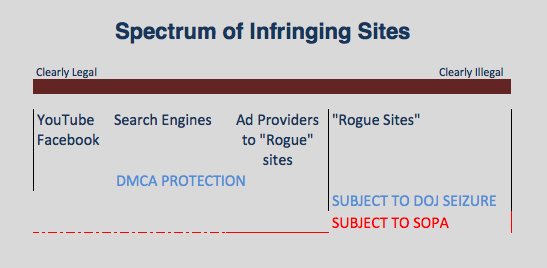
The real problem with SOPA, as far as I see it, is that it doesn’t solve a real problem. On the spectrum of infringing sites, you have sites which generate infringing content as a result of random user activity clearly protected by the DMCA, you have “rogue” sites on the other end that exploit other copyrights illegally for fun and profit, and then you have sites in the middle that profit indirectly from both sorts of sites, such as search engines and ad providers. Have a look at this handy, rather ugly chart I just whipped up:

Basically, the arguments in support of the SOPA have centered on lackluster enforcement tools for content creators against the rogue sites that sit on the right side of the spectrum. This argument would make sense, except for the fact that the DOJ has made it clear that they will seize the domains of these sorts of sites pretty frequently. Today, the DOJ for the second year in a row seized domain names leading up to Cyber Monday (the name for the Monday following Thanksgiving, a big day in online sales). Last year the DOJ generated quite the controversy when they initiated this practice, with many decrying the lack of due process shown by an agency purportedly out to protect justice. It was those seizures that inspired the SOPA and Protect IP acts to some extent, as at least one of the domain seizures generated a lawsuit questioning the authority of the DOJ to take such actions without a court order. SOPA would presumably make it clear that the DOJ has such authority.

But with the DOJ facing just one lawsuit as a result of the 82 seizures last year, and with the DOJ taking down another 130 domains today, it’s becoming clear that the DOJ is going to keep doing this until a court specifically tells them it can’t. Practically, though, if the DOJ takes down only “rogue” sites, who is going to sue them?  What’s more, it’s clear from the list of seized domains that private companies are having a say in what the DOJ goes after already – more than half of the domains seized sell professional sports jerseys, with a small contingent of sites selling name brand clothing and apparel and infringing DVDs. If this is a sign that the DOJ is feeling comfortable with the legal standing of their takedowns, I’d expect more private companies to start dumping lists of “rogue” sites with the DOJ pretty soon, and more takedowns to follow. (I will admit that the list reflects a heavy dose of sites that infringe trademark, rather than copyright, and a skeptic might wonder if the DOJ is worrying that sites they took down last year were protected by the DMCA).

The DOJ’s willingness to seize domains begs the question – why do we need SOPA anymore? The main target of SOPA is the “rogue” sites that the DOJ took down last year, but clearly the DOJ is feeling like they have the authority to take down those sites even without SOPA. If that’s the case, SOPA really only extends potential enforcement power as against sites which are currently protected by the DMCA, like sites that benefit indirectly from infringement through ads, be it the search engines that lead users to those sites or the ad networks that serve ads to those sites. These sites, though, are clearly not at the root of the problem, and if the DOJ continues the domain seizure practice then the amount of money these sites generate from infringement as opposed to legitimate content (already a small percentage) will further shrink. Adding liability to sites like search engines and ad networks will do nothing to stop copyright infringement on a large scale, and it just adds headache for legitimate businesses. But if the DOJ can already seize the domains of rogue sites, adding liability and headache to legitimate business is all SOPA is likely to do.

1 Comment

Filed under Copyright, Law

Digesting the Fall console game season, lack of critical perspective on the medium

This fall was a big season for console games – basically every major release of the year came in the last 2-3 months, and very few blockbusters debuted outside the fall season. All of the blockbuster sequels are on an annual, November release schedule at this point, and this past month or two saw heavyweights like Call of Duty, Uncharted, Assassin’s Creed, Elder Scrolls, Gears of War, Zelda, Marvel vs Capcom, and the Batman franchise release new entries. Fall has always been a popular release target, with the hopes of a small price cut for Christmas boosting sales after the real fans already jumped in, but this year has really been lopsided.

I’m the kind of fan who believes that games have the potential for art, even if they don’t all realize it, and as such I had reason to be skeptical of the fall schedule from the start – There is no original game in the entire schedule. Every single major release has been a sequel, if not the third or fourth or fifth entry in a series. That’s not necessarily terrible, and plenty of my favorite games have been sequels (MGS4, to name just one, is one of the greatest games of all time), but the trend of game developers cranking out sequels rather than working on new properties concerns me as a consumer looking for works with more artistic content. What’s even more concerning is how these games have been received.

So what did the reviewers have to say about this fall lineup? Here’s IGN’s article on the topic, with a spoileralert title of “Was Fall 2011 the Best Season in Gaming History“. I don’t have a huge problem with many of the games (I also haven’t played a majority of them, so I refrain from mentioning those), but some of the scores really don’t reflect the major flaws in the games, and the criticism reflects a lack of perspective on the season as a whole. Some of my biggest gripes: 8.5 for Assassin’s Creed: Part 4, a game which, in my experience, has the buggiest multiplayer of any game I’ve ever played (it wavers in and out of being completely unplayable, and often freezes to the point of needing a hard reset… a truly grave offense given that Part 3 had the same issues but less frequent). A 9.0 for Call of Duty: Modern Warfare 3: a sequel to a sequel that’s seen a spinoff, but it has added remarkably little to the multiplayer experience in two renditions, the campaign mode’s story reads even on paper as if it was written by an ADD seventh grader from a military family after a sugar binge, and the main addition to the franchise still isn’t even functional. Ultimate Marvel vs. Capcom 3 adds 12 characters to the game before it, nothing more, and got the same 8.5 as it’s predecessor. Battlefield 3 received a 9 despite the fact that the reviewer described the campaign as forgettable, and the multiplayer takes hours of grinding to achieve parity with your opponents, and was so buggy that hundreds of players were banned within weeks of release for exploiting glitches. Many of the other games on the list suffer from questionably high scores, but my gripes are less concrete, more along the lines of “how can adding almost nothing to a good game yield a higher score” sort of gripes.

Does this deserve a 9?

The problem of inflated reviews for entertainment on websites that make their money advertising for entertainment isn’t new or unique to console games, but there’s a disturbing trend in game criticism to actually berate critical reviews. IGN recently ran a piece where they got a psychologist professor of psychology psychology major to look at scores on Metacritic, and have him corroborate their complaints that too many users are giving Modern Warfare 3 a zero with some cold hard science. The student seems to understand the user complaints better than IGN –

reviews suggest that there is at least a significant minority of players who feel that the Call of Duty franchise is no longer delivering along those long-held gaming values of originality, innovation, what-have-you

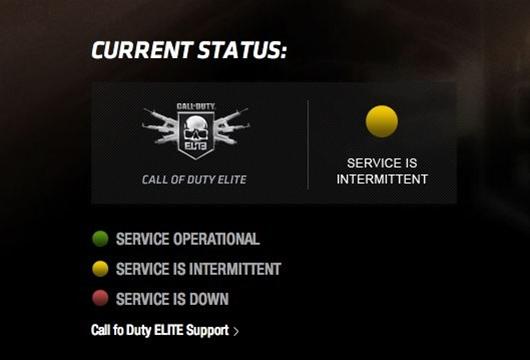
Seems like a valid complaint to me, and when all anybody wants to do is give the game a 10, I feel like I’d give Call of Duty a 0 as well (Full disclosure: I have never reviewed anything on Metacritic. And I’d give call of duty a 7). When the media charged with critiquing games is minting every big-budget release as a 9 or a 10 just for being playable, can we really expect more discretion from anonymous users on Metacritic? And it isn’t just IGN, though I focus on them here.

The industry really has no critical perspective on games as a medium, as component pieces of a large entertainment medium that will keep pumping out derivative works if we pay for them and review them favorably, and it’s not doing much for the argument that the field can produce an experience with artistic merits. It definitely still can, but the November blockbusters aren’t heading in the right direction, and I’d appreciate it if at least one mainstream site would acknowledge that. End rant. I’m off to play Catherine for a third playthrough.

Leave a comment

Filed under Uncategorized

Groupon’s IPO will challenge the SecondMarket business plan, just as the company releases positive growth data

SecondMarket, the secondary market (it’s a well-named site, at least) for shares of private companies, is going to be tested by one of the major companies it provides liquidity to when that company goes public.

Two big events are going on right now for SecondMarket: First, they released their Q3 numbers, and they are growing significantly. The number of participants is up to over 75,000, a 333% growth from last year. The company has conducted $435 million worth of transactions this year, a 75% increase from last year. As they noted on their blog (first link above), the company is conducting “liquidity programs” for many companies at sizes that, in the past, would have likely necessitated an IPO. They also released some descriptive statistics on the people behind the transactions themselves – the sellers of the securities are overwhelmingly ex-employees (64.5%) or current employees (16.9%), and the buyers are overwhelmingly private individuals (63% of the cash spent). The top companies purchased were Facebook, Twitter, and Groupon, in that order.

Second, Groupon is looking like they will actually go ahead with their eternally-delayed IPO, and it’s being guesstimated at a price of $16-18 per share. Comparing it to the big IPOs of this summer (Pandora and LinkedIn) seem to sugest that’s a reasonable range, if you are a fan of young companies with unproven economics (no judgment intended there – many investors apparently are). Problem is, shares on SecondMarket (and SharesPost, a similar site) have traded at an implied valuation of $20-30 billion, whereas the IPO looks to value the company at far less. For reference, I’ve heard of Groupon stock selling on SecondMarket for as much as $60 a share. That’s a pretty big gap for holders of the stock on these secondary markets, who look like they stand to lose more than 70% of the value they paid for just weeks ago.

There are a ton of interesting issues raised by the existence of SecondMarket in the first place (isn’t it clear that SecondMarket supports a speculative bubble if the valuation of a major company traded on the market is inflated by as much as 70% per share? isn’t selling shares at a massively inflated rate to a majority consisting of private individuals the definition of subprime?), but this should challenge the business model as a whole. If we see the other 3 major companies on the exchange (Facebook, Twitter, and Zynga) go public to similarly deflated valuations (compared to the valuations on SecondMarket and SharesPost), then we may see individual investors losing and subsequently pulling back from the private company market entirely. I’d guess Zynga is the next to go, and maybe if investors on SecondMarket believe that Groupon’s IPO is a representative of how Zynga’s IPO might go, we may see shares fall in price as a result.

Leave a comment

Filed under Funding, Law

Breaking my hiatus with a flurry of random thoughts

After a long hiatus for some personal reasons, I’m back! But, this means I have a store of ideas that I didn’t write about. Some of those ideas are now no longer worth covering because they’ve been beaten to death by other sites, but the ones that are still interesting I’m just gonna run through right now to get it out of my system, no rhyme or reason, and little theme besides being among the topics I frequently write about. Let’s get going:

Arkham City is great, but the initial user experience is flawed, and the game outlines a problem with comics-as-broad release media

Loved Arkham City. Played a LOT of it last weekend, probably only possible because my girlfriend is out of the country at the moment. Arkham City launched with a pretty bold, but increasingly common plan to increase sales and profits. Sales, by offering a ton of extra content for new game purchasers (as opposed to used game purchasers), and profits, by having a ton of extra downloadable content to squeeze a few extra bucks out of hardcore fans. It’s hard to fault Rocksteady, the studio behind the game (or any of the other members of the supply chain), for this approach – the used game market is a constant concern for studios, especially during a recession, and providing lots of bonus content both incentivizes new game purchases (by including the content for free with new games), and giving the studio a way to make money on the used games (through the customers then paying for downloadable content). I’ve ranted about terrible DRM as a system that only punishes good customers on my blog before, so I should be in favor of this setup, right?

The problem is, the customer is still the loser here. I bought the game (in fact, I pre-ordered it!), and my reward was that the first time I sat to play the game, I had to enter 3 separate 16 digit codes into the Playstation Network, wait for each of those 3 packages of content to download, and then wait for each of those packages to install. So I spent 15-20 minutes downloading and installing the content I paid for before I even got to fire up the game. Loading screens are obviously a problem for any game with downloadable content, and installation is unavoidable in some situations (PC games in particular) – but having your big blockbuster piece of work open with 20 minutes of downloading and installing is not exactly a killer introduction to the product. Is it better than a lot of DRM? Definitely, because at least it rewards the honest customer with more content rather than punishing them with potentially invasive bloatware. But it’s still a pain, and there must be a better way.

In another unrelated complaint, of the many reviews for Arkham City I saw this week, only one (Kotaku) mentioned a major gripe I had with the game – it doesn’t really push the Batman plot anywhere. This is a problem with any comic-based mainstream story at this point, in that the non-comic media is often limited to stories drawn from the official “canon” of the lore as told in the comics. Put another way, Batman can’t die unless he dies in the comic. Obviously nobody is going to kill Batman anyway, but this mostly holds true for every plot element – none of the villains can die unless they die in the comics. So they are stuck rehashing events that comic fans would already know, and they can’t deviate far from the story as outlined in the comics. This has basically been an issue for every single superhero movie in the recent wave of superhero movies, and while it hasn’t hurt box office numbers much, it might in the future as the limitation plays out over sequels. I’d love to see more companies take the JJ Abrams/Star Trek approach with their IP, giving full reign to a new retelling of an old story keeping just the characters and breaking canon.

Seed stage funding bubble, part II of my post on regulating securities of private companies rumored to come soon

Basically everybody reported on a WSJ article that claimed there was a dearth of funding out there for seed stage companies. It was vigorously responded to, mostly by people refuting the sentiment. My opinion is that while the data the WSJ looked at seems to match historical, quarterly variations in funding statistics, it still seems obvious that new technology has been making it easier to invest, while not making it quite as easy to gain liquidity and get out. Assuming there is a class of people who only want to invest in the seed stage (the angels), then those people have had an easy time of late finding companies to invest in, without finding an easy way to get liquidity from even successful early investments. Angel.co has made finding companies to invest in quite easy, but the time it takes to get money out of those investments hasn’t been quickened in any respect (in fact, given the many delayed IPOs and general malaise of the economy, it’s probably harder than it has been in the past). SecondMarket is definitely doing something to help liquidity for pre-IPO company stock, but it is probably being utilized by employees more than investors, and it’s still a relatively small group of companies compared to the number of companies on Angel.co. So, to me, it seems quite natural that there would be a slowdown in seed funding, and that companies who found plenty of seed investors would have trouble finding Series A and B money. Tech is also prone to bubbles, but that’s for my future, upcoming post on private company regulation.

Tale of two major branding efforts of social games, with very different results

Probably the two most anticipated social game releases on Facebook this year were by traditional console/PC powerhouses new to the Facebook platform. I’m talking about EA’s Sims Social, and Firaxis’s CivWorld. Both were closely watched, as they both were backed by major studios, utilizing the full force of their IP, hoping to break into the Facebook social game scene. Obviously there is a major difference between the studios in that Electronic Arts has 45 titles on Facebook right now, and they’ve spent hundreds of millions of dollars on acquisition like Popcap and Playfish to become a force in the social game market, whereas Firaxis has just the one title, CivWorld, and no experience on Facebook (parent company Take-Two also has no titles on the platform). Both games have been out for a while now (CivWorld in July, Sims Social in August), so it’s safe to make some conclusions about how the efforts went.

Who won? Sims Social by a landslide. Sims Social reached an all-time high of 65 million monthly users (though they took a 20 million hit when Facebook updated their user calculation algorithm), and they are currently cruising along with about 8 million daily users. CivWorld, on the other hand, completely crashed. The all-time high for CivWorld was only half a million monthly users, and they’ve since slid quickly to less than 100,000 monthly users and only 10,000 daily users. I haven’t played either game enough to know if there was some sort of specific disaster with CivWorld, but I played both and they were both solid efforts. Reviews were mixed for both (nobody knows how to review a social game yet, though), but obviously the results were dramatically different.

There are probably numerous takeaways here, but the big one is that having a strong IP, with lots of buzz, and even a strong game itself, isn’t enough on Facebook. The Firaxis team just simply doesn’t have the experience that the EA team has, and obviously those Playfish and Popcap acquisitions are paying off in some fashion. EA knows how to make social games now, and Firaxis doesn’t. Lots of factors go into that – the ability to effectively cross-promote with other games in the network is obviously a huge advantage for EA, but one would have thought that the amount of exposure CivWorld was getting could have made up for that. Now we know that no amount of exposure can make up for a huge installed user base and multiple games to draw experience from. Zynga has probably known that for years, but if there was any question, CivWorld’s flop may have settled it. People may look at EA’s success as a sign of weakness for Zynga, but that’s overlooking the fact that EA spent over a billion dollars to acquire two huge social game studios to reach a point where it could leverage it’s IP into fans on the platform. A billion dollar barrier to entry is pretty solid protection for Zynga’s business model.

Leave a comment

Filed under Copyright, Funding, Games, Social Games

State of the Android market; is the patent fight going to encourage the move to Facebook as an operating system?

A bunch of things have happened recently that seem to be pointing to an inevitable conclusion in mobile devices – Android is going to die, and if HTML5 comes around soon enough and with enough developer support, the mobile operating system as we know it might die as well.

The most recent cluster of news in the space consists of Samsung agreeing to a patent licensing deal with Microsoft over Samsung’s Android devices, Samsung joining forces with Microsoft and Intel to work on a new mobile operating system based on Linux, Google buying Motorola to bolster it’s ability to mount a defense of Android (which should have the unpleasant effect of scaring away the other OEMs who push out Android phones), and Amazon launching an Android-based Kindle Fire which aims to be an ipad killer. Oh, and Spotify’s partnership with Facebook is coming to fruition, proving to be a rather genius way to ween people off of itunes (i’ve barely opened itunes since starting with spotify, and once I can open spotify through Facebook on my phone, I may never touch itunes again).

How does all this information fit together?

Amazon is going to get hit with a patent infringement suit from Apple really fast. Then Android is going to die.

Apple has been aggressive, to say the least, in attacking the Android ecosystem with patent suits. Microsoft has done the same. The combined effect? Companies will be wary of putting money behind a system that may get them sued into oblivion. If Amazon somehow evades the ire of the anti-Android coalition, maybe Android is saved as a potential OS to compete with Apple’s iOS. But given Apple’s aggressive attacks on Samsung in Europe over tablet competitors and their attacks on the Android ecosystem in general, I wouldn’t hold out hope that Amazon is going to get away with launching a major Android tablet without Apple taking action. Maybe there is hope beyond the Kindle Fire, but I’d also wager that if it fails, it’s going to be the last major Android tablet to come out. Android tablets have done absolutely horribly this year, to the point where retailers are having to discount them to almost half-price just to move them. Given the lukewarm reception and patent woes, it’s a bad investment for companies to keep cranking out Android tablets. If companies continue to be exposed to massive patent suits for using Android, it’s only a matter of time before the entire OS collapses.

Facebook is in a better position than ever to become the mobile company they plan to be.

Facebook has been vocal recently about wanting to be a mobile company, and if their Spotify partnership is any indication of where the company is going, I think it’s only a matter of time before they become the default starting location for all things on mobile phones. I was lukewarm on Spotify when it launched – my review of my initial experience concluded with a passing grade of “B” for the service, but that was on the first day it was available in the US. I said I wouldn’t still be paying for the service after a month, but 2 payments later and I’m still using it. I can’t stress how important Spotify’s partnership with Facebook is in my mind – this partnership puts Facebook in position to attack the core of iOS – iTunes. As I mentioned, iTunes is going to die in the face of this partnership – Spotify + Facebook nails the social element of sharing music unlike any prior service, and it just simply offers more than iTunes at this point. So Facebook has an iTunes killer now (only a matter of time before Spotify runs inside Facebook), they’ve got big dedicated app developers (Zynga, EA, Kabam, etc.), they’ve already had messaging and chat, we know they are working on an app market based in HTML5, and the newsfeed is an excellent homepage if you snap a basic web browser on the top. Plus users are comfortable navigating Facebook, so the transition to Facebook-as-operating-system would be seamless for most. Only a matter of time in my mind, and if Facebook approaches device-makers who are frustrated with Android and looking for an alternative, Facebook could make major in-roads into mobile almost overnight.

Google+ can’t transition to mobile like Facebook.

Why can’t Google do the same thing with Google+ that Facebook is going to do with… Facebook? They could, but they don’t have nearly what Facebook has in terms of critical user mass, nor do they have the partnerships in place to transition app developers to Google+. Developers don’t work directly with Google on Android apps like Facebook developers do with Facebook, and if Android dies anyway, the transition from Android to a different Google+ system would likely be more rocky than for Facebook to move developers from web to mobile (especially if web IS the mobile OS… it’s like the twilight zone). Also, Google is tied to Android now with it’s Motorola acquisition, making a transition away from the OS unlikely.

So I’m liking Facebook right now, I think Google is in a tough spot with Android because of the patent issues (forced to buy a company to acquire patents to defend an ecosystem that other device-makers don’t want to be a part of if Google owns a competitor), and Amazon has to really really hope that Apple doesn’t notice that they just launched an Android tablet.

Leave a comment

Filed under Misc, Patent, Social Games

I could forgive the Milkens, but that doesn’t mean I want their money

Most of my blog posts are about random topics that I find interesting in IP law, startups, or whatever. This post is so that in the future, when somebody asks me how I felt about my law school accepting a gift from Lowell Milken, I can rest easy knowing that I publicly announced my disapproval.

UCLA Law recently accepted a gift from Lowell Milken for $10 million dollars, and it has caused a bit of a stir (though shockingly little is actually said about it on the campus itself). For the uninitiated (which I was until very recently), Milken’s brother Michael was the centerpiece of the junk bond scandal in the 80s that resulted in Michael serving 2 years in jail and paying $600 million in fines and restitution on 98 counts of racketeering and fraud. He also paid investors $500 million in a civil suit. Lowell, Michael’s brother, was Michael’s second-hand man in many regards, and he hardly escaped the scandal unscathed – Lowell was charged with securities, wire, and mail fraud, he was barred from practicing before the SEC, and barred from holding a position with any member firm of the NYSE. Lowell, however, was never convicted of anything, as his brother made it a condition of his own plea deal that charges against Lowell be dropped. Many critics seem to think that because Lowell was never convicted of anything, he should be absolved of all blame – that’s one opinion, but I think an equally valid one is that being barred from practicing before the SEC and the NYSE is a pretty bad thing for a securities lawyer.

I don’t object to Lowell Milken’s gift because he is a horrible person – honestly, he’s done some very philanthropic things with the money he made. That money might not have been made through the most ethical of means, but at least he and Michael have put it to some good use in a multi-decade campaign to improve their family’s name. Michael served his time and paid back a tremendous amount of the money he made, Lowell evaded more formal penalties and kept all of his money, so maybe it’s time to stop holding it against them that they were involved in a massive fraud scheme (I’m not saying we should stop holding it against them, but at least there is an argument to be made). Michael’s apparently been extremely generous in donating to cancer research, and Lowell to education, which they both deserve credit for despite their past. I’m definitely not saying that Lowell or Michael are terrible people who should go to jail.

I object to the money because UCLA doesn’t need $10 million badly enough to justify subjecting the professors and students at the law school to scrutiny about our ethics. I don’t want it made more clear to the world that Lowell Milken went to UCLA! He’s barred from practicing in the field he made all his money in because of ethical violations! What’s more, the school now wants to name the entire business law program after him. If I was a part of that program, I would quit immediately and demand it be removed from my transcript. The first thing prospective employers see when they google ‘UCLA business law program’ will now, and forever, be the name of an attorney infamous for being a centerpiece to securities scandal. And in this climate, post-massive-bailout, to name the business law program after this man? MAYBE his transgressions are forgivable as a person, and perhaps his money would be fitting as a general gift, but as an attorney I would not want my reputation tied to a business law program named after a man who was barred from practice before the SEC and NYSE.

Not that it should matter what the amount is, but furthermore, $10 million is nothing speaking longterm. Because we are part of the UC system, 40% of that goes back to the main campus. The rest goes to the now-tarnished business law program. So the law school takes a reputation hit, our business program is forever tied to this man who was barred from practice before the SEC and NYSE, we will likely lose out on professorial talent (both current and prospective), all for about $6 million bucks. Listen, I’m a law student, I KNOW what it’s like to be strapped for money – but I say no thanks to the Milken gift. I’m not even sure the benefits of the money outweigh the costs, and you don’t compromise your ethics as an institution because the economy is tight regardless, especially in the environment attorneys currently practice in where ethics surrounding securities transactions are a constant concern. UCLA is doing no favors to their graduates by naming anything at UCLA after this man, and I respectfully object to accepting the gift.

Leave a comment

Filed under Law

Oddities of the new patent act

If you read my blog often, you know I like patent law. It’s a fascinating, convoluted mess that’s become (fortunately or unfortunately) incredibly relevant for technology companies. Major areas of law rarely receive substantive overhauls, and even more rarely does an overhaul happen in an area of law that you have an intellectual interest in, so I feel lucky to be around studying Patent law at a major turning point. The zeitgeist of the patent world/blogosphere is rather unique right now – It’s like a new season in a sport or a television show; nobody knows exactly what to expect, there are lots of unanswered questions, and everybody has an opinion on how that last season went and what needs to change.

In my opinion, the last season of Patent Law:USA went just okay. Got a little out of hand there at the end, akin to a TV show that gets a bit away from the writers in the final few episodes – sort of like LOST season 2. Everything was going pretty well in the Patent law world until we got to the late 90s, when business methods patents and the internet sort of took us in directions we hadn’t contemplated originally in terms of intellectual property rights. “Prior patent + ‘on the internet’ = bad patent” was the rallying cry of a host of critics – but those critics likely don’t see much on the face of the new act to give them hope that the problem is solved. I for one am somewhere in the middle when it comes to opinions on the last season of Patent Law – I’m not an extremist who thinks we need to blow up the whole system, but there are definitely problems with patent trolls and with software patents in particular that I think need to be addressed, as they put an impossible burden on new companies and reduce the efficiency of capital flowing to useful ends.

Anyway, enough opining on our long lost Patent season (which, as it turns out, will have plenty of support in reruns… see below). We have a new patent act that takes effect in various stages anywhere from last friday to 18 months from now, and I want to cover some of the strange aspects of this reform:

There are now two different, substantive bodies of law on patents, and there will be for the next 25+ years

Every patent currently issued and every patent currently on file (except for those filed in the last 4ish days) is subject to the “old” patent law regime. Considering that the PTO takes quite a while to grant a patent, that there are provisional patents out there (many, many filed last thursday), and that you can file continuation patents and extensions, that “old” patent law we all know and love is far from dead – it will take 25 or more years for every patent issued and subject to the “old” laws to expire. That sounds like just a cute and potentially confusing nuance until you consider that major companies will likely hold patents under both regimes – and they will sue asserting patents from both regimes. Starting in 3-4 years once we see issued patents under the new regime, we may see litigation where completely different rules apply to different patents at issue in the same case. This could be extremely confusing for juries given some of the other substantive changes to the way things like prior art are handled, with some prior art able to invalidate earlier patents but not later patents, a result laypeople will find illogical.

Similarly, there are now four different types of reexam

I haven’t tracked the timing of various parts of the bill closely enough yet, so I’m not sure if there will every be a moment in time where all 4 types are potentially going on at the PTO, but in theory there are 4 types of reexam proceedings that can be initiated in the next year or so (the current ex parte and inter partes, and the new post grant review and new inter partes). Reexam is actually getting a huge substantive overhaul, the primary changes being that it now takes place like a mini-trial with discovery in front of a 3 judge panel with a one year timeframe. That timeframe might be a huge boon to defendants, who may be able to convince judges to stay a district court case more easily if they can guarantee that the PTO will finish the reexam in a year, when a district court is often just getting to the Markman hearing. Lot of “maybe” in there – the thrill of a new patent act – but it seems that reducing the timeframe for reexam should encourage defendants to explore that option more frequently, with courts likely more willing to stay a case in the meantime.

It’s hard to imagine anybody using the new Post-Grant Review form of reexam

The new reexam regime is split into two timeframes – if you apply for review within 9 months of issuance, you do the new Post-Grant Review process; otherwise, the new Inter Partes process. The standard is either lower or higher than the standard for inter partes depending on how you interpret the statute, and you have access to more prior art to invalidate the patent, but you also risk never being able to challenge the patent again – the loser of a PGR is estopped from asserting invalidity on effectively ANY ground. That’s a pretty big risk even for a challenger who has a slam dunk piece of prior art – even if you are 90% sure you’ll prevail in that review, why not wait and bring out the prior art in court? It will be interesting to track how firms and companies strategize around the new review process, but given the incredibly high stakes for losing a PGR and the relatively low stakes of a district court ruling, it seems unlikely that the PGR will become a popular choice. And remember, PGR is only available for 9 months following issuance of a patent, which is a rather narrow window considering the planning that needs to go into filing for the process.

That’s just a few of the interesting twists thrown into the system by the new Patent Act – haven’t even mentioned changes to the joinder rules, or the odd place obviousness may be in after switching to the first-to-file-or-publish system. Lot is still up in the air, there are lots of terms in the Act (which is pretty poorly drafted, actually) that will garner significant debate and eventually litigation, and the full scope of the changes probably won’t be appreciated for many years.

Leave a comment

Filed under Law, Patent

SEC considers loosening regulations, how big would a “crowd-funding” market for startups actually be?

The SEC has formed a committee to analyze regulation around fast-growing companies, and today the House held a hearing on “crowd-funding” for small companies.

On the SEC side, looking to reform regulation around private companies and their ability to raise money is probably a good thing – the market is already doing it, perhaps most publicly exemplified by Facebook using Goldman Sachs and a special purpose vehicle to effectively beat the 500 shareholders of record limit – so, it’s about time that the SEC at least looked at the regulations and decided if they make sense in the context of successful, private companies. But considering those market shifts, I’m not sure regulation is needed to further open the floodgates to private, unsophisticated investors – The Groupons, Zyngas, and Facebooks of the world have no problem raising money until the time comes to file for an IPO, and smaller companies don’t feel pressure from the 500 shareholder limit, which is really the only regulatroy constraint on a company’s growth in that stage. If Facebook’s Goldman Sachs strategy becomes popular, I’m not sure there’s a good reason to loosen regulations on a segment of the capital market that seems to be working quite efficiently. That said, the makeup of the committee is largely representatives from the big private companies I just mentioned, and likely they will push for an abandonment of that 500 shareholder cap.

As for the notion of “crowd-funding”, that doesn’t make much sense to me either. Small companies as a whole have a tremendously low success rate, and I’m not sure it’s in the public’s best interest to have a private market with lower disclosure requirements for funding small companies with 90% failure rates. Even if you focus on the technology/energy/etc startups that tend to come out of startup-heavy regions like Silicon Valley, those startups still have a huge failure rate (at least 40%, my quick survey of blogs seems to suggest), and the startups already have pretty excellent access to capital through VCs, superangels, and angels on Angel.co. Maybe the costs of raising capital for some of those startups would go down, but probably not by much, and it might be better for the public if the risk of those companies failing was taken on by large institutional investors who can better calculate the odds. While I’ll admit that I’ve only considered the benefits of “crowd-funding” for about 15 minutes, it doesn’t strike me as something the startup world is dying to have – picking winners in the early stages of startups is hard enough for institutional investors, and I imagine after one or two rounds of losing money on short-term, low-value investments, most small-time investors would realize it isn’t as fun to invest in startups as it is to read about them. VCs aren’t even that great at picking winners: ten-year returns for VCs as a whole are reported at anywhere from 8.4 percent to a loss of .09 percent, depending on where you get your information, which isn’t necessarily a better return than investors get in the existing public market. If VCs can’t pick winners with all of their knowledge and all of the advantages they convey to the companies they invest in, why would anybody think the public could?

Leave a comment

Filed under Funding, Law

Nintendo seems to be in deep denial over mobile games, still thinks the iPhone is off limits, still thinks the 3DS is the future of mobile

Nintendo’s President is insisting that the company won’t get into the iphone development game, instead focusing on producing content for their own hardware platform. After saying that development for iphone was absolutely not under consideration, Iwata said:

“If we did this, Nintendo would cease to be Nintendo. Having a hardware development team in-house is a major strength. It’s the duty of management to make use of those strengths. It’s probably the correct decision in the sense that the moment we started to release games on smartphones we’d make profits. However, I believe my responsibility is not to short term profits, but to Nintendo’s mid and long term competitive strength.”

As some background, Nintendo recently released the 3DS, they’ve already had to drop the price once because of lackluster sales, and still the system is expected to miss sales targets. As more background, Nintendo has been very slow to get with the new world of games – whereas hardware makers like Microsoft and Sony are encouraging lower price point games on their Live Arcade and PSN networks respectively, and whereas game developers are increasingly tapping that low price point market (see Electronic Arts purchasing social game companies like Popcap and Zynga purchasing mobile companies like Newtoy), Nintendo is still running a business model that looks a lot like what they did in 2000, trying to push their own hardware with limited internet connectivity out, hoping their creativity in first-person development is enough to sell the systems.

And look at that middle sentence in the quote from Iwata – Nintendo knows they would make profits on games released for iphone. Apparently Itawa thinks that development for iphone would only boost short-term profits though, and not mid and long term strengths. This is ridiculous in my mind – maybe 3DS sales would be hurt if every game was released concurrently with an iphone version (ok, they would definitely be hurt if that happened), but sales of games on the rest of Nintendo’s hardware would only be helped. The Wii U is coming out next year, and being the only major hardware company with a huge first-party game development team that cranks out instant classics is a huge strength compared to the other hardware makers, but maximizing that strength depends on Nintendo getting into the iphone market now.

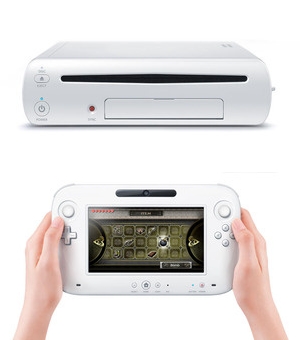
Here’s what I envision being the best case for Nintendo – 3DS sales are mediocre (yep, that’s the best case), and resources shift to Wii U at and around launch. Nintendo takes advantage of their in-house development strengths by releasing games for the Wii U concurrently with iphone games that extend the experience to mobile and impact the console versions, a direction many console developers are already moving in. Nintendo, because of the strengths Iwata notes, is uniquely positioned to take advantage of a market where a console game and a mobile game interact – they have the developer prowess and some of the best IP (Mario, Starfox, Kirby, Zelda, etc.) on the planet to make it happen. The Wii U already has a damn ipad/iphone for a controller – let your hardware geniuses figure out how to match the controller up to interact with the user similarly to how an iphone interacts with the user, and then release mini-games for the iphone that report back to the game (maybe even grab a hot patent on that, while they are at it! Or pay Intellectual Ventures if they already have one…).

Let me put it another way: If you were Nintendo’s President and Apple came to you and said “we really want to release a phone that looks exactly like your console’s controller – we are going to manufacture it, get the wireless providers onboard, sell it in our stores, and foster a huge game development community for it, and all we want from you is to put some of your mini-games on it for our millions of customers to buy, are you in?”, would you say no? So far Nintendo has said no. Because they want to support their own in-house hardware team, and don’t want to give up on mobile. Seems like a huge missed opportunity.

There’s some larger context here in terms of Sega’s transformation into a third-party developer, and Nintendo not wanting to go that route (being the only purely-gaming company left to make hardware). And I LOVE Nintendo, but they need to unchain their game development from their hardware development if they are going to make it past this next console cycle. If they don’t, I predict the Wii U to be the last console release for the company. I’ll be glad to eat those words if I’m wrong, because I’ve been waiting for the next Smash Bros for years.

Leave a comment

Filed under Games, Social Games