Would regulation of the VC/private company market help anybody? Part I

Some background for this post: Facebook has recently been rumored to have raised money at a valuation of $100 billionSecondMarket, a brokerage for private company stock, has grown as a place for robust trading of consumer web company stock, transacting over $150 million in the first quarter of 2011; interest in private or pre-IPO consumer web companies like Groupon/Facebook/Zynga are possibly at an all-time high; everybody is sure that we are either in a bubble, or not in a bubble. Also, I’m writing a paper for a class. 🙂

Now, looking at the information above, it’s not clear by any stretch that the market for private company stock needs to be regulated more than it is. In fact, the presumption is probably that government should stay the hell away from one of the few sectors of our economy that is experiencing some growth. Considering the general health of the industry, regulation seems to make little sense – But I would argue that the industry could benefit from regulation if and only if that regulation helped cure the one systemic ill that seems to serve as a detriment to the startup/tech world, the bubble cycle. As people in the tech world are acutely aware, tech seems to ebb and flow, with a bubble/crash/bubble/crash cycle. The system, unregulated trading and all, seems to work great in the boom years, and then in the bust years nobody is looking to put more restrictions on already rare funding rounds, so regulation seems unlikely to ever be advocated for by insiders. But if some regulation would soften the bubble by lowering the volatility of the market, that would be one scenario where regulation might be favorable.

Currently, private company funding is essentially unregulated. Public companies are forced to disclose a whole ton of information through various (expensive) public disclosures. On top of restrictions regarding insider trading, liability for false statements, and other shareholder protections, this is how public companies are regulated. Private companies are largely exempt from reporting most of these things, as they raise money from institutional investors or “accredited investors” through non-public offerings.

Why we don’t regulate private companies now – 

The justification for the exemption of private companies usually falls into some combination of: “accredited investors” don’t need as much protection as the public and transaction costs associated with disclosure are too high for small companies to afford. The first justification, however, is slowly becoming less applicable, as the standard for who qualifies as an “accredited investor” has failed to keep pace with inflation, and sweeps in a much larger percentage of the population than Congress must have intended when they wrote the regulations in 1933. The second justification becomes less convincing when the companies seeing large markets for their stock are highly profitable and valued in the billions, as is the case with currently-private Facebook and Zynga. So maybe it is time to start considering whether some regulation for at least the upper-class of private companies could temper the boom and bust cycle without disrupting the markets for fundraising at the lower end of the private company spectrum.

Could regulation temper the bubble cycle? – 

The most common form of securities regulation is probably mandatory disclosure. Public companies are asked to do this very consistently, as a way of providing their shareholders or potential shareholders with a broad view of the state of the company. Private companies don’t provide public disclosures – they get information to their smaller group of investors through other means, such as by granting those investors board seats or simply meeting with the investors frequently. Being a seed or angel investor in a private company surely grants that angel a more favorable position in terms of access to information than I have buying stock in Microsoft, thus the lack of formal disclosure has little practical significance for the institutional investor in the market for private companies.

But the issue I am most interested in, and the angle from which I believe regulation looks most desirable, arises when the successful private company files for an IPO. Focusing here makes sense – many use the IPO market as a proxy for whether there is a tech bubble, and bubbles seem to burst at the IPO level rather than at the level of, say, Series B or C investments. When a company files for an IPO, they are forced to make their first public disclosure, and likely the only disclosure they’ll make before shares of their company are put up for sale (unless they make Groupon-level mistakes and are forced to amend multiple times). This, and the newspaper articles describing the unbelievable valuations of the company, are all the public investor has to go on to make his or her judgment about the value of the company – and in reality, the public investor probably didn’t actually read the public filing anyway, but maybe skimmed a blog post on it. I’ve also noted elsewhere on this blog that usually VCs backing the IPO company are looking for a hasty exit, so the very group setting the earlier valuation now benefits from a public perception that the company is worth more than it actually is.

So the real question is, would forcing companies like Facebook or Zynga or Groupon to file more than one public disclosure before filing for an IPO make the market any more efficient? Would it effectively stem the tide of irrational investments into non-performing or underperforming companies, the canary in a mineshaft for a bursting bubble? Are there any other mechanisms or other forms of regulation available to fight the bubble problem? I’ll save looking into those answers for Part II.

Leave a comment

Filed under Funding, Law

Diablo 3’s DRM : why I don’t like it

Blizzard announced last week that Diablo III will come with DRM that prevents players from playing the game unless they are online. Presumably this is an anti-pirating measure – being online will allow Blizzard to check your CD-Key against a database of CD-Keys, and thus prevent multiple people from using the same CD-Key simultaneously. But DRM is a terrible idea – As Sony found out this Spring, restricting what your consumer can do with a product they purchase can have tremendous consequences for a company. Blizzard is obviously unlikely to be attacked as viciously as Sony was, but the business and legal ramifications of bad DRM can be far-reaching even in the field of computer software where DRM is relatively common. EA saw a hard backlash against DRM in the game Spore a couple of years ago, with players harshly rating the game on Amazon to express their displeasure.

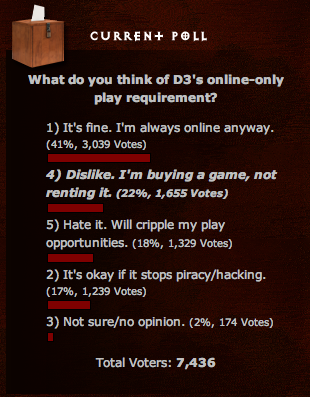
But back to Diablo III: Everybody who is looking forward to the game knows about this DRM by now – it’s garnered a tremendous amount of attention on websites of all varieties. A Diablo fan site recently conducted a poll, with the following results:

Obviously these aren’t the most scientific poll response choices, and the political science major/statistics guy in me is cringing at the double-barreled options on there (I hate the DRM but it definitely isn’t going to cripple my play opportunities), but clearly a lot of people don’t like the DRM. 40% either dislike or hate it.

Besides being interested in games, there is a legal component to this – when you buy Diablo III, you’ll be buying it under a lease agreement subject to a terms of use, which is how companies like Blizzard control and restrict the activity of a player. Doing this with software is nothing new, but let’s be honest – nobody reads those terms of use when they install a video game. Players have been clicking through those terms without thinking about the property rights (understandable, really) for years. Players simply assume that they purchased a game, that they are free to resell it, that they own it currently, and they can do what they want with it (except for a few things that will get them banned online, but that doesn’t usually enter the mind of a player as a limitation on a property right). As the phrasing of the “dislike” option in the results above shows, consumers really do think they “own” the games they purchase free from obvious limitations on things like copyright.

When a company like Blizzard makes a move like putting an online-only DRM onto a major release, it pushes the fact that the player doesn’t own the game into the player’s face. I’d argue that this isn’t a good thing for game developers – for better or for worse, players believe they own the games they purchase, even if that belief is somewhat incorrect. When that belief is disrupted by new, invasive DRM, players tend to get upset and generally pessimistic about the intent of the companies, who players view as punishing their paying customers.

I’m generally against putting DRM in a game for a few reasons:

For one, it isn’t a low cost for a developer.

Putting in traditional DRM like a CD-Key is cheap, but it also is incredibly easy to break, because hackers have had years of experience cracking existing DRM. For DRM to really work with computer software, a company needs to make something relatively customized, which usually involves hiring a security company. This isn’t going to be cheap, and the consumer gets to pay for that cost a lot of the time, though often indirectly through a diversion of resources away from making the game higher quality.

Second, it never works and doesn’t make financial sense.

I don’t have the stats to back that one up, but DRM doesn’t work. There’s something of an economic reason for it, so that will have to suffice for lack of empirical evidence. Think of the PC game economy as having 4 actors – there is the game developer, the paying user (“user”), the non-paying user (“pirate”), and the hacker. Putting DRM on a game has a cost – the initial payment is made by the game developer, but the cost is ultimately passed on to the paying user in the form of a lower quality game for the same price (since the developer diverted some resources away from making a higher quality game to put towards the development and testing of the DRM). The pirate bears none of the cost, because they aren’t paying anyway, and the hacker (who might also be a paying customer, a pirate, or even a developer in rare cases) is presumably motived by the desire to crack the game. This is actually a somewhat interesting point that I think is overlooked – hackers are naturally attracted to new challenges, and DRM is one place where an amateur hacker’s natural propensity for computers and likely shared affinity for games played on them leads to a cracking race. PC games are often cracked by the hacker community in less than a week, and major releases with new DRM tend to excite that community more than the simple CD-key crack, because new DRM brings some level of prestige to the first hacker to crack it. I can guarantee you that not only will Diablo III be cracked in a week after release, but it will be widely reported news because of Blizzard’s approach thus far. So hackers actually see new DRM as something of a gain, pirates are unaffected, and paying customers lose, while the developer is spending the same to put out an inferior product, which will likely sell worse. All the costs of DRM are born by the people already paying to play, and there’s mostly only an incentive on the side of the nonpaying pirates and hackers. The financial logic just isn’t there.

Third, it generates bad press, and burdens the paying customer more than any other party.

As the poll above and hundreds of other articles on the topic show, Blizzard has already paid a price for publicizing the DRM they are throwing on Diablo III. Will it hurt sales? Maybe not – it’s a multiplayer game that 90% of people want to play online anyway. But they basically just killed all of their single-player only sales, and limited the ability of some to enjoy the game entirely. I plan on buying the game, and now I’ll have a slight chip on my shoulder for having my play limited by Blizzard’s desire to cut back on activity that I don’t even engage in (though I’ll admit to having hacked Diablo II a vast number of times back in high school). If Blizzard wasn’t making a game that I’ve been waiting for for almost a decade, I’d actually consider avoiding the game. I’m sure less interested fans will be turned off completely.

Leave a comment

Filed under Copyright, Games

My Pre-Football Fantasy Cheatsheet

I know, I’m crazy. Had a page for every position 🙂

Leave a comment

Filed under Uncategorized

How the future of Social Games is related to patents, to Google+, and to Zynga’s deal with Facebook

Social games are an industry I follow pretty closely; I currently work for a social game company while I’m attending school, and I’ve always been a fan of videos games and interested in startups, which collide in the realm of social games.

The industry is young, but already the first phase is coming to a close in a sense. Facebook was the first dominant platform, and Zynga the first dominant developer on that platform. The iPhone became the next truly conquerable territory, and Rovio probably captured that market better than anybody else. There’s a few things that I think will shape the next phase of social game development:

The result of the Lodsys patent suits

Lodsys is currently suing a bunch of mobile companies (including Electronic Arts and Rovio) for patent infringement. Lodsys is a “patent troll” – a term used to describe an entity that doesn’t make a product and acquires a patent solely to license it, or sue if companies decline to license. Lodsys is hardly the first company to take this approach, but it is one of the first to actively go after mobile developers on ios and Android. If Lodsys succeeds in gaining licenses, or if nobody steps up to pay to challenge the patent in court, the chilling effect on app developers could be big – and it could potentially slow growth of social games on ios and Android if the developers fear that success will lead to an inevitable patent suit.

Google+’s success, and their games platform

Google+ is definitely a product that many game developers are cheering for. Game developers would love another platform to publish on aside from Facebook – Facebook is a wonderful platform, but ever since Facebook cut down on the ability of new games to access virality channels, it has been hard for new developers to gain a big following on the platform. Facebook is actually saying that they will start integrating some new virality that social games can access, specifically reopening the possibility of game activity posts being displayed on the new feeds of Friends who are interested in games, but a new platform would have all sorts of other benefits. For one, Google+ may start out by offering developers an open platform for payments, whereas developers are now forced to utilize Facebook Credits for monetization on Facebook. Additionally, Google+ might push down the industry standard 30% cut that both Apple and Facebook take for their game platforms, mobile and web-based, respectively. There have already been rumors that Google+ will launch their platform asking for only 20% of gross revenue as compared to the 30% that Facebook takes, which could both help developers monetize by increasing their portion, and expanding the potential audience by letting more users play for less while still making a profit.

The contents of the Zynga/Facebook deal

Zynga and Facebook cut a deal back in 2010, and the details of the deal are only rumors, but it could have a huge impact on the future of the industry. The main issue is if Facebook got some sort of commitment from Zynga to stay on Facebook exclusively for a period of time, and if Google+ launches their games platform within that period, then Zynga may not launch titles for Google+. While that would obviously be a huge win for Facebook, it isn’t necessarily a huge win for Zynga, Google, or even other developers. Zynga brings a gigantic user base with it wherever it goes, and without a Zynga title available at launch, the Google+ platform may not take off. While it might be interesting to see what would happen on a social game network free from Zynga for a period of time, developers as a group might lose out by having fewer total users interested in the platform.

Those are the big issues as far as I see them in terms of what will shape the future of social games and the platforms they appear on, or, at least, it’s three of them. 🙂


Leave a comment

Filed under Social Games

What’s really going on with this Google/Microsoft public patent spat

It’s been a very entertaining 24 hours if you follow tech news, with the legal head honchos of Google and Microsoft getting into a very public spat over the sale of $4.5 billion worth of patents from defunct Nortel to a consortium lead by Apple and Microsoft.

First, Google SVP and CLO David Drummond went public on the Google blog with complaints of how the Nortel patents were “bogus” and only purchased as an anti-competitive play by Apple and Microsoft to try and kill the Android ecosystem by suing Android manufacturers. The blog post was initially (remember, the internet moves pretty fast) hailed as a potential opening salvo in a war against software patents by Google, and was generally praised.

Soon, though, the tide turned in the war for the media. Microsoft’s Brad Smith replied by tweeting this, which I’m sure is his most re-tweeted tweet ever:

Google says we bought Novell patents to keep them from Google. Really? We asked them to bid jointly with us. They said no

Sounds beautiful, but as we will get to in a second, it’s a red herring from the real explanation. Microsoft’s apparently a collaborative place, and realizing this was a media play by Google (and a poor one), Microsoft’s Frank Shaw jumped in, posting an email from Kent Walker, another member of Google’s legal team, to Brad Smith:

Brad –

Sorry for the delay in getting back to you — I came down with a 24-hour bug on the way back from San Antonio. After talking with people here, it sounds as though for various reasons a joint bid wouldn’t be advisable for us on this one. But I appreciate your flagging it, and we’re open to discussing other similar opportunities in the future.

I hope the rest of your travels go well, and I look forward to seeing you again soon.

– Kent

Ouch, right? How embarrassing!

Well, actually, not really. As those familiar with patent licensing would tell you, most patent licenses and especially consortiums like this come with an agreement that the members won’t interfere with the activities of other members as it pertains to the enforcement of the patents. You also usually agree not to challenge the validity of a patent you own/license in one of these arrangements. Obviously, Google would have been better served if they had anticipated Microsoft’s response, because Microsoft seems to be getting the last laugh in this one, but in reality Google would have paid lots of money to join the consortium, then been unable to protect their interests (defending the Android manufacturers from attack) anyway. So for Google, no consortium with Apple or Microsoft would have been agreeable, the only option was to own the Nortel patents outright and hide them in a closet, else they would have spent money to be contractually prevented from defending the manufacturers.

Google actually may have learned this mistake from Apple, or, actually, Google may have already made the mistake once before. Apple is currently trying to intervene in a series of suits against Apple app developers launched by patent troll Lodsys, but as Florian Mueller has noted multiple times on his blog, Apple’s hands are probably tied because they have a license to the same patent through Intellectual Ventures. Apple’s license probably precludes them from challenging the validity of the patent itself – thus they are stuck with only one strategic option, an unappealing and likely hopeless claim that the license extends to the developers. Google might be in the same position, assuming they have a similar license from Intellectual Ventures, and perhaps this explains their reticence to enter the battle, as they have thus far been quiet as it comes to the Lodsys suits against apps on Android.

So I feel for Google’s legal squad right now – their developers are being sued by trolls over silly patents, and their hands are tied because of a patent license, while their manufacturers are getting sued by Apple over silly patents (with more ammunition on the way if the Nortel deal isn’t blocked or force-licensed by the DOJ), and Google was hopeless to stop that as well. Google’s maybe in the best position ever to make a strong case against software patents right now, with their truly innovative and consumer-approved Android platform being taxed by patents. With a conveniently timed article today on Huffington Post (tl:dr version) showing how patent reform is mostly a Congressional lobbying game, maybe Google can step up and be the hero we need.

Leave a comment

Filed under Law, Patent

Zynga sued over a patent in dressing up avatars

Lots of noise in the patent world lately, especially in the realm of apps and social games. Lodsys is making headlines for suing a litany of small app developers, as well as super-successful game developer Rovio, for a rather broad patent. As of Monday, Zynga was officially added to the list of companies attacked by patent trolls, though not by Lodsys.

Segan LLC, a company with no website and no products aside from broad patents, is suing Zynga for infringement of a patent in a “System for viewing content over a network and method therefor”. The title of the patent is actually broader than the claims of the patent, though as you will see below, the claim is rather broad as well. In case you aren’t familiar with software patents, here is the pertinent claim, below. If your eyes glaze over and you can’t figure out what this means, that simply indicates that you are normal:

What is claimed is:

1. A system comprising: a user device having a processor and comprising: a browser program capable of being run on said processor for viewing website pages; a graphical user interface (GUI) application capable of being run on said processor, containing a proprietary communication protocol and providing a GUI for depicting a character icon; and a unique identifier for identifying the user of the user device; a service provider for maintaining a user record corresponding to said user, for communicating with said GUI application by means of said proprietary communication protocol, for authorizing the GUI application to depict the character icon, and for providing one or more previously enabled character enhancements for the user’s character icon depicted in the authorized GUI application, wherein said user record comprises identification of the user’s character icon, predetermined user preferences, and the one or more previously enabled character enhancements; and a target website for offering a new character enhancement for the user’s character icon, wherein the new character enhancement is capable of being enabled in the user’s record at the service provider without requiring user interaction with the service provider, and wherein the character enhancements are obtained per predefined authorization rules from the service provider and/or the target website in addition to the predetermined user references; and wherein, when the user visits the target website using the browser program, the target website uses the unique identifier on the user device to access the user’s record at the service provider without requiring user interaction with the service provider, whereby any new character enhancement offered to the user is appropriate for the user’s character icon.

To really boil that down, the patent covers the concept of putting a new item on an avatar in an online setting. The description is more illustrative of the purpose of the “invention”:

Illustratively, a user may be interested in acquiring fishing-theme enhancements for one character icon, and baseball-theme enhancements for another character icon.

For one, this patent covers something that seems completely obvious now, and almost every social game has some version of this incentive system. Just off the top of my head, I know Yahoo! does something similar with their avatars, Xbox Live uses avatars, every fashion-themed social game on Facebook uses avatars, and every cafe-themed game uses avatars. This could be an extremely damaging patent if asserted against every one of these companies.

The whole patent is pretty ridiculous; the idea of accessorizing a doll has been around forever, and the fact that you can use the concept to incentivize activity on a website isn’t much of a leap from early video games that did the same. Diablo is the earliest example I can think of off the top of my head – it incentivized further play by allowing you to change the appearance of your character through the acquisition of new items, and it still came out four years before the patent was filed. Moving that activity from a single computer to an online interaction between a user, a GUI, and a website ought not to create a patentable “invention”.

To get more technical, I’m not even certain I understand how the patent reads on what Zynga does in a game like Farmville. There’s lots of potential for the patent to be read in a way that doesn’t implicate what Zynga does, depending on the definition of some of the specific terms. But the problem with patent suits is that, even if Zynga decides it is worth it to fight the case rather than settle, the suit could go on for a very long time even after the district court chooses the definitions for those specific terms. An appeals court would get to redefine the same terms, and the entire district court decision could be irrelevant as a result. This is why patent trolling is so effective – big companies would rather pay a small settlement than risk years of legal fees. We will see what Zynga does, and we will see if Segan LLC goes after any of the other major game developers who do essentially the same thing.

Leave a comment

Filed under Law, Patent, Social Games

The real reason Google+ may fail, it lacks a core use that is different from Facebook

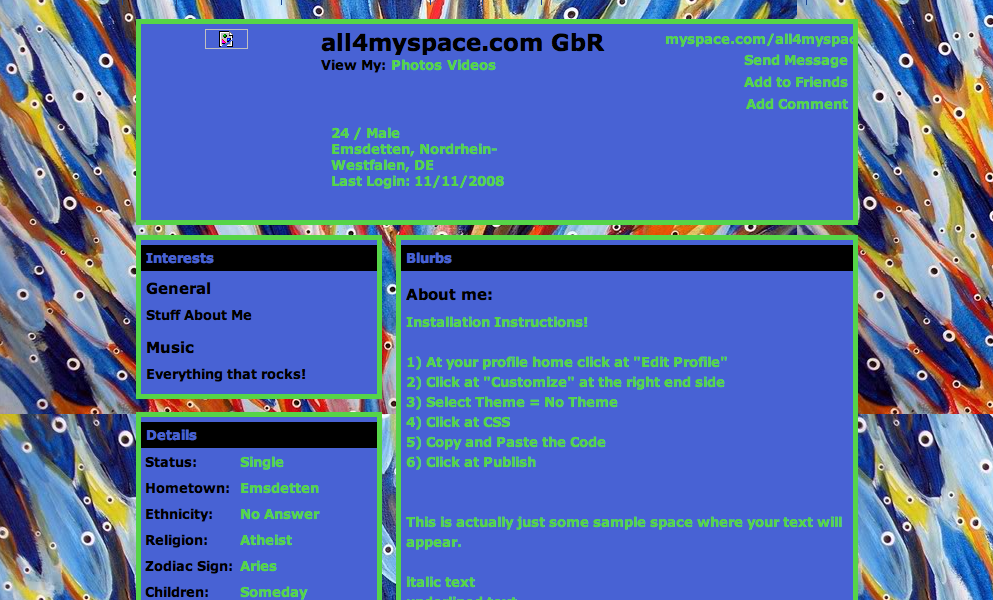
Google+’s main challenge, as I see it, is to develop a core use that draws users away from Facebook in a new way. Let me explain by highlighting the core uses of the other major social networks of our time / Myspace was really the first social network that worked, and it did so on the strength of one principle – a custom space on the internet that is yours to do with what you please. It was a great idea, and at the time, completely groundbreaking in that it was too far head of its time in many ways. It started out before internet companies needed a revenue model to get anywhere, and in many ways that made Myspace a really charming experience. The core principle worked for its uniqueness, but primarily surged based on usage by a teenage customer base that was increasingly using the internet as a way to entertain themselves in the boredom of middle and high school. I was a teenager when Myspace was popular, and every teenager I knew had a Myspace, while my Dad wondered what on earth the internet was. Brands that sought the attention and money of teenager flocked to Myspace, and the network seemed like a hit. Except that eventually the principle wore thin for that teenage set when they grew up a little and realized they didn’t want shiny stars shooting behind 4 simultaneously playing youtube videos of a crappy pop band above two years of sappy blog posts about gym class to represent themselves to the world. Plus, it was really hard to look at some of those pages, providing a big disincentive for users to explore the service more than just their immediate friends.

     (Believe it or not, this isn’t just a bad myspace layout – it’s a layout somebody put together and recommended to others)

Facebook’s one principle was to be the antithesis of Myspace in certain ways (no shooting stars, no music, a fixed color scheme and one choice for layout). But the core principle that made Facebook work initially was as a psuedo scrapbook of all the things your friends were doing, with tagging all over so you could just sit and get completely distracted clicking on the profiles and pictures of people you hadn’t seen for years for seemingly no reason. People refer to it as Facebook stalking, and while I suppose that’s accurate, it paints a pretty voyeuristic picture of a completely voluntary decision to make certain things in life public by putting them on Facebook in the first place. It’s not even a really destructive thing, and it tends to make the service money! The more you partake in life on Facebook – inputting interests, perusing and clicking on things your friends like and liking them, the more Facebook can target you with ads that are more likely to convert, and the more Facebook makes from transactions using Credits. Facebook was wise to position itself in other ways to survive when their generation of users (Facebook rose on the backs of college students) again realized that they were in need of an image shift and that they didn’t want pictures of keg stands and posts about how drunk they were last night to show up as the online representation of themselves – Facebook persisted by allowing users to lock up their privacy and delete pictures and walls, while at the same time becoming indispensable (for now) as a picture warehouse, game platform, phone and address book and messaging service.

Twitter works on an entirely different principle – it’s a way to connect with anybody in the world, and access everything they choose to say on the service, with no privacy walls whatsoever. It’s part news aggregator, part friend activity monitor, part brand outreach, part celebrity follower, part location sharer, part revolution starter – Part of what has made Twitter so hard to monetize is that despite being popular, it appeals to people for different reasons. It’s really the only technology of its kind, and it works on many levels, making it a powerful social network (if not a very profitable one). Whereas Facebook is a very individual experience in many ways (much of the use is directed completely by the user and you navigate to the person you want), Twitter is an avalanche of information about where people are, what they are doing, what’s going on in the world. You are agreeing to submit yourself to viewing the 160 character thoughts of a random assortment of people anytime you access the service, and “following” somebody is not nearly the commitment that “friending” somebody is.

(A really ugly picture representing three successful social networks and, at the same time, looking like it was made before the founders of those networks had graduated college)

LinkedIn doesn’t deserve extensive treatment, but it is relevant here because Google+ is really Facebook+, and LinkedIn is really Facebook+Job Stuff. Whereas Facebook represents you as a person, LinkedIn’s core principle is that it represents you as a professional – a great, profitable twist, because Job Stuff is pretty important to people, and people who take Job Stuff seriously tend to be willing to spend money on Job Stuff, meaning advertising works well on Facebook+Job Stu… ahem, I mean LinkedIn. Where Facebook’s emphasis on on the Social in social networking, LinkedIn’s is on the Networking – perhaps a glib way to put it, but accurate I think. LinkedIn wasn’t particularly creative as it comes to pushing technology forward – sort of just a “well that’s obviously a good idea”, but also a “boy this is set up just like Facebook isn’t it”.

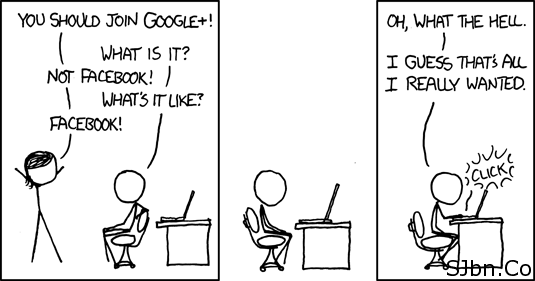
                                                                                 (My favorite comic on Google Plus, though I disagree with the last pane [see below])

Google+ is basically Facebook+Different Social Management. That’s it at this point. It’s not even a new take on how you interact – it borrows heavily from Facebook in lots of respects, be it the News Feed/Profile setup, the “Friending” mechanism of adding somebody to a circle, and the desire to be your picture warehouse and phonebook and address book. It’s missing a core principle that is different from Facebook- Myspace had being a unique online sanctuary to yourself, Facebook had stalking everybody you knew in a digestible format, Twitter had a firehose of unapologetic information from everybody you’ve ever been interested in hearing from, LinkedIn had Job Stuff. But what does Google Plus have? It’s more like Facebook Minus, Facebook, minus all my friends, photos, events, etc. It isn’t even as easy as typing in the names of all your friends to recreate the Facebook experience – you have to actually put all of your friends in circles that have been suggested to you, or you have to invent an entire inventorying system on your own, on the fly. Sometimes you drag one person into many circles, sometimes just one, but each time it feels more like work than like an innovative social experience. It can do everything Facebook can, and maybe even a bit better in some respects, but only if I sit through and recreate exactly what I have on Facebook already. It is completely derivative.

Maybe in 2-3 years I’ll look back and wonder how I was so blind to Google+’s beauty (even dumber… search engines ignore plus signs as a default, so “Google+” is difficult as it comes to the very technology made famous by its namesake). But more likely, I think Google+ will complete the holy trinity of hot, buzzy social products that eventually get dropped of Wave, Buzz, and Google+. Google really needs to add some new spark to Google+, or the early adopters may be the only adopters.

Leave a comment

Filed under Misc

We are approaching a nuclear war era with patents, but at least people are noticing

My last post on Intellectual Ventures and the NPR article that gained national attention was the most read post I’ve ever written, in no small part because people are more interested in the state of patent law in America than possibly ever before. And that’s because patents in America are reaching something of a boiling point. We are seeing really unprecedented wars over patents in completely ridiculous technologies and software, and as more and more people become familiar with Apple and Google and Microsoft as technology spreads, more and more people are becoming interested in the fights behind the companies.

Things have really been building lately in terms of patents in the news: Nortel sold a portfolio of their patents for $4.5 Billion to a consortium of buyers lead by Apple and RIM just last month. Google, missing out on the Nortel bunch, jumped at the chance to buy a bunch of IBM patents for an undisclosed price, but likely somewhere north of half a billion. Apple is currently engaged in a boat load of patent suits against Android phone makers like HTC, who, by the way, just bought a small company for $300 million solely based on the fact that the company won two patent cases against Apple. Rovi is suing Hulu. A company that hasn’t released a product in a decade is suing Spotify over a patent that they claim covers streaming music. Patent troll Lodsys is suing a bunch of mobile app makers, including Angry Birds developer Rovio, indicating that no app maker is safe right now. And of course there was the Intellectual Ventures/NPR piece, highlighting the fact that most software patents don’t inform anybody of new technology, and don’t actually help innovate. Oh, and by the way, the DOJ thinks patents are becoming important.

It’s really an unprecedented era for patents – all the major tech companies are arming themselves with hundreds if not thousands of patents to use against one another, and small rogue nations (Intellectual Ventures and the rest of the non-practicing entities) are taking pot shots at every company they can construe their patents to read on. We might be on the cusp of a patent war unlike anything we’ve ever seen, if we aren’t in that era already. The mainstream media is starting to notice that patents are getting out of control more than usual – the NPR article, this economist article, a post on the Guardian, and a great article by Mark Lemley that is getting some attention. Will this help? Probably not – don’t expect substantial patent reform from Congress. Perhaps the Supreme Court will continue their trend of cutting back on the rights associated with patents, but that process is likely to be slow, and with billions of dollars being spent on the transactions, the court might actually hesitate to cut back on the property rights further to avoid angering those who have already invested.

I think patents are interesting because they cover technologies I love, and they have innate notions of property implicit in their use, but I also think anybody in any software/tech industry (which is increasingly where a lot of business is going) has to be aware of the activity in this space. A company really can’t launch in those spaces without factoring in the cost of licensing patents from patent trolls at this point, as Lodsys is teaching many app developers in the mobile space right now. And while I agree that the notion of a defensive patent goes against the aims of patent law, new companies need new patents so they retain some leverage against the biggest companies in the space they seek to enter. Take Hulu or Spotify, for example, who are both being sued over obvious patents on streaming video and streaming music, respectively. While Hulu is being sued by a real company, Spotify is being sued by a company that hasn’t released a product in a decade. Spotify is an extremely well-funded startup and can mount a strong legal defense if need be, but if it wasn’t, this sort of suit could potentially ruin the business. If Spotify was smaller (watch out Turntable.fm), this patent could be used to strong arm them into an acquisition, or could force them to take a funding round on unfavorable terms to mount a defense, or in any number of ways disrupt their progress. One could wax poetic about how ridiculous this outcome is, and how our patent system is completely stifling the innovation is was meant to inspire, but I’ll leave that to Techdirt. The real lesson is that new companies need patents to protect themselves in this cold war/nuclear era of software patents, at least until something major changes. If Hulu held just one patent that could read on Rovi, they might have avoided this suit – or at least they might have bought some leverage in a settlement negotiation.

Leave a comment

Filed under Funding, Law, Patent

It’s been a bad week for Intellectual Ventures – NPR hates them, they might own Lodsys, and they are backed by Apple and Microsoft

It’s been a really tough week for the biggest patent troll in the world, Intellectual Ventures. NPR had an amazing expose on the state of patents in our country last week, software patents in particular, and Intellectual Ventures was the centerpiece. If you read one article on patents this year, it’s probably a pretty good one to go with. The article focuses on how IV has built a giant software patent portfolio on a $4 billion budget, but that they only hold people who have already invented things hostage with the patents, and most software engineers hate patents and think they are nonsense. It’s a solid summary of where software patents stand today, and the story attempts to track down some of the “inventors” and small patent holders involved, mostly with results that are less than encouraging. There’s also some great facts in the piece that few probably knew about IV before – such as the fact that none of the 1,000 or so patents produced from in-house research have ever been licensed to make a real product.

The NPR piece contained another interesting wrinkle I hadn’t seen elsewhere, where the article suggests that IV might own Lodsys, the company that’s been suing tons of mobile app developers. NPR discovered that Lodsys’s primary address is the same as Oasis Research, another non-practicing entity connected to IV – suggesting that IV is gaining financially from Lodsys’s activity, and possibly funding it.

While the NPR piece was probably more damning for IV due to its wide audience and eloquent prose (it’s very entertaining), a Business Insider article from Sunday was just as bad in some ways – the article pointed out that based on recent court filings, it turns out IV is at least partly supported by money from companies like Apple, Cisco, Amazon, Sony, eBay, and Microsoft, though much of that money is probably for the right to not be sued. It is both strange and frightening that the companies most tormented by patent trolls are supporting the biggest in the business. As the NPR piece noted though, IV has made only about $2 billion on it’s $4 billion worth of investments, so the company is actually behind on trolling in some respects, which is a scary thought.

IV had a typical response to the article, as reported by Geekwire: IV strongly disagreed with NPR’s portrayal of their business, and stuck to their guns with claims that “ideas have value” and that they “provide an efficient way for patent holders to get paid for inventions they own”. Of course, IV talks right past the premise of the NPR expose – that while ideas may have value, the patents often don’t reflect the ideas, or are unnecessary to actually getting those ideas to market.

2 Comments

Filed under Law, Patent

Protected: Vostu responds to Zynga’s copyright suit, some serious implications for social games and copyright are in play

This content is password-protected. To view it, please enter the password below.

Enter your password to view comments.

Filed under Copyright, Games, Law, Social Games