Spotify… A liveblog/review of my first day with Spotify

I write a lot about music services on here, because music services are sort of in the startup world now, they are sort of copyright-relevant, and I listen to a lot of music. Spotify has been the hot new music service, out now for paying customers and with a wait if you want an invite to the free service. Spotify’s angle is that you can listen to anything you want at any time in a giant catalog of music, with some limitations if you are a freebie customer, and essentially no limitations if you are a paying customer at 5 bucks a month.

Eager to try out the service, I paid 5 bucks figuring it was worth a month. Here’s my experience:

1:00 pm – Ooooo Spotify! I want to try it, but I’m so impatient I might as well pay the $5 and try it RIGHT NOW.

1:05 pm – Signup was easy and I’m now listening to music while I work on some other things. Immediately I’m familiar with the interface:

This slideshow requires JavaScript.

On the right there is a little bar with my facebook friends who have spotify (only about 20 right now), and if I click I can see their shared iTunes playlists. Spotify automatically imports all of your iTunes music into the program – convenient. On the left is a couple shortcuts – obvious things like links to my own playlists and music, and then at the top a “What’s new” button. There seems to be three main modes of discovery built into this button – New stuff featured by spotify, “top lists” which is a list of the most popular stuff, and “feed” which pulls from recommendations made by your friends.

I click feeds, and find 10 messages from spotify and 1 from a friend, who recommends a song I don’t like. Ok so that feature isn’t really working yet, maybe the service is too new.

I click “top lists”. The top tracks are basically just the top radio songs, as are the top albums – a mixture of Adele, lady gaga, katy perry, and other things I wouldn’t listen to for free.

I click “What’s new”. I see LMFAO, Limp Bizkit (??), Fatboy Slim, and Foster the People. Not really interested in those first three, but Foster the People is playing at Outside Lands and I’m going to that, so I click Foster the People and see I can listen to their whole album! Now we are getting somewhere! I click on “Pumped up Kicks”, their most popular song…. nothing happens. I don’t see any reason why the song shouldn’t play, it’s clearly available, but it doesn’t play. Bummer. So I click on another song on the album, which also doesn’t play. This is getting frustrating. I click on another song, and it plays, so I listen to that for a bit and go back to some work.

2:30 pm – After doing some work, walking around to chat with some people about some work stuff, I realize my earphones haven’t been in for at least 40 minutes and I plug them back in. Nothing is playing. I flip over to Spotify and find that “Pumped up Kicks” is still waiting to start again… Hmm, I need a new route. I realize I’m seeing a TV on the Radio show in September, so I search and find that Spotify has that entire new album up! Great. I click on a song and let it shuffle, back to work.

2:35 pm – Music stops again, one song into the album. Seems the “pumped up kicks” problem isn’t isolated to Foster the People. I click around for another song that works, forced to skip two on the album. Back to work, I was actually getting something done.

2:50 pm – Music stops again, three songs later. WHAT THE HELL IS WRONG WITH THIS THING. I’ve been wanting to listen to the most recent lykke li album a bit more but have neglected to downl….. acquire it through other channels so I type that in, find the new album, and click on the second song. Lykke li bursts, and I’m back to work.

3: 15 pm – Music stops again, a few songs later. Stuck on an indefinitely buffering Lykke Li song, once again. I decide to test some of the other discovery possibilities of the service – I open the “facebook friends” bar, and am faced with a tough decision…. who looks like they listen to music I might like? A few random facebook friends are immediately eliminated based on some mental calculations of how crappy I know their taste to be, and I settle on Smephanie Momlin (name changed for privacy sake). I click her, and it shows me two playlists she has made “1forthecar” and “2fortherun”. Smephanie is apparently from the literal camp of playlist naming. I recently read a pretty hilarious blog post on playlist names here, but I’ll save time and post the relevant portion here:

Some of the other people here, most of whom are still setting up for the party, look over at my iPod playlists which is so fucking embarrassing because the things you name your iPod playlists are very personal and aren’t meant to be displayed in front of a crowd of people you’ve never met. Like sometimes I DJ under the name Big League Jew, like that chewing gum, so that’s right on the TV and 5 fancy girls are looking at it. In my peripheral vision I can see that one of them looks at me and I think, “Stop looking at me swan!!”

If you are an active playlist maker who isn’t a literal playlist titleist (like “Workout 2,” “Dance Party 8”), look through your playlists right now. What would people think of you if they saw them, right? Would they think you haven’t gotten over any of your exes and you are annoying and sentimental? It’s hard to say exactly what they would think, but you still wouldn’t want to show them.

Note to self – remove embarrassing shared playlists before logging into Spotify. I’m neither in the car, nor am I running, so I click on another friend, who it turns out has no shared playlists. I click on another. No shared playlists. Apparently Smephanie is in the minority. I randomly decide to listen to The Beatles. The Beatles, I find, aren’t on Spotify. Okkkk what else do I want to hear but know I don’t have? How about Talking Heads, I just saw “Stop Making Sense” last weekend. Oh good, they have that, I click, and head back to work.

3:40 pm – Happily chugging along with Talking Heads, I decide I want to hear the live version of “This Must Be the Place”. I search Spotify and find they have it! Great, this service is coming ALIVE! Click… nothing. Music eternally buffering. My internet is pretty solid, this doesn’t make much sense. I close the application and reopen it. Still buffers eternally. Disgruntled, I queue it up on Youtube instead.

4:18 pm – After some work leads me away from the computer, I’m back, and I click over to Spotify. Decide to try some Radiohead, they have it, so I click and it works! Back to real work.

After my short afternoon with Spotify, I’ve got a few conclusions:

It’s awful for discovering new music. Pandora just owns it on that front. Seeing my friends’ playlists is great, but if Smephanie only has shared a handful, or if other anonymous friend hasn’t shared anything, it doesn’t help at all. The “what’s new” and “top lists” pages are populated purely with the crap that people listen to on the radio, which I can easily get for free on Youtube, and I don’t really need to “discover” that music because it a) sucks and b) is all over the radio. I need to know what I’m looking for when I want new music on Spotify, which isn’t necessarily terrible, it just doesn’t leverage my social graph in any discernable way, and it doesn’t suggest anything to me based on what it should know I like.

Tracks randomly won’t play. Listen, I know this service just launched. But I’m not a beta tester – I shelled out $5 for this thing. Some people are paying more for the super uber premium version, and I would be truly miffed if I paid for that price point and was given eternally not-streaming songs. It’s a buzz kill to be in the groove doing something else and have to switch back over because Spotify hit a “Pumped up Kicks” again.

It’s not better than downloading the whole album for free as a torrent. People who pay for music pay for music, and maybe for them this service makes sense. But people who don’t pay for music get nothing from Spotify that they aren’t getting for free at a torrent site – on both I need to know what I want, and search for it. As a torrent, I can have the whole thing in 3-5 minutes, on Spotify, I have to pay, they may not have it, and it may not stream if they do. The only chance the music industry has to recapture the people who don’t want to pay for music is to either ramp up enforcement (which they’ve tried, and doesn’t and will never work), or to offer them a value proposition that they can’t turn down – Like utilizing the social graph in a new and cool way (turntable.fm) or offering an interesting method of discovering new music (pandora). Spotify doesn’t do either of those things well. It’s just a legal version of Napster, which is cool, but Napster was cutting edge in 1999, and didn’t have the possibility of drawing on advanced algorithms or facebook friends to suggest new music. Spotify should utilize those things, but it doesn’t.

I’ll give Spotify until the end of the month to convince me, but right now that $5 is probably the last Lincoln they are getting from me (Lincoln is on the five right?). I give Spotify a 72/100, barely passing, and not worth the cost.

(Next Day Update: Spotify seems to have largely fixed the nonplaying issue I was experiencing, which at least makes the service useable. Based on the search terms that brought people to my blog, I definitely wasn’t the only one experiencing the problem, but it’s good that Spotify fixed it so quickly. My other criticisms stand, but this improves my score to 80/100, a B-.)

1 Comment

Filed under Misc

Copyright & Photography – Why not have mechanical licenses for photographs?

Compared to most areas of law, copyright is a rather polarizing issue for people. It’s a perfect storm of sorts – Copyright pertains to just about every creative work authored by man in our country, so most everybody has some opinion on how it should work, because it probably impacts them in some way.

One of the strangest problems in copyright to me is that around fair use. Thinking about the topic, I’m reminded of how a Professor framed the issue for the class – Copyright is about whether you have to ask, and whether you have to pay (a rather realistic approach). With most works, and with most potential infringement, the answer is that the person seeking to exploit/further the original work has to ask, and probably has to pay (unless the original artist grants the license for free). If the use is “fair use”, then the new artist doesn’t have to ask, and doesn’t have to pay. For most situations then, the new artist either asks and pays, or doesn’t ask and doesn’t pay.

There is one rather unique situation in copyright though, where a new artist doesn’t have to ask for permission to use an original work, regarding covers in music. New artists seeking to rerecord a song already released by another artist need not ask that original artist for permission, they only have to pay a statutory license. It’s been the law of the land since 1908, when Congress was pushed to add the mechanical license by piano roll manufacturers who feared a monopoly by a major player in the piano roll market. Can’t make that stuff up.

If you really think about it, the exception for covers of musical compositions is exceedingly strange, and it casts some doubt on a lot of the justifications you hear for copyright law in other areas. It’s kind of like fair use, where we have agreed that there are some instances where the new use is so valuable for society that we don’t want to give the original artist the right to disapprove and shut it down. Fair use is typically found when a copyrighted work is used for something like research, parody, teaching, or the like, and the two main factors the court looks at are both economic, asking whether the new work is commercial in use, and whether the new work is likely to displace the older one in the marketplace. If covers in music weren’t protected by statute, however, they definitely would fail the fair use analysis – when a band releases a cover of an older song, they almost always are doing so for commercial gain, and the new version is likely to compete with the old version for ears. The license, though, solves these worries – every play of the cover generates some revenue for the artist of the original, and thus, everybody wins.

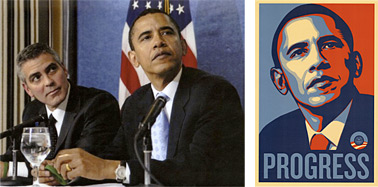
A compulsory license would have definitely been an economically efficient outcome for Fairey and the AP, who fought a high cost legal battle over the above images

Photography, on the other hand, seems to have reached something of an impasse of late. I wrote a post on the topic recently, and to summarize, what has happened in photography is that artists just end up taking work by prior artists for use in their new art, hoping to win the lottery on a nuanced piece of language in the law that has driven courts to rule in two different ways. Basically, artists are forced to decide if their use of the photo will be “transformative” under one of two different definitions embraced by different courts, in the hopes that a judgement in their favor will exempt them from seeking permission by qualifying their use as “fair use”. In practice, neither the original photographer nor the new artists have any idea whether a use is going to be deemed transformative and thus “fair” except in the most extreme cases, so the industry sees a chilling effect. Which system sounds easier and clearer to you, the system that photographs operate under, or the system that music operates under?

I’m not the first to suggest that photographs should be subject to a compulsory license, though the idea doesn’t seem to come up a lot. Mechanical licenses would be easy – just as in music, an agency would likely arise in the market that would make the transactions easy, and provide a way to connect a new artist to the original photographer. If the original photographer can’t be found by the new artist, then they can go ahead and continue without fear of a costly copyright infringement suit later, knowing that the maximum amount of risk they will take on is the cost of paying a mechanical license if the photographer comes out of the woodwork. It would be a smarter system, and I’m not sure why it hasn’t gained more traction.

Leave a comment

Filed under Copyright, Law

Internet imperialism – Every company makes a play for every other company’s territory

Over the last few months, there has been a rather unprecedented amount of competition for consumer attention in a couple spaces among the major players in the tech/consumer web industry. Companies respond to success in an industry by trying to compete immediately, and the same goes for space where they think consumer attention might shift to next, all in a giant game of follow the leader. To spice up this post, I’ll predict winners. Let’s start with music:

Entrants into the internet music space:

Pandora (old)

Grooveshark (old)

Spotify (old/new)

Amazon with Cloud Player (last 6 months)

Google with Music Beta (last 6 months)

Apple with iCloud (last 6 months)

turntable.fm (last 6 months)

Somebody forgot to tell all the tech companies that the music industry is dead. (note: Music isn’t dead, it’s probably more vibrant than ever. It’s just not gonna make people the kind of money it did in 2001.) It’s not a distribution problem just waiting to be solved either – it’s a price problem. People are now accustomed to paying $0 for music, and that will not change no matter how many social tweaks and ease of access manipulations tech companies throw in. Look at Pandora – unless the law actually changes (the DMCA specifically), Pandora utilizes every currently legal feature that a company can use streaming online music. Pandora is the pioneer of adaptive, social, internet music access, which is where all of the current tech companies getting into the space would like to head, and Pandora hasn’t yet turned a profit, and their IPO was less than a success, currently trading $2 dollars below what they opened at.

Despite this, news came that Facebook is looking to enter the internet music space, possibly as part of a collaboration with Spotify. This plan would make Facebook a competitor, presumably, to prior entrants Apple (iCloud), Amazon (Cloud player), Google (Music Beta), and, of course, the entrants with many months head start, Pandora and Grooveshark. Nobody has yet found a way to make this space profitable – It’s almost impossible, because record labels still demand extremely large licensing fees despite the year-to-year declines in revenue they’ve faced in the internet era. Eventually the labels may jump on board and try to replicate something like a how social games monetize, letting users access music for free and charging for content associated with the music rather than the music itself, but because the industry was so comfortable for a while there selling CDs for $15, it may take a while for the industry to adjust.

Who will come out on top? My winner: a tie between iCloud and TURNTABLE.FM. iCloud is what Mom will use to put music on her newest device, and what most consumers will use to get music. Apple just has too much of a lead in music to lose here – Apple has an established presence in the music industry with the ipod and itunes, and they already have partial licenses. Turntable.fm, though, could be wildly successful as the greatest music based social game ever (sorry, Night Club City). Imagine if Pandora got every user to pay $5 a month for sweet clothes for their avatar DJ, which the DJ knows everybody on their channel can see? They can sell ad space in the form of special chat rooms (clubs), and by giving out special promoted avatar gear. Zynga proved the virtual currency model works, and it’s Turntable.fm’s race to lose at this point.

Entrants into the app market space:

Apple with app store (old)

Google with Android (old)

Facebook with their Facebook applications, but no official “market” (old)

Blackberry with whatever they call their app store (old)

Amazon with app store (last 6 months)

Google with Chrome app store (last 6 months)

Microsoft with Kinect SDK (to come)

Facebook with “Spartan” (to come)

The app store entrants haven’t all been so fast, with Facebook and Microsoft still to come, but the competition is clearly there. Google’s running two app stores, sort of, with Android obviously being a huge hit and challenging Apple’s dominance. Apple is far in the lead at this point, with Amazon and Facebook looking to play catchup in the mobile space. Facebook has complete dominance on laptops and non-mobile computers, at least when it comes to games, which, as it turns out, is where a whole lot of the money is (see Zynga).

Who will come out on top? My pick: Apple and Facebook. Apple for mobile, where they already have a huge lead, and Facebook for non-mobile, where they also already have a huge lead. There is some chance Google+ will start to pressure Facebook for social games, and might even be able to work a bit of the Android apps into Google+, but that’s a ways off and Google might want to think twice before letting the unfiltered nightmare of Android loose on their tightly controlled social network.

Local Deals:

Groupon (old)

Living Social (oldish)

Google with Google Offers (new)

Amazon with Amazon Deals (new)

Facebook with Facebook Deals (new)

Movement into this market has been a bit slower for the tech giants, with Google and Facebook still basically in Beta versions of their deals platforms (Google only offering deals in Portland), despite the fact that the deals industry clearly makes money as compared to the music space. Groupon has a big lead, but it’s less important in this space, because businesses just have to say yes to one of or all of the other deals offerers for Groupon to start losing their market share. Groupon did a great job getting millions of people to sign up to receive their daily emails, but Groupon now isn’t getting much love in any mobile application I use, at least, and Amazon, Facebook, and Google won’t let their users see Groupon ads over their own Deal service ads if they can help it.

My pick: Amazon Deals. Sounds weird, but hear me out – a year ago, 90% of consumers only had their credit cards on file with 1 of the companies listed above, and it was Amazon. Amazon has a great history of reducing friction between the seller and the buyer (1-click checkout), they have established relationships with thousands of businesses who already use their infrastructure to sell full price items, and setting up deals can be easily integrated into that system. Of Google, Facebook, and Amazon, Amazon may have a smaller number of total users, but ALL of Amazon’s users are looking to buy something when they log in, compared to a small fraction of Google and Facebook users who are looking to do the same.

I’ll cut it off there. There’s probably a bunch more I could detail; I’ve already covered Google+ v Facebook in another post, everybody is making a move into photo sharing it seems, and mobile games is a topic I love and might touch on similarly in a future post. But mark my words on Amazon Deals, it’s gonna be HUGE.

1 Comment

Filed under Funding, Social Games

Google storms the Facebook Castle with Google+, does it help social games?

A while ago, a story about Warren Buffet gained a lot of traction in the tech world. The story focused on a description of Google made by Buffet, who said that great companies have core products (castles) that they then build features and services around to prevent competitors from getting to the core product (moats). Google’s castle is search, and the moat is gmail, google voice, chrome, and the other products Google puts around the search to control the user experience.

Google has had a history of launching some pretty mediocre products and making some strange acquisitions, but a week after Google+’s launch, it is starting to look like there was some semblance of a plan behind the seemingly crappy launches. Google Buzz, Wave, Picassa, +1 and Blogger were hardly search related, unlikely to become castles, and unlikely to serve as moats, but now seeing the Google+, circle-based social network, it actually seems like they are moats for the new castle. All of those products either taught Google something about how to build the new social castle, or will help “moat” that castle. And Google+ actually seems like it’s being widely praised – a great comic I saw noted that the only way to describe the service is as a Facebook that isn’t like Facebook, which is a testament more to how strong Facebook’s grasp has been on everything social for last 6 years than a statement about our collective distate for Facebook.

If Google+ catches on, users will be faced with a choice of either using both services, or staying exclusively on one or the other. The real risk for Facebook is that, even if people choose the former, it may cut time on the site in half. Half the eyeballs = half the time spent viewing ads = half the ad revenue, which is obviously not a good thing for a company that makes a lot of it’s money off of ads. The other issue is social games – Google+ will definitely become a games platform eventually, as early reports are already considering. So far, the main criticism of Zynga’s IPO has been that Zynga is tied to Facebook, but that looks like it should really be a criticism of Facebook at this point, as Zynga now has a major player they can jump ship to, or at least use as negotiating leverage. One wonders what the exact contents of that non-compete deal Facebook and Zynga signed back in late 2010, and if there is any chance it considered some sort of exclusivity for Facebook. The negotiations at that point in time probably looked an awful lot different though, with no clear alternative for Zynga to publish games on besides Facebook. Now, however, Zynga might actually be in a position to push for a better % of their own revenue (Facebook takes 30%) given that Zynga could potentially swing hundreds of millions of users over to Google+ pretty easily. That move might be too risky for a company waiting to go public, but it will definitely be an interesting standoff between Facebook and Zynga whenever Google+ does open a games platform to the public. A public games platform on Google+ would only help social games as a whole – though the 30% cut seems like an industry standard for all game-hosting platforms, at least it will allow developers to have some sway over the policies that Facebook and Google come up with, and react to them by investing more heavily in one platform over the other. Another interesting thing will be whether game development for Google+ looks more like game development for the Android platform, or if it will be an entirely new experience. It seems the possibilities for games on a new platform similar to Facebook would be more inspiring for developers than just a new version of Android, but on the other hand, opening up the Android platform to Google+ would allow minimal investment from current developers, and give Google+ instant access to games available on the platform. All in all, Google+ will have a big impact on social games, we just don’t know what that impact will be exactly until Google makes their move.

1 Comment

Filed under Uncategorized

“when does zynga shares hit th market” – The link between the IPO market and the tech bubble

I laughed and rolled my eyes when I looked at the sentence above, a search term from Google that brought a reader to a post of mine referencing Zynga’s IPO. No offense to the innocent internet wanderer who stumbled upon my site through that horribly constructed sentence, but he/she highlights a problem with the IPO exits of many of these buzzworthy tech companies. I’ll discuss them in the popular lazy blogger format of “some bolded words as a means of generating structure”:

Everybody involved in the startup wants the company to exit, eventually.

Most people involved in young companies like being involved in young companies. Typically the talent at young companies got there in one of two ways – they always worked at young companies, or they left big companies to work with young companies. Both of those sorts of people end up wanting to work at young companies, which means that if the young company works out and becomes a tremendous hit, the company is no longer the sort that the person wants to work for. It’s ironic (I think, though after being peeved by other people when they incorrectly label something ironic for so long, I’m actually beginning to wonder if the word has any meaning whatsoever). Look at the co-founders of a startup you pay attention to, and it’s almost guaranteed that they jumped over to startups from a larger company in the space, or they’ve always been a startup person. Startups draw a sort of entrepreneurial spirit, which typically isn’t sated by the bureaucracy of an IPO-ready company.

Despite my personal turmoil over the uses of the word ‘ironic’, it is decidedly not ironic that venture capitalists want the companies they invest in to exit. VCs have two goals: invest money and make money on that investment. It’s hard to make money if the company never sells to anybody and never IPOs – the company must make an exit in 90% of circumstances, or the VCs delay reporting a success to their limited partners. Only with rare, super successful mega companies can a VC potentially get out of an investment with a gain, but that’s not ideal, as it forces the VCs to rely on inaccurate, non-free market pricing and the wiles of the secondary market for private stock, a market that probably shouldn’t exist and requires approval from the company for the institutional investor to access.

And we are now seeing a third group that clamors for an exit, though only through an IPO – the everyday investor. Mr. “when does zynga shares hit teh market” wants in on the big private companies he reads about, and wall street wants to get in on the action as well. Private companies can legally only be held by 500 people before the company must report to the SEC as if it were public, essentially forcing the company to go public when it reaches a certain capacity. If you aren’t in that lucky 500, Zynga, Facebook, and Groupon stock has been off-limits (largely, and in the US) despite the fact that half of the tech articles you read are about the three companies. So everything is lined up from the beginning to push startups towards an IPO exit, or a sale to another company.

Everybody involved in the success of the company is probably leaving when the company exits (aka when Ivonna Zyngastock buys her shares).

People get terrified at the slightest hint of news that Steve Jobs is ill. When Jobs coughs, Apple stock drops. Not that every founder is as valuable to their company as Jobs is to Apple, but there is a general consensus that the founders are pretty darn important, even when the company has years of institutional knowledge and thousands of employees. You could argue that the founder is even more important to a small company with less institutional knowledge and likely a smaller number of employees. Obviously not every founder leaves the company when the company exits, and often in acquisitions the key founders are contractually obligated or heavily incentivized to stay, but many upper level executives feel compelled to leave. For one, the desire to work with startups outlined above makes founders want to move on to their next venture. Upper level execs are also likely to be holding on to years worth of stock, and looking for a chance to finally make some money for those shares they’ve had for so long, and often divesting from the company financially means divesting personally. Employees at all levels can now also jump ship more easily, as the pressure to stay to make something off the stock is no longer there.

Success is also, in part, driven by the investors (at least, if you believe the investors). VCs have tangible connections and expertise in areas, often with insider knowledge of the going-ons at other companies they invest in. But once the company exits, the VCs are less likely to play an intimate role in the company’s direction and business decisions. VCs at least see their % ownership of the company decrease, especially as they begin pulling their own stock out to make money on their investment (which has, like the founders stock, been practically illiquid for years). Another odd part about this is, the VCs are the ones who set the price of the company closest to the IPO – take Pandora for example, which just had an IPO despite the fact that the company doesn’t make any profit. Or Groupon, who raised nearly a billion dollars from VCs, then paid most of it out to other investors, then reported a loss for the quarter before their IPO. How do you value a company with no profits? VCs set valuations in the most recent series round, and often the IPO price is, at least in part, based on that valuation. So VCs sort of cooperate to create the illusion that a company has an enormous amount of value, then they dump the company on the public and sell those shares to investors who’ve only heard about the company because of the reporting generated by the investments the VCs made in the first place. I’m not saying it’s crooked or anything – probably just basic marketing – but when the public hears about how valuable a company with no profits is, and then the guy who last invested is very excited to sell, some alarms should go off.

Public disappointment in the quality of companies in the IPO market is what drives the tech bubble cycles.

So all of the above is driving cycles where the public hears about awesome companies, but then gets to invest at a point in time where the company is probably undergoing its biggest transition in terms of culture, turnover, and makeup at the top. Sometimes it works out or the founders truly retain control (google), but often it doesn’t, and if the hype gets too big around a few success stories, its in the best interest of the founders, the VCs, and everybody “in” the bubble to keep pushing young companies to IPO, then jumping out to show a strong short-term gain on the financials or cash out the founders cheaply-bought stock. Eventually the public catches on, gets frustrated buying shares of hot young companies that aren’t businesses yet but are still valued in the millions, and the public stops buying. The fact that people who can’t even construct sentences are googling to find out when they can buy into Zynga is great in some ways – if the overall value of the companies coming out of sillicon valley is high, then the companies deserve the buzz and the valuations – but in other ways it’s bad – once the public starts getting carried away with IPOs, the next phase is discontent with the performance of the companies, followed by a quick burst of the bubble. So get your Groupon stock while you can, but remember that all the people who’ve believed in the company up til now will probably be doing the opposite. (Note: Zynga is great though, I’ll probably be a Zynga stockholder one day. Anybody who can make millions selling 50 x 50 pixel art is on to something.)

Leave a comment

Filed under Funding, Social Games

The used game market problem – Capcom tries what will inevitably be an unpopular solution

We are definitely in the midst of a shifting market in terms of video game pricing. Video game publishers are increasingly searching for ways to beat the used game market, where companies like Gamestop make over $600 million a year by buying newish games from consumers and reselling them to others. The activity is completely legal (the first sale doctrine of copyright allows you to sell a copyrighted work after you buy it), but game developers would love to get a piece of that $600 million; Gamestop is currently making their money by living in the pricing problem publishers have yet to solve, namely that publishers don’t want to drop the price of the game at release, but by the time the first price drop comes around, many who didn’t want the game at $60 have already bought the game on the used market for the price drop price.

Publishers have tried to deal with the problem in a number of ways:

Sell a license to the game – Software can be licensed rather than sold, alienating the consumer from the ability to resell it. Computer games have started to go that way, and combined with things like multiplayer accounts and CD keys, have largely reduced the amount of piracy, or at least reduced the amount of fun you can have with a pirated copy (But look up “Spore” for a cautionary tale). But reselling PC games has never been a huge industry partially for those reasons, and video games haven’t made the jump to a licensing approach, perhaps out of fear of shifting to something too dramatic. The first console game that comes out claiming to deny the consumer the ability to resell it will face a tremendous backlash from consumers, and it isn’t even clear how such a plan would work – no publisher wants to go around suing the consumer as a means to enforce the license, and suing Gamestop is just as unappealing (they might just drop your games from shelves entirely). But I wouldn’t put it past an aggressive publisher to try it. Chance this approach becomes popular with consoles: 20%

Extend the duration of time that the game has value to the first purchaser  – This has definitely become more popular, especially since it can make the developer money. Mass Effect 2 released a number of $10 expansion packs almost immediately after the game was released, in the hopes of convincing release price purchasers to hold on to the disc for a few more weeks. The Halo and Call of Duty series do the same with map packs, and really most major releases try to adopt some version of this approach now as a way of both milking the game for more revenue, and as a means of holding off a wave of discs from hitting the used market. Chance this approach becomes popular: 100%

Cut the price almost immediately – Portal 2 was possibly the first game to utilize such a dramatic version of this strategy – just a couple weeks after the game released, Valve slashed the price of Portal 2 almost in half. It’s not clear how much of this was motivated by slow sales, or possibly because of the PSN downtime that coincided with the game’s release, but I imagine it was driven at least in part by a desire to shunt the used market, which would have been especially hot for a game that was fully beatable in about 15 hours. The downside is, if every game you release takes this approach, you effectively just shift a large portion of your audience to that lower price point, because most people will wait a week to get $20 off (that is, after all, why the used game market exists in the first place). Chance this approach becomes popular: 5%

Ruin the experience for anybody trying to replay the game – This is a new strategy being used by Capcom in Resident Evil: The Mercenaries for 3DS. The game comes with a special feature, where saved data cannot be erased. While it will probably take the game’s release to discover what this actually means, it seems as if Capcom is limiting consumers to one playthrough of the game in “new” condition, and every subsequent playthrough will be tainted in some fashion by that original game – perhaps your character will stay overpowered, or will have access to amazing guns from the start, or other usual powerups received after beating a game for the first time. So if you try to sell the game to gamestop, the game will always retain these advantages, making a used copy rather unappealing to a new consumer. I expect the backlash on this to be pretty massive, and ruin any sales this (likely already bad) game would have had. Chance this approach becomes popular: 5%

Digital distribution – Steam’s success on the PC/MAC, combined with Blizzard’s success in releasing Starcraft II from their own site and the profitability of Xbox Live titles will likely lead some developers to consider full digital releases over Xbox Live and PSN in the future. Currently the hardware has some issues, namely that the consoles don’t have big enough hard drives to support holding many titles, but look for that to change in the next console cycle. Digital distribution is potentially extremely profitable simply for the ability to cut out the middle man, plus the game is impossible to resell in the that format. It also allows specific pricing control, with the developer able to lower the price whenever they want, perhaps even based on sales through the digital marketplace. Digital distribution has taken over on the computer, and it will be the future of consoles once the hardware can support large libraries of downloaded games. Chance this approach becomes popular: 80%

In the short term, expect most companies to follow the approach of releasing new content almost concurrently with the game’s release in an effort to prevent games from hitting the secondary market before the first price drop, perhaps mixed with some slightly earlier price drops, as a manner of taking some of the secondary market’s pie. In the long run, I expect most will move to digital distribution once the consoles themselves can support it. And look for a post on how poorly Capcom’s strategy will work in the near future.

1 Comment

Filed under Copyright, Games

Fair use in photography, art, and copyright – Two trends in lower courts

WordPress tells me that the most popular search leading to my blog relates to fair use in photography, telling me that a whole lot of people don’t understand what the law in the area is on the issue. My last post on the topic covered Richard Prince’s fight with a photographer, from whom he borrowed/stole/was inspired by/copied photographs of rastafarian men and added little flourishes before displaying the art in a gallery. Below is the picture, which I “stole” from a blog:

Prince lost the case in the lower court (more on that in a minute), but for us copyright watchers, that opinion doesn’t really matter, because he is appealing, and he is appealing BIG TIME. Boies, Schiller & Flexner, the firm started by David Boies, is taking the case. BSF is a top-flight litigation boutique, and they probably took the case because it could go to the Supreme Court, so IT’S ON. This case won’t be over anytime soon, and will probably redefine fair use by the time it ends.

But back to the lower court – Prince lost primarily because the lower court judge decided that the nature of the use wasn’t “transformative” (if Prince makes it to the Supreme Court, this will be the crux of the case). [Prince also shot himself in the foot by making all sorts of court unfriendly comments, like saying that it never occurred to him to ask Patrick Cariou, the photographer, for permission and that he would have taken the imagery even if explicitly told not to, and that even with Cariou’s work removed his art would be valuable and Cariou’s worthless.] This is only one factor in the four factor test, but it is a really important one, and possibly the one in the most flux as the law goes. Without going all law review article in this post, there are two trends in the determination of “transformative” that the Supreme Court would have to settle if Prince’s case makes it to the Supreme Court.  These two approaches vary based on how much they pay homage to the moral rights of the author, or the author’s right to be attributed as the author even in criticism. We don’t have moral rights to copyrighted works in the US, but the concept is inescapable, popular in other countries, and I feel quasi- moral rights drives the two trends, detailed here:

I. Transformative / preserves attribution – Some think that based on the language of the statute, a work is only “transformative” if it comments ON the original in some way, as for the purposes of criticism, research, or scholarship. This was where the lower court decided in favor of Cariou, the photographer who took the pictures that Prince copied. The lower court said that the problem with Prince’s activity was:

Prince’s Paintings are transformative only to the extent that they comment on the Photos; to the extent they merely recast, transform, or adapt the Photos, Prince’s Paintings are instead infringing derivative works.

Prince testified that he doesn’t “really have a message” he attempts to communicate when making art.

The idea is that “transformative” means something like “having the purpose of commenting on”, rather than just changing the message. Commentary that uses a piece as a point of reference is fair use because it preserves the original authors identity. Parody, while not necessarily as explicit on original authorship, is fine as well and this camp would likely also keep the traditional exceptions intact for scholarship, teaching and research for similar reasons.

Reproduction of Cariou’s pictures would be fair use only if they were in a book critiquing something about the work, such as an article on composition that believed Cariou poorly framed a subject, or for use in a class on a similar topic. An article commenting on our society’s fascination with Rasta culture could probably safely print a reproduction of Cariou’s picture as well.

The line is drawn with the second approach where the original work is used as a mere vehicle for commentary, but the commentary doesn’t actually relate to the original work itself. If I reprint Cariou’s work with the words “George Bush sucks” in small font, that’s not going to be fair use (it’s also not very topical). I say moral rights drive this camp’s opinion because they are fine with any transformation that maintains the integrity of the original author as an author of the work, even if the transformation is ultimately a critique.

II. Transformative / doesn’t preserve attribution – Others think that use of another’s work should be protected even when it doesn’t preserve authorship, such as what Prince did to Cariou’s works. The focus on attribution drops away, and the question becomes whether the new work added something new or merely supplants the old work. It’s Supreme Court case law that the more the work is transformed, the more the other factors of the analysis become less important, indicating that a truly radical change in an image, for example, should weigh heavily in favor of a transformation (and fair use). The way the first and ninth circuits have interpreted that, the focus should be on the functionality of the new work as compared to the old – if the new use has a different function, it should weigh in favor of fair use, even without attribution. The problem is, any lawyer can come up with ways in which a use is functionally different from another; Cariou’s pictures were used by Cariou in a book about the history of Rastafarian culture in a coffee table marketed to people looking for coffee table books, whereas Prince’s work is displayed as modern art in art galleries and valuable primarily because he had a hand in making it. See, it’s that easy! Other translations of this camp come out with “is something new added to the original work, which is used as a raw material”, which ends up operating similarly; Prince added his touch to anywhere from 20-30% of the visible canvas. This camp holds that such a simple distinction is fine, because the point of copyright is to protect the original author’s chance to collect profit from his works in the market he might sell the work in – Cariou was unlikely to make the alterations that Prince made and sell them in art galleries. This approach is very market driven in that way, unconcerned with the moral rights of the author.

It is worth noting that I is narrower, in that II encompasses the uses considered fair under I as well. All of the uses deemed fair under I are fine under II because commentary and critique are markets where the original author is unlikely to enter.

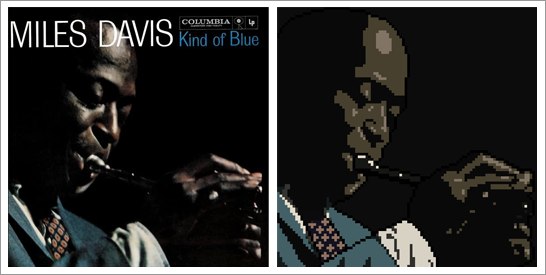
So which is the real answer to transformative use? Courts have ruled both ways. As evidenced in the Prince case, some courts think that a transformation can’t be protected unless it is making a commentary on the original work itself, such as for critique or scholarly purposes. Other courts have held to something closer to version two, that to transform the new work must merely add something new. I’m personally in the latter camp – Functionally, the current system puts a big burden on the person making a transformative work. A story recently gained traction about an artist who remixed the cover of a Miles Davis album for his own remixed Miles Davis music. He licensed the music, but didn’t license the cover, because he transformed the cover picture from a normal piece of art to a pixelized version. Here’s the comparison the artist posted on his blog:

He got sued, and had to settle despite feeling that he had substantially transformed the art, because the legal costs of even a successful defense would have significantly outweighed the costs of a settlement. The artist was probably fine under Transformative II, but not under I. The author has a great series of pictures at the bottom of his blog where he pixelizes the picture further and further until it is just 4 color squares, asking, with desperation, “Where would you draw the line?”.

The artist’s plight underlines the problem with approach I, and with the currently murky legal landscape. It puts a huge burden on artists to try and navigate the legal definition of fair use, a definition which isn’t even clear to legal scholars, rather than letting them work on their art. The Supreme Court needs to clarify the fair use issue, and needs to do so in a way that lets transformative works flourish – the definition needs to be clear enough that photographers will be discouraged from filing lawsuits against transformative works. We need a bright line rule on the issue one way or another, but so far we haven’t gotten one.

1 Comment

Filed under Copyright, Law

Zynga, Vostu, and why social games don’t need copyright law

Forgive me the indulgence of continued discussion about the Zynga v Vostu lawsuit when so little has transpired since the filing of said lawsuit in the last week. If you didn’t hear, Zynga is suing Vostu for copying the art style and game flow of many of their titles. To catch you up, Vostu said Zynga is a copier as well, and that Vostu doesn’t copy anyway, a great standard lawyer-advised answer. But this case fascinates me:

Copyright law is generally justified like this: If we didn’t have it, people wouldn’t create things as often. It’s a right that we give out because we are afraid of what would happen to creativity in a world without it, and we want to encourage big cultural contributions through art and music and writing by letting the creators of that art make money. We have this idea that too little protection would stifle our cultural richness by disincentivizing creativity. But we worry about too much protection as well – we carve out space for modifications to existing art, and for criticism and educational use of such cultural materials through the fair use and first sale doctrines, along with free speech. So it really is a rather delicate balance, as ‘just enough’ protection should lead to the greatest gains for our culture, as well as the proper profit motive for artists.

Copyright law typically doesn’t do much in the realm of video games. Yes, if somebody makes copies of a game’s disc and distributes it, copyright is there to stop it. But that same result can be achieved through contract, as it is in other parts of software and with databases contained on software – simply by granting limited licenses to users, companies can effectively prevent unauthorized distribution, perhaps MORE effectively because the license can defeat the first sale right. So copyright law is pretty useless to video games in that regard, as its benefits as a piracy-preventer could be replicated using other legal doctrine. It is redundant at best, and actually somewhat limiting at worst (some video game developers would love to quash the used game marketplace by removing the first sale right through contract).

Now in terms of the original motivations for copyright law, does having it really encourage more games to be made than we would have otherwise? It’s pretty tough to say – unfortunately our forefathers weren’t particularly into using treatment and control groups when they theorized what impact strong IP rights would have, so we ended up with pretty crappy, flawed patent and copyright laws. So we just have to guess – if copying a video game could be done, would it work, and how hard would it be to build a strong enough business off of a copied game that future developers would be discouraged? Note that the question is far more straightforward when you consider the impact of copying on the market for a book or a piece of music: especially in the digital age, unauthorized reproduction of those (relatively simple) forms of entertainment kills the value of the original for the artist – If I copied a best selling novel and sent it to all my friends and sold it on the street for a dollar, I’d effectively displace the sales of that book to all of those people. If that sort of action was widespread, we would genuinely have fewer people taking the time to write books.

But can the same be said about video games? As noted above, video games are harder to copy. You can burn a disc and hand it to your friend, but that’s not really scalable and basic licensing rules can deal with that threat just as adequately as copyright can, albeit with a bit more effort. Computer games are pretty widely available via torrents, so obviously copyright isn’t doing a whole lot there, and as I mentioned, licensing could just as easily establish a legal basis for preventing that. Social games on facebook or the web are essentially impossible to distribute to your friends – they are usually free to access anyway, and the whole point of the games is to encourage users to invite their friends to join (Someday the music industry will figure out that this is the model they ought to be using, but that’s beside the point).

Back to the Zynga v Vostu case: Zynga makes games, and they are wildly successful thus far. Vostu is making very close copies of these games and marketing them in regions of the world where Zynga is not yet dominant. It’s not working very well (Vostu has only 500,000 users, compared to Zynga’s 267 million) – what makes social games effective are the viral mechanics and fine-tuning that incentivize you to invite friends, keep playing, and pay for virtual goods. Those sorts of things aren’t readily copied – unlike a book or a song, where it takes an army to create the work but just an individual to copy it, social games take an army to create and an army to copy. Free-riding is not the same in social games. As Vostu pointed out in their defense, they are a company of 500+, not a guy in a basement redistributing Zynga’s products. Social games don’t need copyright law, because the elements that make them successful (engagement mechanics, notification mechanics, tweaked progression, feedback loops, carefully chosen monetization points) aren’t subject to copyright protection.

It’s surprising Zynga even sued over the issue: Megacity, the most successful game in Vostu’s catalog, has just about 300,000 monthly users and only 30,000 daily users, while Cityville, the game it copied, has 90 million monthly and 30 million daily users. The DAU as a percentage of MAU paints an even uglier picture for Vostu compared to Zynga (only 10% of Megacity players return daily, compared to twice that for Cityville). I’m sure Zynga monetizes those users better as well, though there is no way to know. So while I’ll undoubtedly have a great time watching the Zynga lawsuit as an observer, Zynga doesn’t need copyright to protect it’s core business – it’s core business is a mastery of engagement, notification, progression, and monetization, not art style.

(Update: Based on Vostu’s response, it appears that they have a robust core of millions of users in Brazil which Appdata, the only real source on numbers for social games and the basis for my numbers above, didn’t capture. This doesn’t necessarily change my opinion, but it’s worth noting.)

Leave a comment

Filed under Copyright, Law, Social Games

“Video games can never be art” – Rebuttal number 343

Roger Ebert wrote an article last year with the above title, and just about everybody in the world has chimed in on the topic. It’s actually a topic that’s been beaten quite to death on the internetz in the time that has passed since that initial claim by Ebert, and I’ve read opinions on every end of the spectrum, from “never” (Ebert’s position) to “definitely”.

                                                                                            (“art”)

Debate on the topic is so tired to me that I’ve had this post saved as a draft since I started this blog. Being an avid fan of video games and coming from a liberal arts college, entering the fray of an un-winnable debate seemed like a natural move. But a post on video games as art was already feeling a year late, months ago. Why now then? My inspiration will be revealed shortly, after a very brief somewhat long just frickin stick with me okay? aside:

Art is an ideal. Nobody has the example form of “art” locked away somewhere, for us to look at and compare new creations to as a manner of deciding if they are up to snuff. Like any good liberal arts student, I’m well aware of the history of ideals in our society, and could bore plenty of people with musings about the development of ideals in society from Plato to Kant to Nietzsche. Woo hoo. The only thing that matters about ideals is that we never have a mutual, universal understanding of what they describe. Just like good in one culture is different from good in another, art in one culture is different from art in another. In an internet world where the majority of our personal exposure to culture is self-selected from an almost limitless number of sources, agreement on what is contained within a notion like “good” or “art” has fragmented even further – the websites I read tell me one thing, and the websites my roommate reads tell him another. Our inability to come to a consensus on video games as art is as unsurprising as our inability to come to a consensus on any other intangible concept, like justice or religion.

But I venture that art does have one quality which most would agree upon – art needs to be able to push boundaries. There’s an innate concept of progression in the endeavors we generally consider art, as opposed to the things we don’t, like, say, filing taxes. When people ascribe the qualities of art to typically non-art things, they are describing the sense they get when they feel a progression in the practice of that thing – when an accountant claims that there is indeed an art to filing taxes, she is describing the sense of progression that comes from doing an activity in repetition. While video games obviously have a similar learning/mastery feel, that isn’t the type of progression I feel all art shares.

This year’s E3, the perennial festival of game announcements for the coming year, was the inspiration for this post. I’m excited to play a bunch of different games, but here’s the meat of the list: Assassin’s Creed 3, Mass Effect 3, Halo 1 remake (but really, it’s the 6th Halo game – 1, 2, 3, ODST, Reach… and 1 again), Uncharted 3, Call of Duty number 70, Diablo 3… and Journey. You don’t have to know anything about video games to realize that only one of those titles has the potential to be a wholly unique experience (and thank god for Journey, or else this article would need a different conclusion). You can argue that the sequels are art in the manner that tax filing can be art, in progression through small improvements achieved through repetition. But Halo and Call of Duty are basically simple first person shooters, of which there have been literally thousands before. They will be quality entertainment, but it’s a stretch to say that they are pushing boundaries in an artistic sense.

Pushing boundaries, and thus art, requires that completely new takes on the medium show up. Van Gogh, Escher, Picasso were all great artists for their newness, as compared to pre-Renaissance greats. Those pre-Renaissance greats, the ones who painted still lifes and landscapes over and over, were artists indeed, but painting as an art form required the Van Goghs and the Eschers to lend the medium promise of originality in a sense that transcends perfection through repetition. Pre-Renaissance artists were definitely the seasoned tax specialists of my double-analogy. (Painting has always intrigued me as an art form historically, because being a living painter was a rather bleak experience in the pre-Renaissance period as compared to the fabulous lives lead by, say, Andy Warhol or Banksy, AFTER human culture agreed that painting was a true art.)

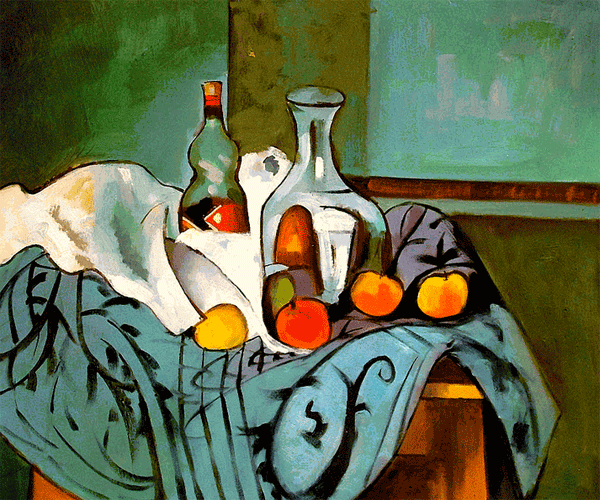
                                                    (Still life by Cezanne, a boundary pusher)

Video games are young, and my point in all this is that the medium hasn’t left the pre-Renaissance phase. I’m more excited about the games coming out of E3 than I have been in years, but Assassin’s Creed 3 is the third rendition of a decent still life. Halo is the 800th rendition of the still life called Doom. Developers are, largely, still painting still life. A large part is tied to expense: The profit motive that funds these games is, to really push this metaphor, like the patronage system that drove pre-Renaissance art. It still costs a LOT of money to make and market a big video game, so 90% of the stuff we hear about is driven by the aims of the companies bankrolling the ventures. Games are increasingly built to fit the agreements that make the developers money, by establishing a brand, and making the majority of the profits on the cheaper-to-develop sequels. This cycle works, and because games are such expensive investments, developers stick to it.

So that’s basically my take on the whole thing… Economics have driven games to the point of being somewhat repetitive and derivative, and while there are certainly unique, original entries that push boundaries (Limbo and Heavy Rain last year, Journey this year), they are few and far between in a sea of first person shooter rehashes, and they don’t make nearly as much money, so developers don’t clamor for them. There’s art out there, but until the cost of distribution, marketing and development come down dramatically, studios will still favor the still life to the Picasso.

2 Comments

Filed under Games, Misc

Zynga sues Vostu for copyright infringement, will Zynga “win”? Zynga probably doesn’t care about the outcome.

Really, really fun news this week as Zynga filed a lawsuit against a copycat. The complaint is nothing short of entertaining ( at least five pages of screenshots), and the techcrunch article even has the accompanying video, which shows side-by-sides of players playing both games. Here’s a couple important things to think about when you chat about this over the watercooler:

Zynga has a reputation as a game stealer, but stealing games isn’t usually illegal. Notice I didn’t say they stole games: barring really extreme situations, you can’t “STEAL” a game and have an actionable right under copyright law. Copyright protects original expression fixed in a tangible medium. That part is easy, but when the copycat reproduces everything themselves, it’s hard to draw the line between inspiration and blatant ripoff. If you straight up rip the art pixel by pixel from a game and reproduce it without permission, then that’s copyright infringement. But short of that, nobody has really explored where the line is for copyright infringement in a video game/facebook game. Game mechanics aren’t usually subject to copyright law, so the fact that coins pop out when you click on a house in both Cityville and Vostu’s clone doesn’t mean a whole lot. And copying the art style of a game is close to accepted practice in the social game world, where Zynga rose to fame on the shoulders of other, extremely similar games by lifting the art styles of those games (Google “farmvillians” for more background if you don’t know). While people complained about Zynga’s art appropriation, and while they were sued by those games, those suits were mostly over trademark infringement, not copyright infringement, and they were settled before legal costs could ramp up. Zynga might have been able to win most of those suits had they wanted to fight them out.

Blatant copying doesn’t really WORK in social games. Copying allegations were a big part of Zynga’s early history, but most people recognize that copying wasn’t what made Zynga’s games popular. Social games spread through virality, through network effects, and through cross-promotions with other games in the developer’s network. Zynga realized this early on, and while they did borrow most of the mechanics from the early games from others, they also added all of the features that grew the game, and they tweaked it to make the user base into a revenue generating monster. Even copying these mechanics, Vostu hasn’t really made much off of it for many of these reasons (you can’t copy a critical mass of users). Has Vostu actually benefitted from this copying? Vostu has half a million users, monthly. Zynga has 264 Million. So I don’t think their copying is really helping that much.

The legal strategy is interesting. Zynga isn’t bringing out the big guns on this one (they are already spending A LOT on their IPO, to be sure). No offense whatsoever to Keats, McFarland and Wilson LLP, the firm handling the complaint, but it’s a six attorney boutique in Beverly Hills. Not exactly a traditional heavyweight in the copyright or startup world by any stretch, and google searches turn up nothing much on the lead attorney on the case, Dennis L. Wilson. A few complaints that he was aggressive in sending out notice letters when he was at Fox… Like I said, I’m sure he is great, but hiring that firm to take the case is, in my estimation, a slight reveal of what Zynga is thinking. I’ll elaborate:

Zynga probably doesn’t care if they win or not. Zynga doesn’t need to win. Zynga is FLUSH with money, and they literally don’t care if this lawsuit goes on forever. They may WANT it to go on forever. If this is a battle of attrition, Zynga just needs to not get brushed aside in a summary judgement, and then hope Vostu can’t afford to pay the bills for a drawn out fight. Maybe draining Vostu’s resources is enough. Maybe the lawsuit scares away future investments into Vostu. Maybe the lawsuit helps assure Zynga’s potential IPO investors that the company’s core business isn’t easily copyable (ahem groupon ahem). All of those outcomes are achieved by assuring that the lawsuit survives just a few months, so it really doesn’t matter if Zynga wins. Vostu isn’t really even a threat to Zynga: Vostu has half a million users across all of their games, compared to Zynga’s 264 MILLION.

It’ll be fun to watch the suit though, because if Vostu fights it, we may get a court to make some strong precedent on where the line is between copying and homage in a genre of entertainment where that line is blurred constantly.

Leave a comment

Filed under Copyright, Law, Social Games